
Dutch tech in motion: from potential to global leadership
Our weekly overview offers a summary every Sunday of the most compelling stories around key innovations, with a focus on the Netherlands.
Published on February 1, 2026
Bart, co-founder of Media52 and Professor of Journalism oversees IO+, events, and Laio. A journalist at heart, he keeps writing as many stories as possible.
The harvest of the past week paints a picture of a Netherlands at a turning point. Economic and technological developments no longer unfold linearly; they reinforce each other at a rapid pace. The strong figures from ASML make clear that global shifts, such as the explosive demand for AI chips, have direct consequences for regional ecosystems, labor markets, and policy choices. What once appeared to be success stories of individual companies now signal a broader structural shift: technology is no longer just a sector but the backbone of economic and geopolitical positioning.
At the same time, there is a growing realization that ambition alone is not enough. The action agendas within the National Technology Strategy, the explicit ambition to become a global technology leader by 2035, and lessons from international ecosystems such as Bavaria collectively indicate that the Netherlands is seeking a new form of organizational strength. Not fragmented initiatives, but focused collaboration between government, knowledge institutions, and industry must make the difference. The challenge lies less in formulating plans than in building execution power and maintaining long-term focus.
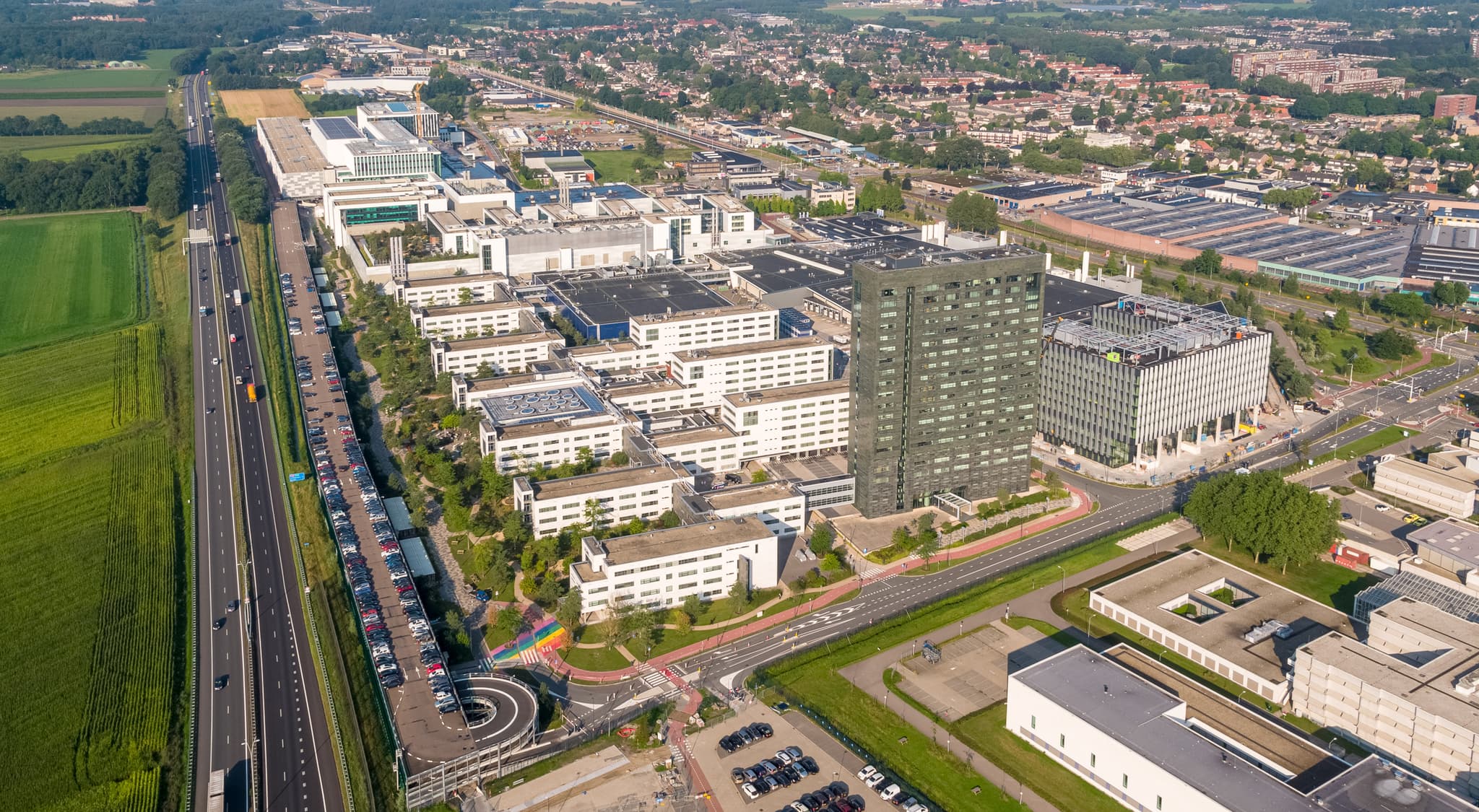
ASML Campus Veldhoven
This is compounded by the development of ecosystems such as Brabant, which illustrates both the scale of the potential and how fragile it remains without sufficient capacity to scale. The new cabinet’s policy on science and digital autonomy, therefore, underlines that strategic independence is no longer an abstract ideal, but a practical necessity. The common thread running through the articles is clear: the Netherlands has the knowledge, companies, and networks to lead, but only through coherent choices and structural investments can that position be sustainably secured.
A selection of highlighted articles:
1. ASML’s numbers are not an incident. They are an announcement
ASML’s recent quarterly results do not represent a coincidental peak, but a structural shift: record order books driven by real, contractually secured AI demand and a deeply integrated supplier ecosystem. For the Brainport Eindhoven region, these figures function less as a scoreboard and more as a planning horizon that justifies growth investments. At the same time, this success brings societal and infrastructure challenges, from housing shortages to pressure on public services, requiring both economic and social policies to adapt and enable sustainable regional development.
2. A boost for Dutch tech with ten brand-new action agendas
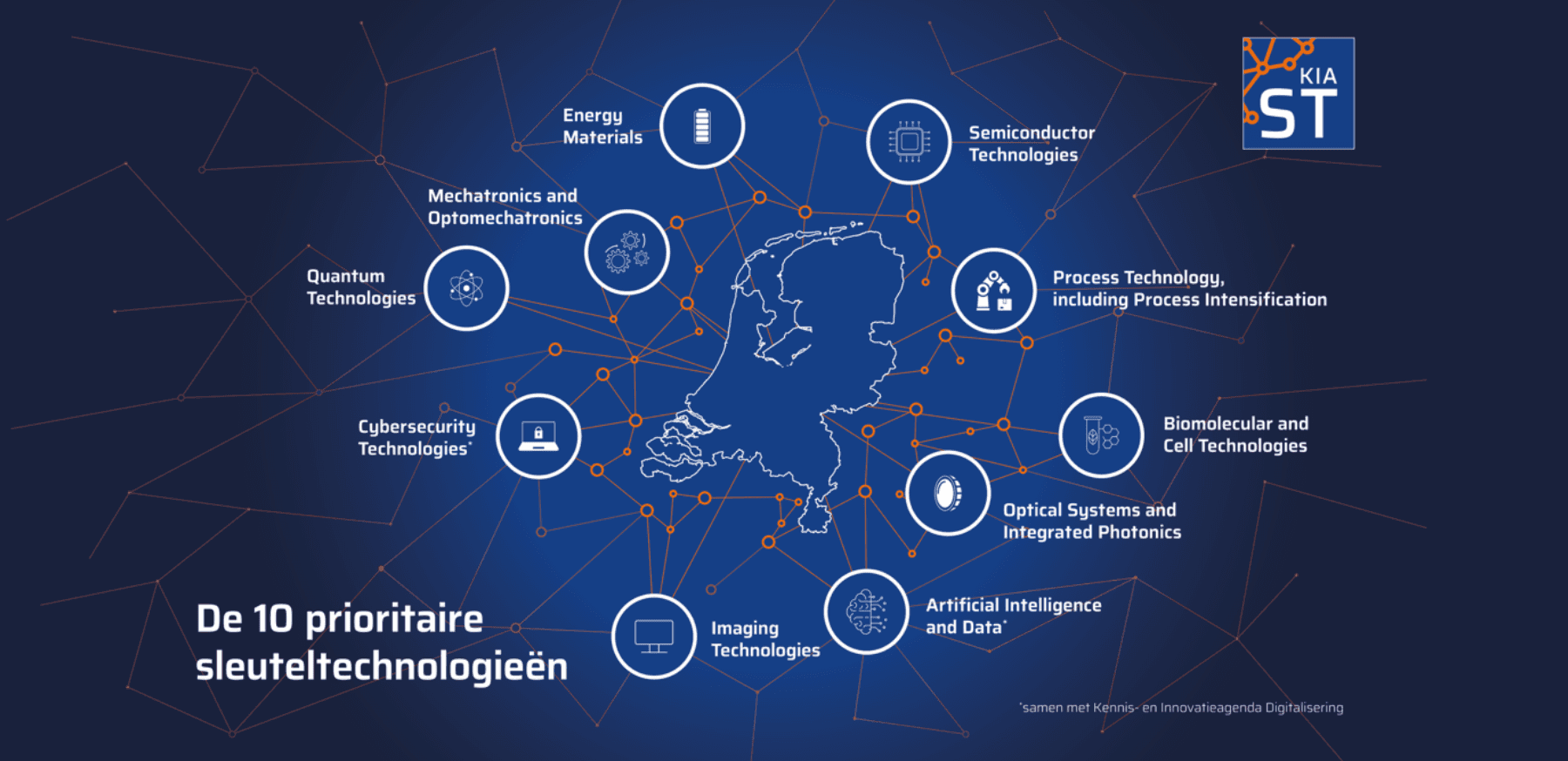
The presentation of ten action agendas within the National Technology Strategy (NTS) marks a major step from strategy to execution. More than 1,000 organizations have contributed to 53 large-scale public–private innovation programs with a combined budget exceeding €14 billion. These agendas focus on key technologies such as AI, quantum, semiconductors, and cybersecurity, offering concrete roadmaps for technological breakthroughs and ecosystems that strengthen the Netherlands’ earning capacity and strategic position.
3. Dutch tech world leader in 2035: “The time for talking is over”
The blueprint event around the National Technology Strategy at the NEMO Science Museum emphasized the Netherlands’ ambition to become a global technology leader by 2035. With ten action agendas, a clear focus on priority domains, and the involvement of knowledge institutions, startups, and industry alike, work is underway to build an integrated innovation landscape. The message was clear: strategic collaboration and focus - not scattered efforts - are essential to realizing this ambition.
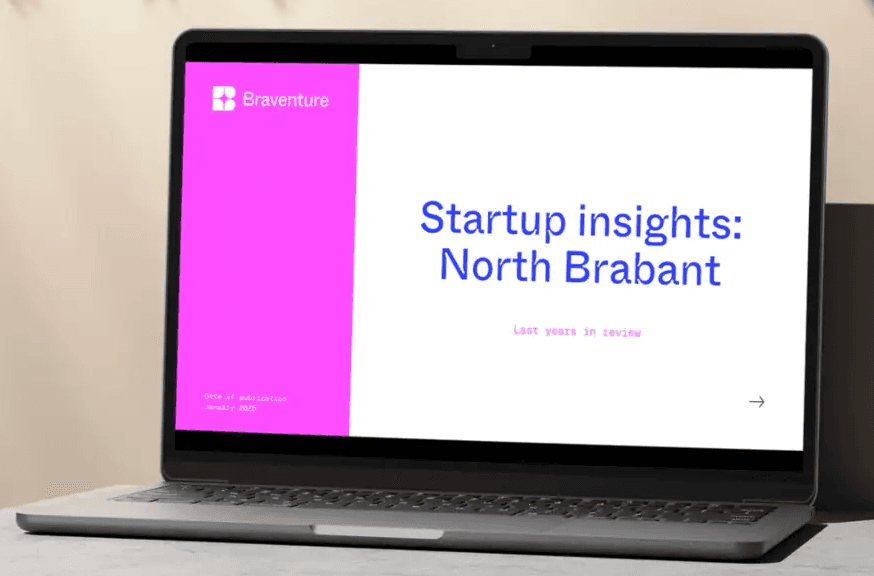
4. Brabant grows to 768 startups and scale-ups, but scaling remains a concern
Brabant has firmly established itself as one of Europe’s leading startup regions, with 768 startups and scale-ups and nearly €2 billion in raised capital. The ecosystem focuses strongly on deep tech, semiconductors, and health innovations, attracting increasing levels of investment. At the same time, scaling to an international level remains difficult: the “scale ratio” (the share of startups that grow into significant scale-ups) continues to lag behind top regions elsewhere.
5. What a top ecosystem like Bavaria can teach us
The comparison with Bavaria illustrates that strong ecosystems are built on organizational strength and coherence, not just individual success stories. Bavaria’s approach (characterized by structured collaboration among universities, government, investors, and corporates, and participation in pan-European networks such as RISE Europe) offers inspiration for the Netherlands to not only generate initiatives but also strategically connect and scale them. The article, written by two participants of the study trip to Munich, emphasizes that scale and impact are outcomes of deliberate design choices.
6. What the new cabinet wants with science and digital autonomy
The new Dutch cabinet is pursuing a structural course change to strengthen economic power, with education, science, and digitalization as core pillars. Policy focuses on improving basic skills, strengthening vocational education, and attracting and retaining international talent, all as foundations for innovation and competitiveness. Universities and universities of applied sciences are positioned as engines of economic renewal, with an emphasis on R&D investments and strategic valorization. Digital autonomy is explicitly framed as a geopolitical necessity, with European cloud and data solutions, cybersecurity investments, and the scaling of technological innovation central to the coalition agreement.
%2520and%2520researcher%2520Paul%2520van%2520Zoggel%2520(Wageningen%2520University%2520%2526%2520Research%2520%2526%2520Eindhoven%2520University%2520of%2520Technology)&w=2048&q=75)
Designer Floris Schoonderbeek (inventor Circlefarming) and researcher Paul van Zoggel (Wageningen University & Research & Eindhoven University of Technology)
A selection of other highlights from the past week:
- Towards the next food system, circle by circle
- Gates Foundation donation helps imec advance photonics R&D for healthcare
- Dutch founders in Silicon Valley raised half a billion euros in 2025
- Second chance for the producer of orange peel-based products
- Microsoft stores and shares your encryption keys
- Maakkracht: “You start with a piece of metal, and end up with something that works”
- More R&D, more return: how to make innovation more efficient
- Why we can’t escape America’s digital grip
Want to explore all other articles? You’ll find them here.
A daily podcast
Every weekday morning at 6:30 a.m., a new podcast is ready for you. Our AI colleagues, Oliver and Shelby, discuss the two most interesting topics of the day, making IO+ Daily the perfect way to start your day with optimistic news from the world of innovation and technology. Again tomorrow.
Our other newsletters
Thank you for reading this newsletter, but there’s more. Signing up is easy, via the option block on the IO+ homepage or simply by clicking your favorite newsletter below:
- IO+ Daily (1.200 subscribers)
- Mauro’s Green Corner (monthly, 13,800 subscribers)
- Elcke’s Saturday Data Dive (monthly, 20,550 subscribers)
- Elcke en Mauro’s BIO+ Bites (monthly, 29,300 subscribers)
- Bart’s Saturday CHIPS (monthly, 16,300 subscribers)
Enjoy your Sunday, and don’t forget that a new episode of IO+ Daily will be waiting for you tomorrow morning at 6:30. Be prepared before you hop on your bike 🚲