
More R&D, higher returns: how to make innovation more efficient
In a series of blog posts, Marco Coolen offers a glimpse into his work as a Dutch and European patent attorney at AOMB.
Published on January 25, 2026


Marco, a patent attorney at AOMB since 2013, shares his expertise on IO+ about patents—how they work, why they matter, and when they lose their value.
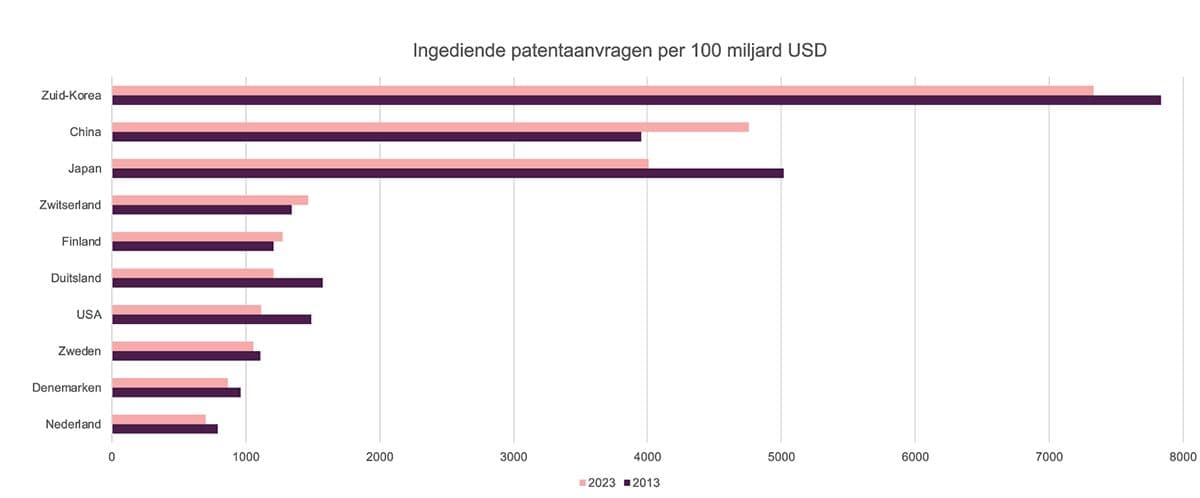
The Netherlands ranks among the global leaders in terms of innovative strength per euro invested. With 693 patent applications per €100 billion of GDP, we firmly sit in the global top ten. This is no coincidence, but the result of how our economy is structured: a great deal of knowledge, relatively little mass production. And in such a structure, a little extra R&D can set a surprisingly large amount in motion.

Marco Coolen, photo © Bart van Overbeeke
The formula for innovative power
Those who want to accelerate innovation don’t need to reinvent the wheel. The recipe is well known, and the chain reaction is predictable:
More R&D → more innovation → more patents → more investment → mass production → economic prosperity.
The good news is that the Netherlands already performs well in the early links of this chain. We know how to deploy R&D intelligently, and we are remarkably good at translating research into patents. In that respect, we hardly lag behind heavyweights such as the United States, Sweden, or Denmark.
© WIPO
Efficiency as a strength
Compare us with countries like South Korea or Japan and the difference becomes clear. There, thousands of patents emerge from enormous production chains and industrial conglomerates. That leads to high numbers, but also to a different dynamic: innovation there is largely driven by scale.
The Netherlands works differently. Here, it’s all about efficiency. We convert every euro of R&D relatively quickly into applications that also deserve protection. This is due to the strong role of SMEs, close collaboration with knowledge institutions, and a focus on deep tech and high tech in regions such as Brainport.
A dial, not a mystery
The good news? The formula already works. If you want more, there’s no mystery to solve. You simply need to turn the right dial: R&D investment.
Investing more in research automatically leads to more inventions. And when those inventions are protected by patents, ownership is created. And that is the moment when investors step in. Because patents inspire confidence. They make innovation tradable. And they open the door to production, growth, and export.
The World of Patents
Read all the columns Marco Coolen has written about the world of patents here.
Who dares?
So the big question is not whether we can scale up, but who has the courage to step on the gas first. Government? Industry? Investment funds? The chain reaction is ready. The efficiency is there. The return has been proven.
What we need are decision-makers with the courage to give that first push; people who understand that every euro of R&D is more than a cost item; it is a flywheel.
The Netherlands is not a country of assembly lines and mass production. But it is a country of ingenuity, precision, and collaboration. Those very qualities make our innovation engine so efficient. So let’s not leave it idling. Step on the gas. Because the sooner you start the chain reaction, the sooner prosperity will follow.