
Netherlands to be tech leader by 2035: “Time for talk is over”
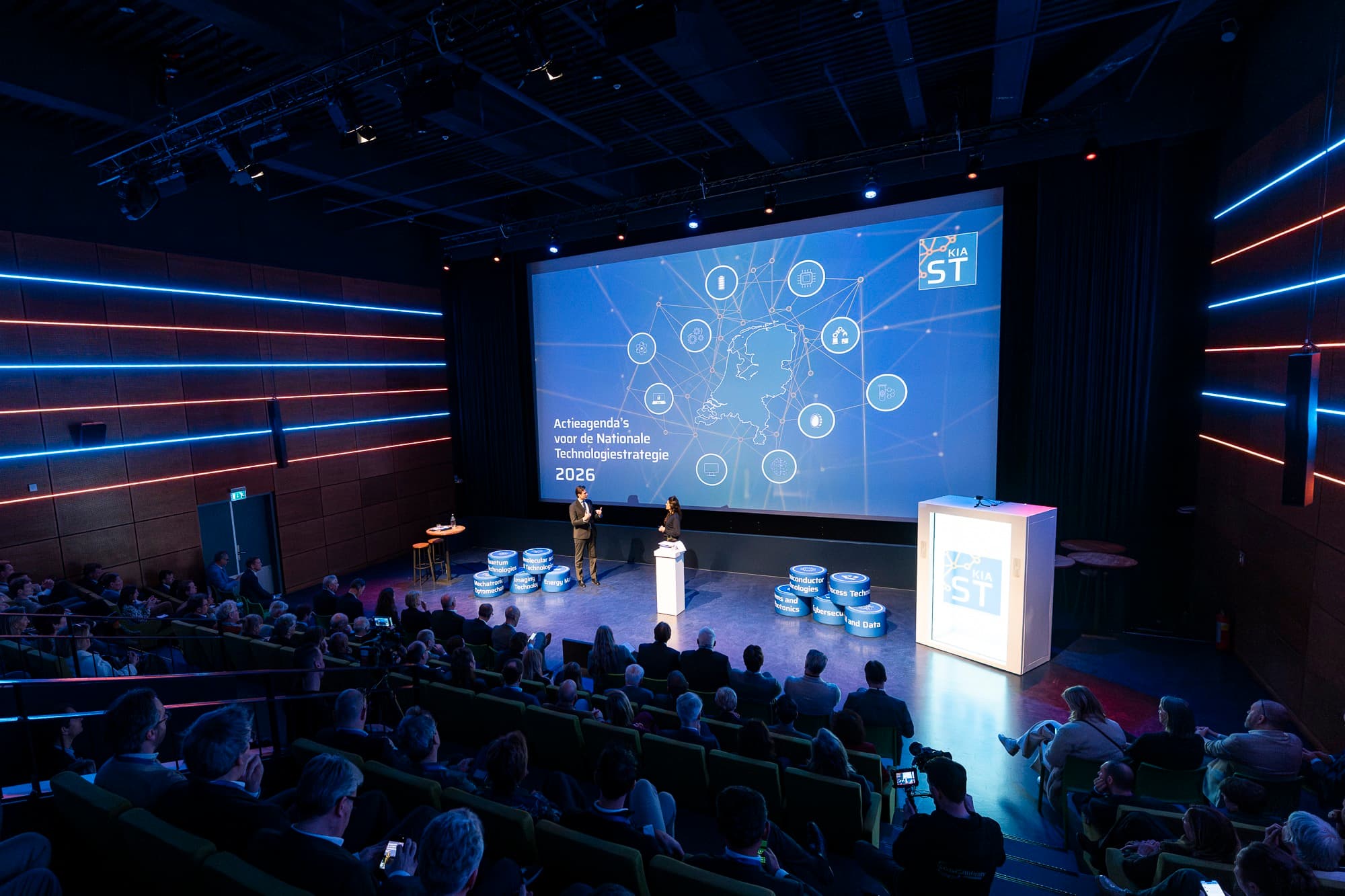
On Monday, the blueprint that will contribute to the Dutch economy in 2035 was unveiled at the NEMO Science Museum.
Published on January 29, 2026
Our DATA+ expert and Editor-in-Chief, Elcke Vels, explores AI, cyber security, and Dutch innovation. Her "What if..." column imagines bold scenarios beyond the norm.
On Monday, at the NEMO Science Museum, among the experiments that illustrate the laws of physics, the blueprint that will contribute to the Dutch economy of 2035 was unveiled. With 10 brand-new action agendas from the National Technology Strategy, 53 innovation programs, and more than €14 billion in investments, the Netherlands is setting a clear technological course. “The 10 action agendas are rock solid,” says Peter Stolk, chairman of the Knowledge and Innovation Agenda Key Technologies (KIA ST). There is a strong focus on AI, quantum, and semiconductors, among other things. Minister Vincent Karremans was present, as were important representatives from knowledge institutions, government, and the business community. The overarching message was clear: the time for talk is over.
The world has changed. The economic and strategic need to have technology in-house is greater than ever. Minister Vincent Karremans of Economic Affairs outlined a picture of the world order at NEMO. He referred directly to the recent political shifts in the United States, to Trump, who wanted to impose a 10% import tax on the Netherlands and other European countries because of Greenland.
“I am constantly receiving calls from CEOs who are concerned,” Karremans said. This is not an isolated incident, he warns. “Technology is being used as a political tool. We are in a constant battle with economic superpowers, and the only defense is attack. We must become indispensable. We must ensure that China and the US are also dependent on us,” the minister said.
Abstract concept translated into reality
Standing on its own two feet: that is what the Netherlands is going to do. Two years ago, the cabinet launched the National Technology Strategy. The goal was abstract but ambitious: the Netherlands must become a world leader in ten key technologies. On Monday afternoon, that abstraction was translated into reality. Peter Stolk, chairman of the Knowledge and Innovation Agenda for Key Technologies (KIA ST), did not mince words. “Ten themes, key technologies chosen at the time, are rock solid. A lot has changed in the past two years. The importance and relevance of the NTS and the action agendas have only increased. Economically, socially, and also strategically. I am pleased that they are being presented today. An important step from strategy to plan to implementation.”
More than a thousand organizations contributed to the plans. The result is a finely meshed network of 53 innovation programs. From knowledge institutions to multinationals and from startups to regional development companies (ROMs): the entire chain is involved.
The 10 action agendas for the National Technology Strategy are:
- Artificial Intelligence and Data
- Biomolecular and Cell Technologies
- Cybersecurity Technologies
- Energy Materials
- Imaging Technologies
- Mechatronics and Optomechatronics
- Optical Systems and Integrated Photonics
- Process Technology, including Process Intensification
- Quantum Technologies
- Semiconductor Technologies
Examples of innovation programs within the action agendas are: GPT-NL (€80 million), Organ-on-a-Chip (€260 million), and Laser Satellite Communication (€67 million). During the event, the parties involved discussed the details of these programs in greater depth.
Holland High Tech organized the action agendas on behalf of the Knowledge and Innovation Agenda Key Technologies, together with other parties. Leo Warmerdam, director of Holland High Tech: “I think it's great that these parties have now actively said to each other: we are going to work together. Holland High Tech will do everything it can to give the collaborating parties the power to succeed.”
Focus: a recurring theme
The action agendas provide clear direction for the future of technology in the Netherlands. ‘Focus’ was therefore a recurring theme in various presentations. Eline van Beest, CEO of Hybridize Therapeutics and chair of Tech Champions: “It's good that we are making a strong choice for ten technologies. Long-term focus is essential for entrepreneurs and investors.” According to her, technology needs five to ten years to reach the market. Lukas Roffel, CTO of Thales Netherlands and chair of NAE, said: “It is tempting to want to invest in everything, but that is fatal to our effectiveness. We must let go of non-priorities.”
‘There is no silver bullet’
Roffel also emphasized the importance of cross-pollination between the various technologies within the action agendas. “Renewable energy systems, defense: everything depends on progress in multiple domains—software, materials, system integration. If one is missing, the whole will not reach its potential. Innovation policy must focus on ecosystems rather than individual technologies. Collaboration between startups, SMEs, and large companies is essential. There is no silver bullet.”
Fast forward to 2035
To make the billions more tangible, the audience at NEMO was taken to the future via a ‘Holobox’. ‘Sophie’, a virtual guide from the future, spoke with Stolk and moderator Eva van Mol from the year 2035. She painted a picture of the Netherlands that has taken the plunge. Whereas we are still talking about vulnerable supply lines and fragmented initiatives, 2035 showed an integrated landscape. “The action agendas have led to more cooperation,” Sophie explains. We have caught up in robotics and drones. Neuromorphic computing has given an extra push towards energy-efficient AI; we are at the forefront of quantum computing, and laser satellite communication has also become an indispensable Dutch technology in 2035.
A vibrant European market
In short, the Netherlands has a bright future ahead of it. But we will have to collaborate fully with other countries within Europe. Minister Karremans was clear about this: “The core of the problem is the lack of a true internal market. If you can scale up quickly as a company in Europe, as in the US, the money will follow.”
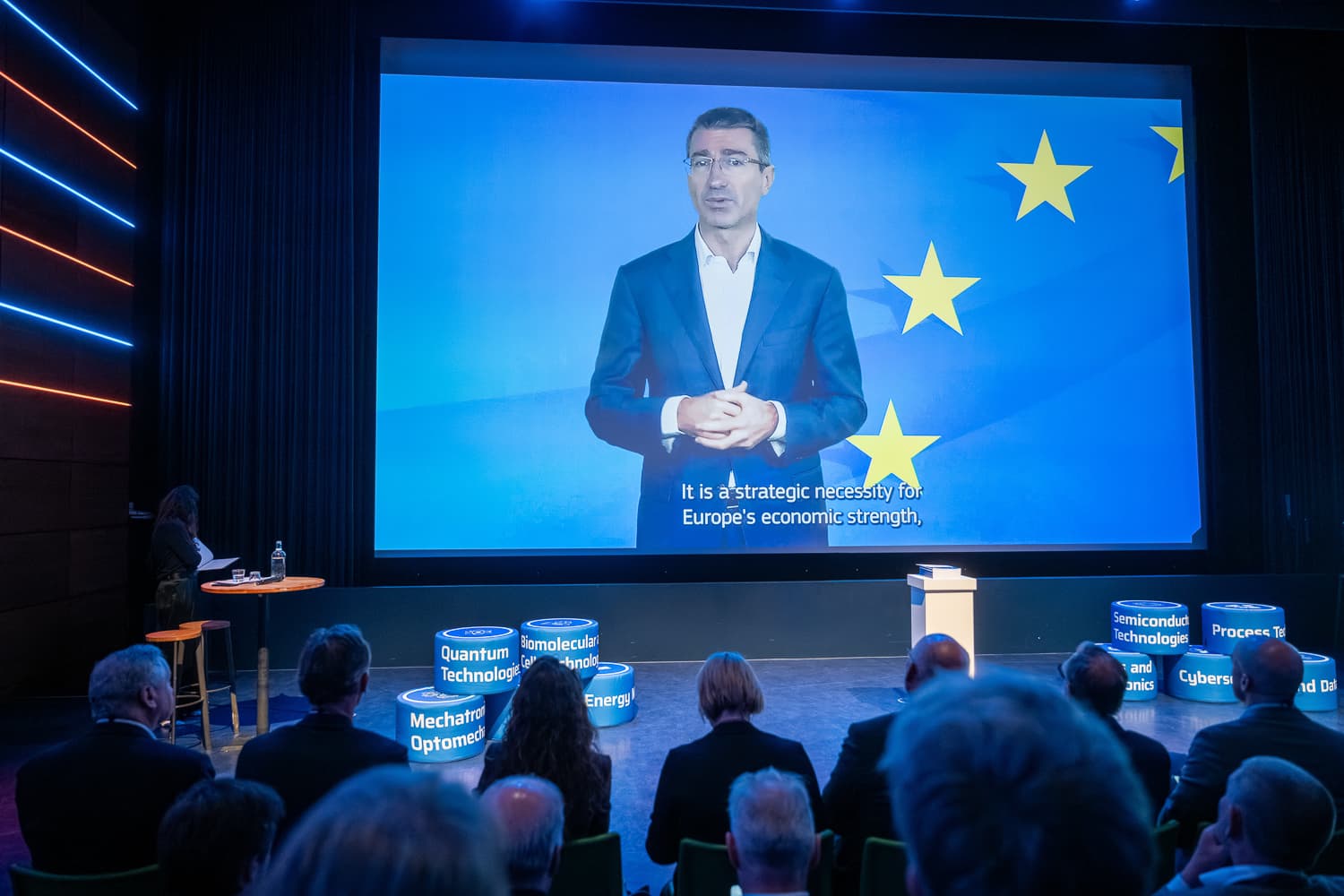
Marc Lemaître of the European Commission also emphasized the importance of cooperation at the European level in a video message. He also mentioned the strength of the Netherlands within the EU. “The Netherlands has long been a leader in innovation in Europe.” According to him, the Netherlands excels in areas such as optical systems, quantum technology, and semiconductors.
Finally, he underlined that the action agendas are essential for Europe's success. “Europe's future competitiveness rests on shared ambition, cooperation, and European scale. With its National Technology Strategy [...], the Netherlands is leading the way.”
Alignment with reports and developments
The plan is in place. In the coming years, cooperation on key technologies will be cleverly linked to existing plans, funds, and (European) initiatives—from the Wennink Report to the National Growth Fund.
Sponsored
This story is the result of a collaboration between Holland High Tech and our editorial team. IO+ is an independent journalism platform that carefully chooses its partners and only cooperates with companies and institutions that share our mission: spreading the story of innovation. This way we can offer our readers valuable stories that are created according to journalistic guidelines.
Want to know more about how IO+ works with other companies? Click here