
ASML’s numbers are not an incident. They are an announcement
For the Brainport Eindhoven region, ASML's results serve less as a scorecard and more as a planning horizon.
Published on January 30, 2026
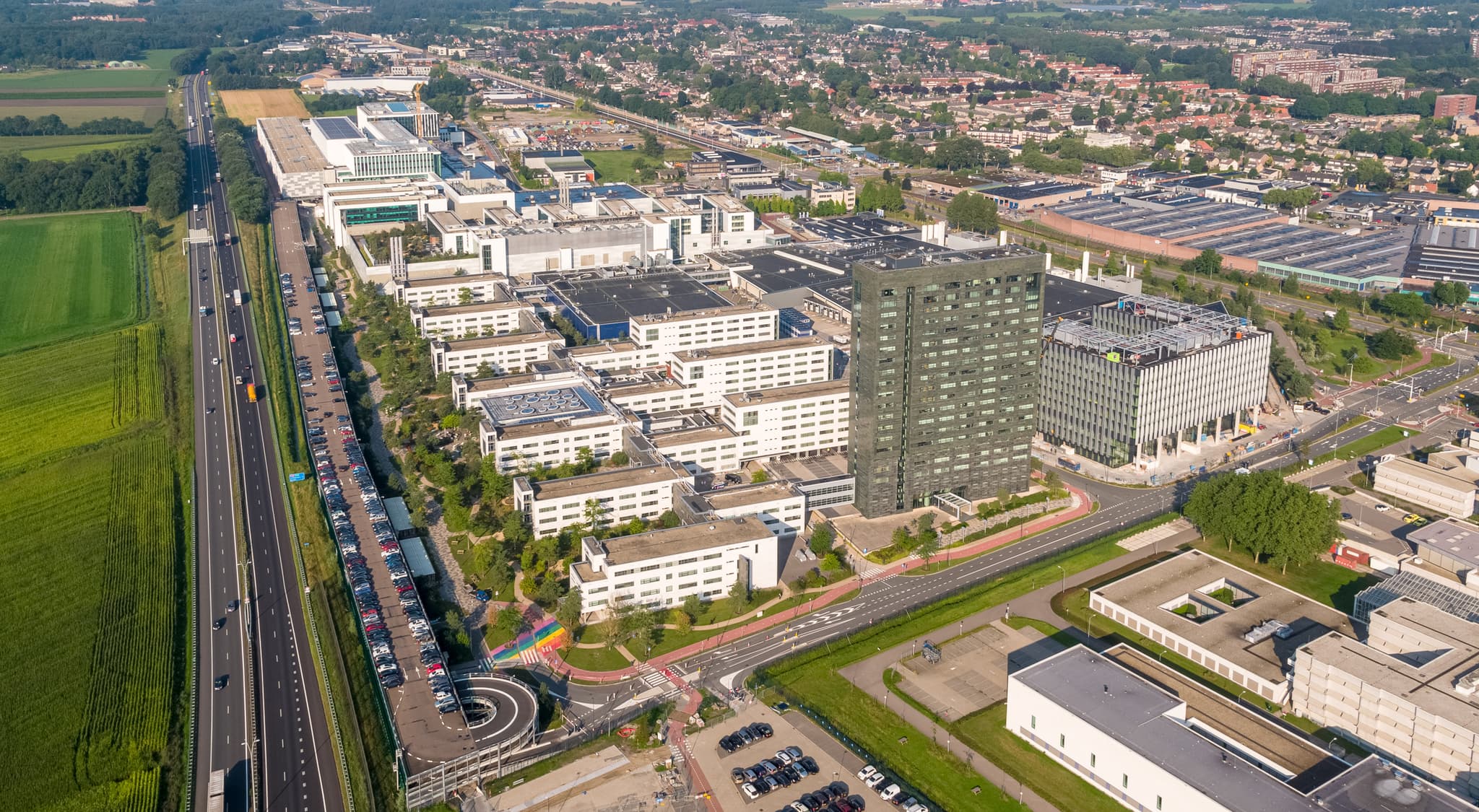
ASML Campus Veldhoven
Bart, co-founder of Media52 and Professor of Journalism oversees IO+, events, and Laio. A journalist at heart, he keeps writing as many stories as possible.
When ASML published its latest figures, the headlines focused on the obvious: record bookings, orders far above expectations, and a revenue forecast that left analysts scrambling to update their models. €13.2 billion in Q4 bookings alone, driven by AI demand that is no longer speculative but contractual. Impressive, certainly. But if we treat this as just another quarterly surprise, we miss what is really happening.
This is not a spike. It is a structural shift.
For the region around ASML, and especially for Brainport Eindhoven, these numbers serve less as a scorecard and more as a planning horizon. They redraw the map for an industrial ecosystem that is already expanding at unprecedented speed.
A supply chain that behaves like a system
ASML does not build its machines alone. Around 5,000 companies are directly or indirectly tied into its supply chain, spread across the Netherlands and far beyond. Names like VDL, Prodrive Technologies, and Carl Zeiss are well known. Hundreds of others are not. Small precision manufacturers, mechatronics specialists, software firms, cleanroom builders, logistics providers, often invisible, but absolutely essential.
What sets this network apart is not its size, but its depth. These are not arm’s-length suppliers responding to purchase orders. They are co-developers of technology, some of whom did not exist five years ago. Engineers cross company boundaries as if they were internal departments. Facilities are known by heart. Roadmaps are aligned years in advance.
That level of integration does not scale overnight. It is the result of decades of trust, shared risk, and mutual dependency. And it means that when ASML’s order book “explodes,” the shockwave is not chaotic; it is directional.
From uncertainty to permission to invest
ASML’s CEO noted that customers have a “strong belief that the AI demand is real” and are preparing for “a major addition of capacity” through 2026 and beyond. On paper, that sounds like cautious corporate language. On the ground, it translates into something far more tangible.
It gives suppliers permission.
Permission to hire the engineers they were hesitant to commit to. Permission to order new equipment with multi-year payback periods. Permission to expand cleanrooms, production lines, and R&D teams. Permission to stop optimizing for survival and start optimizing for growth.
In manufacturing ecosystems, confidence is a resource. And confidence is exactly what this forecast delivers. One company’s outlook suddenly stabilizes thousands of balance sheets and investment committees.
Brainport, already under pressure, is about to double down
All this comes at a moment when the economy of Brainport Eindhoven is already straining at its seams. ASML's plans to develop four new campus facilities and grow by an estimated 20,000 employees are no longer abstract projections; they are part of everyday conversation in city halls, boardrooms, and living rooms across the region. By any European benchmark, and increasingly by global ones, Brainport is booming.
But that success comes with a feeling many residents already recognize: acceleration without pause.
Housing shortages are no longer policy debates; they are a lived reality. Young families wonder if they will ever be able to buy a home in the communities where they grew up. Teachers, nurses, and police officers increasingly commute from outside the region because living nearby has become unaffordable. Roads that were busy five years ago are now structurally congested. Public transport expansions help, but they rarely keep pace with demand. Healthcare and education systems are working at full capacity, often stretched by the very internationalization that fuels Brainport’s success.
What makes this moment different is not just the scale of growth, but the awareness that the region is about to double down on it. The new wave of industrial expansion, driven by structural demand for semiconductors and AI infrastructure, means what already feels tight will tighten further before it improves. Governments at the municipal, regional, and national levels are not standing still. Housing agendas are accelerating, mobility plans are being revised, and investments in schools and healthcare are being scaled up. Yet among citizens, a deeper concern is surfacing: will the Eindhoven region still feel like home in five or ten years? Will communities remain recognizable, affordable, and cohesive?
These are not arguments against growth. They are signs of a region becoming conscious of its own success and wrestling with what it means. The challenge now is not whether Brainport should grow, but how it can grow in a way that strengthens the social fabric at the same pace as economic power. That is the real test of whether this boom can mature into something more durable: a model of prosperity that people not only benefit from, but continue to believe in.
The difference between a boom and a trajectory
There is a tendency, especially in Europe, to treat industrial success as fragile, something that must be protected from overheating, from arrogance, from disappointment. That instinct is understandable. But it can also lead to underreaction.
ASML’s numbers indicate that the Brainport region is no longer riding a temporary wave. It is on a trajectory. The AI boom is not just inflating valuations; it is converting into factories, machines, jobs, and long-term commitments.
That shifts responsibility. Not just for ASML, but for governments, municipalities, educational institutions, and healthcare providers. Planning can no longer be reactive. Housing, mobility, talent pipelines, and public services must be designed with this scale in mind, or risk becoming the bottleneck in an otherwise world-class ecosystem.
Grounds for optimism
Despite the pressures, the dominant emotion should be optimism. Europe rarely gets industrial stories of this magnitude that are both globally relevant and locally anchored. Brainport has one. And unlike many tech booms, this one is rooted in physical production, engineering excellence, and a deeply embedded supply chain.
The ecosystem around ASML has proven that it can absorb complexity, collaborate at scale, and innovate under extreme constraints. Those same qualities will be needed to manage the social and infrastructural consequences of success.
If this moment is approached not as an incident to be explained away, but as an announcement to be acted upon, then today's record numbers become the foundation of tomorrow’s resilience.
The machines may be built in cleanrooms. But the future they enable is being built across an entire region.