
One hundred columns later: patents are about more than protection
Every Sunday, our weekly review offers an overview of the most interesting stories around important innovations.
Published on September 13, 2026
Bart, co-founder of Media52 and Professor of Journalism oversees IO+, events, and Laio. A journalist at heart, he keeps writing as many stories as possible.
With his hundredth column for IO+, patent attorney Marco Coolen has reached a remarkable milestone. What began as an attempt to make the world of intellectual property more accessible has grown into a wide-ranging collection of stories about inventors, entrepreneurs, and the sometimes surprising ways in which patents work. Writing about the subject has also changed the way Coolen views his own profession.
Intellectual property is indispensable to innovation. A strong patent gives an inventor the temporary, exclusive right to a technical invention. It prevents competitors from simply copying a solution that may have taken years to develop. For startups, such a position can be decisive when attracting investors, entering into licensing agreements, or establishing a competitive advantage.
At the same time, a patent is not an end in itself. The art lies in protecting not just a product, but the underlying principle that makes it special. Through familiar examples, Coolen brings intellectual property down from the ivory tower. His columns show that patents are not merely the legal finishing touch to innovation, but part of the strategy that enables ideas to grow into businesses and create social impact.
https://ioplus.nl/nl/posts/hoe-marco-coolen-intellectueel-eigendom-uit-de-ivoren-toren-haalt
GENTOO aims to cross Antarctica without emissions

Ece Gungor, Team Manager, and Polina Savelyeva, External Affairs Manager Team Polar © Bart van Overbeeke
Student Team Polar from Eindhoven University of Technology is developing an autonomous, solar-powered research vehicle for one of the harshest environments on Earth. Equipped with custom-made solar panels, airless 3D-printed tyres, and autonomous navigation, GENTOO is ultimately intended to travel 1,000 kilometres across the Antarctic ice sheet. The team hopes to enable scientific research without the kerosene and heavy transport equipment on which polar expeditions still depend.
https://ioplus.nl/nl/posts/team-polar-met-gentoo-door-het-grote-witte-onbekende
A Dutch laboratory on a chip searches for extraterrestrial life
A consortium led by Delft University of Technology is developing a photonic chip capable of detecting signs of life on Enceladus, one of Saturn’s moons. The instrument weighs just 700 grams, yet can identify specific molecules in liquids with near-perfect accuracy. Originally developed for medical applications, the technology is now being adapted to withstand the extreme temperatures, radiation, and vacuum of space.
https://ioplus.nl/nl/posts/nederlandse-fotonische-chip-zoekt-leven-op-enceladus
Thousands of sailing boats could form a coastal monitoring network
Sailing yachts already carry sensors that measure wind, water depth, and temperature. SeaSense wants to combine this data to create a detailed and relatively inexpensive monitoring network for coastal waters. An initial trial shows that atmospheric-pressure and water-depth measurements are particularly useful, although further research involving multiple vessels is needed to correct deviations automatically.
https://ioplus.nl/nl/posts/zeilboten-als-meetstations-seasense-bouwt-fijnmazig-kustnetwerk-
The Netherlands chooses a European eye in the sky
The Netherlands and Sweden plan to jointly operate four GlobalEye reconnaissance aircraft. The Dutch aircraft is expected to be delivered in 2031 and will be capable of detecting drones, cruise missiles, and radar installations from great distances. The decision to purchase Saab’s system reduces dependence on ageing NATO AWACS aircraft and supports the ambition to strengthen European defence cooperation and strategic autonomy.
https://ioplus.nl/nl/posts/nederland-koopt-zweeds-globaleye-vliegtuig-tegen-drones
When AI chooses the words, who is really speaking?
Research into the communications of Rob Jetten and D66 raises questions about the use of artificial intelligence in politics. AI can make texts faster to produce, simpler, and more accessible, but its undisclosed use may undermine a politician’s credibility. The dilemma is becoming increasingly urgent as AI evolves into an everyday writing tool: when is a text still authentic, and who bears responsibility for it?
https://ioplus.nl/nl/posts/is-rob-jetten-echt-of-ai
Dutch mushroom coffin goes global
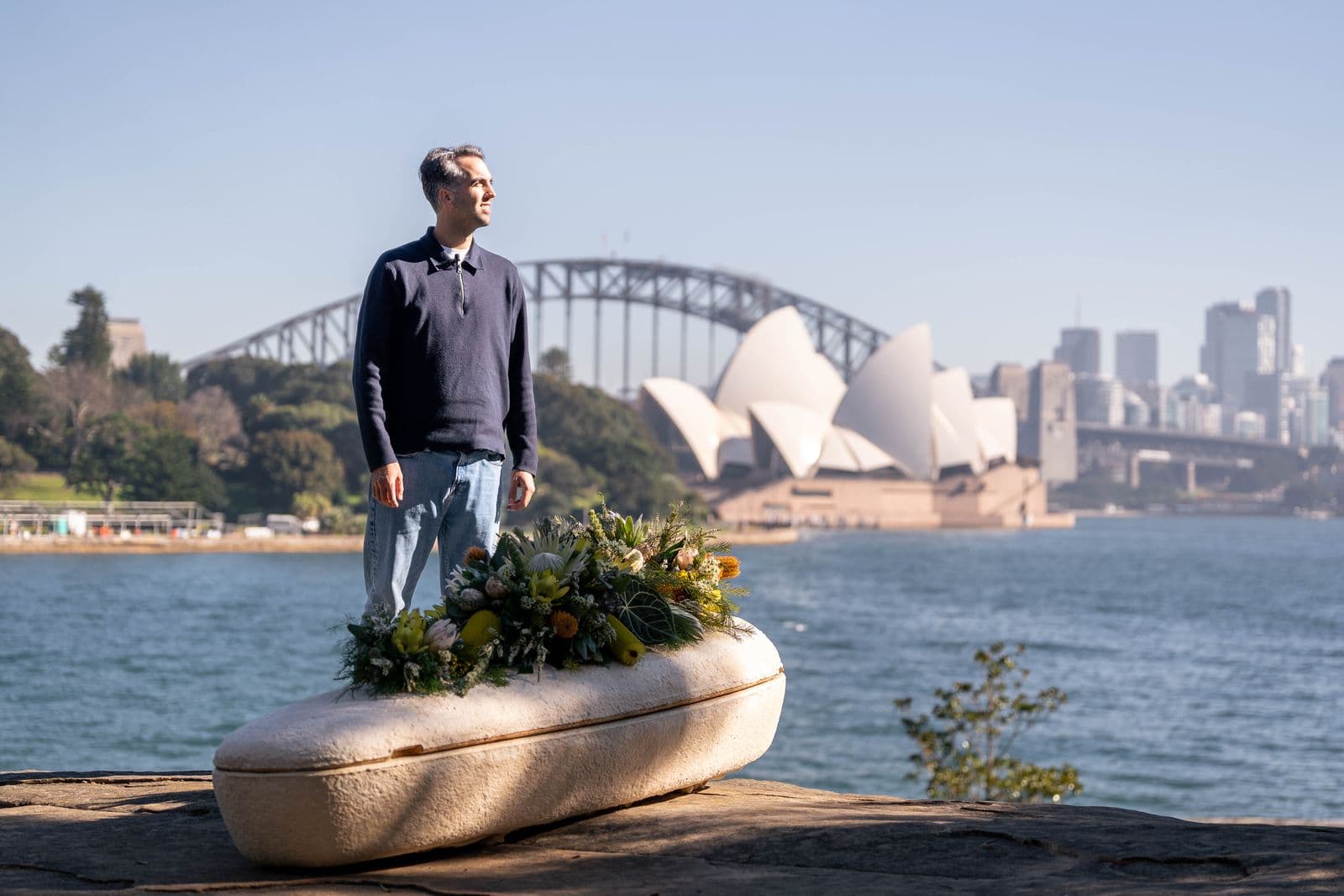
The Living Cocoon of Bob Hendrikx
Loop Biotech’s Living Cocoon has been used for the first time at a funeral in Australia. Grown in Delft from mycelium and hemp fibres, the coffin breaks down much faster after burial than a conventional wooden coffin. Founder Bob Hendrikx ultimately wants to move production to other parts of the world, using local facilities and locally available waste streams as raw materials.
https://ioplus.nl/nl/posts/nederlandse-doodskist-van-paddenstoelen-gaat-de-wereld-over-
ASML takes the first step towards a campus for 20,000 employees
ASML has begun developing its new campus in Eindhoven. The expansion is intended to accommodate up to 20,000 employees and underlines the enormous growth of the Dutch semiconductor industry. At the same time, the project places a major responsibility on the region: housing, infrastructure, education, and public services will all need to grow at the same pace.
https://ioplus.nl/nl/posts/asml-start-bouw-campus-in-eindhoven-voor-20000-werknemers
PAL-V wants to become the Tesla of the fly-drive industry
After years of development and certification, PAL-V says its flying car is approaching commercial production. The first vehicles are expected to be delivered within eighteen months from a new production facility in Brabant. CEO Robert Dingemanse sees opportunities primarily among police forces, fire brigades, border-control agencies, rescue services, and other users that need to reach difficult locations quickly.
https://ioplus.nl/nl/posts/pal-v-wij-worden-de-tesla-van-de-flydrive-industrie
US sanctions expose Europe’s digital dependence
Sanctions imposed on staff members of the International Criminal Court demonstrate the extent of US influence over European banks, payment systems, cloud providers, and digital platforms. Anyone placed on a US sanctions list can suddenly lose access to essential services, even in Europe. This makes digital autonomy much more than an economic ideal: it is a prerequisite for independent political and legal action.
https://ioplus.nl/nl/posts/hoe-amerikaanse-sancties-europa-in-een-digitale-val-lokken
Maastricht and Enschede give young people a climate budget
Maastricht and Enschede are joining Bloomberg Philanthropies’ Youth Climate Action Fund. Through local innovation competitions, young people aged 15 to 24 will receive funding and support to develop their own climate projects, ranging from urban greening and waste reduction to films and podcasts. The fund aims not only to produce tangible results, but also to give young people a greater say in the future of their cities.
https://ioplus.nl/nl/posts/maastricht-en-enschede-zetten-jongeren-in-voor-klimaat
Our Other Newsletters
Thank you for reading this newsletter. But there’s more. Subscribing is easy — via the options on the IO+ homepage or simply by clicking one of the newsletters below:
- IO+ Daily (1,200 subscribers)
- Mauro’s Green Corner (monthly, 13,800 subscribers)
- Elcke’s Saturday Data Dive (monthly, 20,550 subscribers)
- Elcke en Mauro’s BIO+ Bites (monthly, 29,300 subscribers)
- Bart’s Saturday CHIPS (monthly, 16,300 subscribers)
Rather listen?
Here's a small selection of last week's highlights in a half-hour podcast:
External Content
This content is from spotify. To protect your privacy, it'ts not loaded until you accept.
Enjoy your Sunday!