
The IO+ Week: progress requires proximity
Every Sunday, our weekly review offers an overview of the most interesting stories around important innovations.
Published on May 24, 2026
Bart, co-founder of Media52 and Professor of Journalism oversees IO+, events, and Laio. A journalist at heart, he keeps writing as many stories as possible.
To paint a reliable picture of the world of progress, you have to get out there. Sometimes digitally, but usually literally: out the door. This past week, our stories came from Amsterdam, Groningen, Utrecht, Heerlen, Antwerp, Paris, Eindhoven, and The Hague. Not because traveling is a goal in itself, but because innovation cannot be captured from one desk, one region, or one discipline.
What stands out in this week’s stories: Europe is looking for control over its technological future. That is about chips, AI, cloud storage, data centers, and quantum technology, but just as much about how we can organize cities in a smarter, more circular, and more efficient way. The same underlying question keeps returning: do we want to remain dependent on systems, materials, and infrastructures over which we ourselves have hardly any influence, or do we build alternatives that better fit our values, economy, and future?
With a small team like ours, that means making choices, looking sharply, and being present in many places. That is precisely why every Sunday we bring together the most striking innovation news of the week: not as separate reports, but as a window onto developments that will matter tomorrow. And if you want more — because there is more — just have a look at IO+ every day. Or subscribe to our daily newsletter. The links are below.
Proximity
Oh, by the way, this week we also came across another important aspect of “proximity.” During an event at the High Tech Campus Eindhoven — also our own workplace — Euclyd founder Bernardo Kastrup put it aptly: “The campus infrastructure helps us with recruitment, customer onboarding, and even physical security. In one case, a customer’s security onboarding was completed in just three days, including a weekend, mainly because the campus already had the necessary infrastructure.” Indeed, after all those trips, the campus always feels like a warm — and safe! — home to us.
And now for the highlights...
Imec brings quantum technology closer to industrial scaling
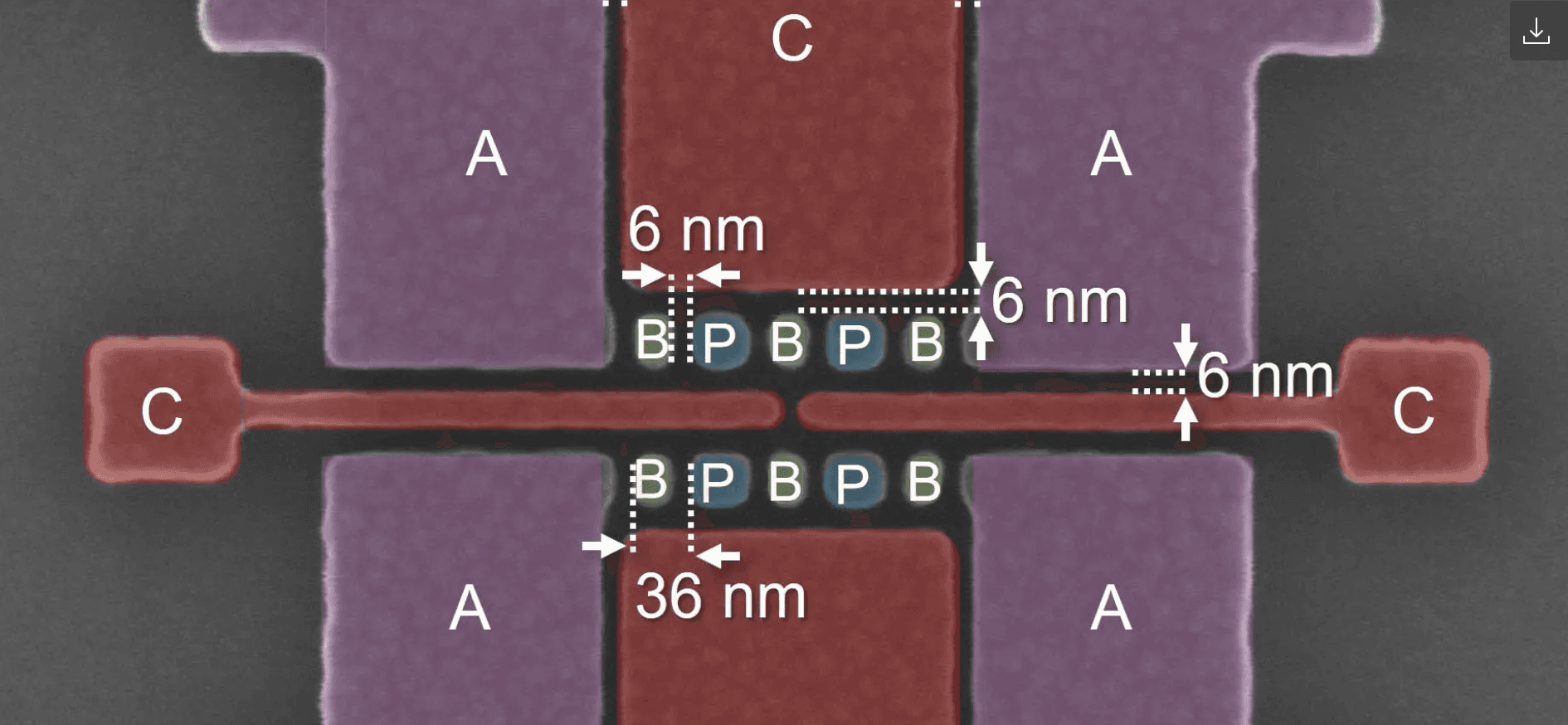
Imec has, for the first time, created a qubit using High NA EUV lithography, the most advanced chip production technology of the moment. This brings the industrial production of more reliable quantum bits one step closer. The breakthrough is especially relevant because silicon quantum-dot spin qubits are largely compatible with existing chip production processes. That makes the step from laboratory experiment to scalable quantum computer more realistic. More here
Amsterdam and Eindhoven can together form a European top region
A stronger tech corridor between Amsterdam and Brainport Eindhoven can significantly strengthen the Dutch position in Europe. Amsterdam brings AI, data, and digital applications; Eindhoven brings hardware, semiconductors, and high-tech systems. Together, the regions represent more than a quarter of Dutch GDP, but the research IO+ wrote about mainly shows that their strength is still being used too fragmentarily. The challenge is clear: fewer pilots, more joint scaling. More here
Europe’s chip demand is growing, but benefiting from it is not self-evident
European demand for semiconductors will almost double by 2040. Yet it is by no means certain that Europe will benefit economically and strategically from this. A German-Dutch study warns that Europe must make choices now: invest in talent, faster procedures, better energy costs, automation, and stronger value chains. Without those preconditions, dependence on other regions will remain high, precisely at a time when chips underpin AI, defense, mobility, healthcare, and industry. More here
Europe does not have to lose the AI race, but it does have to think bigger
At a meeting of the AI Innovation Center at the High Tech Campus Eindhoven, a clear message rang out: AI sovereignty does not mean that Europe has to do everything alone, but it does mean that it must determine which parts of the AI stack it wants to control itself. Founders of Euclyd, Axelera AI, and Datacation pointed to chips, data centers, models, applications, and customer relationships as components of a single strategic infrastructure. Europe has the knowledge, the people, and the resources, but it must stop talking itself out of the race in advance. More here
Bernardo Kastrup / Euclyd, Bram Verhoef / Axelera AI, Ralf Zoetekouw / Datacation © Floris van Bergen
Cloud storage becomes a privacy issue
For years, cloud storage was mainly about convenience. But more and more European users are asking themselves who has access to their files, under which legislation those files fall, and what business model lies behind it. Proton Drive presents itself as an alternative to Big Tech services, with end-to-end and zero-access encryption at its core. This makes cloud storage not only a technical service, but also a choice for control, privacy, and European digital autonomy. More here
Data centers are not a side issue, but digital infrastructure
The discussion about data centers is often conducted in terms of space, energy, and nuisance. But according to Michiel Eielts of Equinix, the Netherlands risks losing ground if there is no room left for digital infrastructure. AI capacity, cloud applications, and business IT will then move abroad. According to him, the core of the problem is not only grid capacity but, above all, the lack of a spatial policy in which data centers and fiber optics are treated as seriously as roads, bridges, and railways. More here
Heerlen startup MAECONOMY sees the city as a materials bank
MAECONOMY wants to make visible the value hidden in buildings, roads, lampposts, and other urban infrastructure. The Heerlen startup is building a platform that enables municipalities to inventory, value, and resell materials. The idea is as simple as it is radical: treat the city as a Lego set, in which blocks are not thrown away but are repeatedly given a new function. In this way, circularity becomes not only a sustainability ideal, but also a data issue, a marketplace, and a new economic model. More here
Share this newsletter
IO+ follows the future, step by step, breakthrough by breakthrough.
What this week shows: innovation is not an abstract story. It becomes visible in systems that are changing, from streets to hospitals. And that is exactly where technology makes the difference. In the meantime, help us by sharing this newsletter with colleagues and partners, and stay connected to tomorrow’s ecosystem.
A Daily Podcast
Or do you prefer to listen? A new episode of our daily podcast is ready for you every weekday at 6:30 AM. In it, our AI colleagues Oliver and Shelby discuss the two most interesting stories of the day. That makes IO+ Daily the perfect way to start your morning with optimistic news from the world of innovation and technology. See you tomorrow.
Our Other Newsletters
Thank you for reading this newsletter. But there’s more. Subscribing is easy — via the options on the IO+ homepage or simply by clicking one of the newsletters below:
- IO+ Daily (1,200 subscribers)
- Mauro’s Green Corner (monthly, 13,800 subscribers)
- Elcke’s Saturday Data Dive (monthly, 20,550 subscribers)
- Elcke en Mauro’s BIO+ Bites (monthly, 29,300 subscribers)
- Bart’s Saturday CHIPS (monthly, 16,300 subscribers)
Enjoy your Sunday, and don’t forget: a new episode of IO+ Daily will be waiting for you tomorrow morning at 6:30. Be prepared before you hop on your bike! 🚲
💡 Stay ahead of the innovations shaping tomorrow
Follow IO+ for daily stories on technology, science, entrepreneurship and the systems that shape our future. 👉 https://ioplus.nl/en/posts
Enjoy your week!