
HTC's AI sovereignty event offers a stack of responsibilities
The AI event did not bring a single definition of AI sovereignty - "Europe does't have to lose the AI race, but has to start choosing."
Published on May 22, 2026
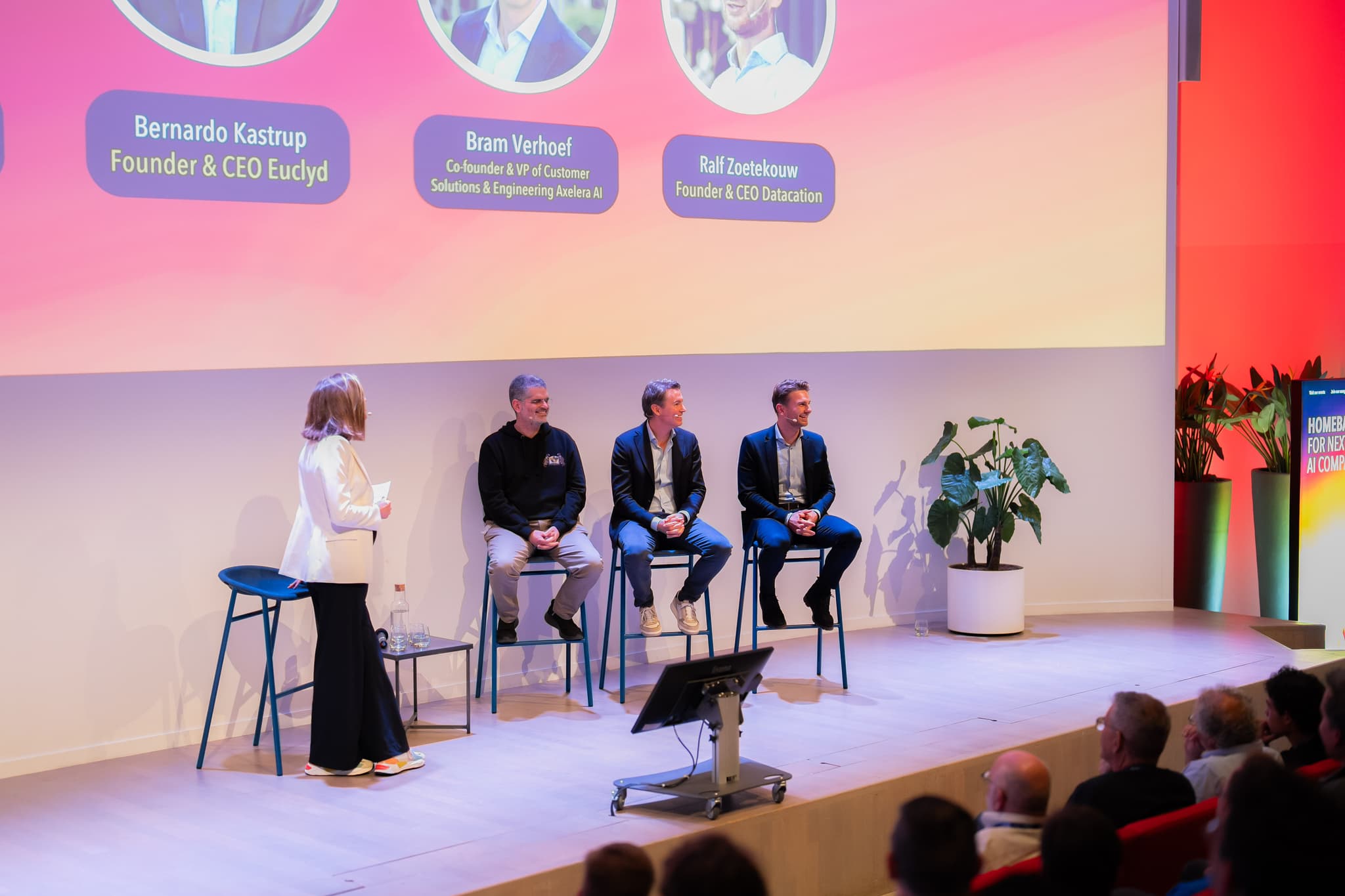
Bernardo Kastrup / Euclyd, Bram Verhoef / Axelera AI, Ralf Zoetekouw / Datacation © Floris van Bergen
Bart, co-founder of Media52 and Professor of Journalism oversees IO+, events, and Laio. A journalist at heart, he keeps writing as many stories as possible.
At the AI Innovation Center in Eindhoven, founders of Euclyd, Axelera AI, and Datacation argued that AI sovereignty is not an abstract Brussels concept. It is about chips, data centers, applications, customers, investors, and the courage to build a full European stack.
The discussion about Europe’s role in artificial intelligence at the High Tech Campus Conference Center quickly moved beyond familiar slogans. Nobody on stage argued that “AI sovereignty” should mean isolation, protectionism, or building everything alone. But the message from Bernardo Kastrup of Euclyd, Bram Verhoef of Axelera AI, and Ralf Zoetekouw of Datacation was unmistakable: Europe cannot remain merely a user of other people’s models, chips, clouds, and platforms. If AI is becoming a strategic infrastructure, Europe must decide which parts of that infrastructure it wants to control.
A full AI stack
Moderator Irene Rompa framed the afternoon around one central question: how can Europe build and control its own full AI stack? The three answers together formed a layered picture. Kastrup looked at the data center and the hardware needed to train and run advanced models. Verhoef widened the view from silicon to systems, pointing at defense, robotics, and data centers. Zoetekouw brought the discussion back to companies and organizations: sovereignty, he argued, only becomes meaningful when AI is connected to what makes an organization unique.
Bernardo Kastrup / Euclyd © Floris van Bergen
Kastrup, co-founder of Euclyd, described the moment that convinced him AI would become “the most consequential technology humanity has ever developed.” He had given a model the schematics of a 1970s television and asked it to explain what was happening. “I was floored,” he said, because the system could read a poor-quality PDF and identify the amplifier, the tuner, and other components. But when he looked at Europe, he saw most activity taking place at the edge, while “the real breakthroughs” would happen in the data center. “We have the skills, we have the capabilities in Europe, we have the people. Frankly, we have the money too.”
Euclyd’s answer is to develop technology that can replace GPUs in data centers. Kastrup was blunt about the current foundation of AI computing: “GPU is video game hardware. That’s what we are using to run neural networks today.” It was available when AI exploded, he said, but it was not designed from scratch for the way neural networks work. Euclyd is therefore building systems on silicon and systems-in-package to run AI workloads with higher efficiency, lower energy use, and lower cost. The original plan was to build a first chip in 2026 and reach the market around 2028. Instead, the company taped out a chip last year, in six months, without using ARM, RISC-V, or external communications IP. “If I think back at that, I think we were crazy to do that,” Kastrup said.
His broader point was not just technological, but cultural. Europe, he argued, too often assumes it has already lost the hardware race and should therefore focus elsewhere. That, he said, is “not justified by reason and evidence.” His advice to the room was simple: “Think bigger. Stop thinking small, stop thinking in terms of what we can’t and what’s too late to do.”
Dominance in advanced chip manufacturing
Verhoef, co-founder and senior leader at Axelera AI, approached sovereignty from another angle. He started with the famous laws of robotics and showed how easily the values embedded in an AI system can be shifted by changing the word “humanity” into the name of a nation or group. That, he argued, makes AI models a sovereignty issue. Europe is currently dependent on foreign large language models, foreign chip manufacturing, and foreign AI systems. He pointed to TSMC’s dominance in advanced chip manufacturing and to NVIDIA-based servers powering many of the world’s AI factories. “If something happens to TSMC, we are in big trouble,” he said. “Especially here in Europe.”
Bram Verhoef / Axelera AI
For Verhoef, sovereignty matters most in three verticals: defense, robotics, and data centers. The requirements differ sharply. Interceptor drones need low-cost and energy-efficient AI; robotics, including automotive and industrial systems, requires control over supply chains; data centers demand high performance to serve billions of model requests. Axelera AI is trying to span that spectrum with a platform that combines hardware and software. Its current Metis chip focuses on computer vision applications such as smart cameras, retail, security, and drones. The coming Europa chip is aimed more at generative AI and robotics, while Titania is being developed for data center performance.
The important thing, Verhoef stressed, is that Europe can compete. Axelera has developed its own technology by bringing memory and processing closer together, reducing the costly and energy-intensive movement of data between separate memory and processor units. “This really shows that we can do this in Europe,” he said, pointing to more than 500 customers and a platform that includes chips, M.2 cards, PCIe cards, single-board computers, systems with partners such as Dell and Lenovo, and an open-source SDK.
Consume or shape
Zoetekouw, founder and CEO of Datacation, then moved the debate from the foundation of AI to its use in organizations. He opened with a story about a company that refused to deploy a computer vision model in its own Microsoft Azure environment because the images were “way too important” to be stored in the cloud. After further questioning, Zoetekouw discovered that those same images had already been stored in Microsoft SharePoint for ten years. For him, the lesson was that AI sovereignty is rarely black and white. “It’s not always like European, non-European, open or closed, on-premise or in the cloud.”
His central message was that organizations should not only ask whether they consume AI, but whether they shape it around their own intelligence. “AI becomes most strategically valuable when it’s really connected to what is uniquely yours,” he said: data, domain knowledge, processes, and proprietary expertise. He illustrated this with examples from KLM Catering Services, where AI helps predict food and beverage needs on flights, and Van der Valk + De Groot, where computer vision is being used to detect defects in sewer inspection footage. In the latter case, more than twenty years of labeled sewer data became the basis for a solution that could reduce manual inspection work and open new advisory services for municipalities.
Bernardo Kastrup / Euclyd, Bram Verhoef / Axelera AI, Ralf Zoetekouw / Datacation © Floris van Bergen
An entrepreneurial question
The panel discussion made clear that sovereignty is also an entrepreneurial question. Verhoef recalled Axelera’s early uncertainty: even with a strong first product, customers initially found adopting a new chip too risky. The company needed one first customer willing to take the leap. Kastrup described Euclyd’s rapid chip tape-out as “downright bonkers” but instrumental, because it created evidence, confidence, and a roadmap. Zoetekouw said Datacation had to educate the market before ChatGPT made AI a boardroom topic.
All three speakers also addressed Europe’s risk-averse culture. Verhoef argued that innovation should come before regulation: rules are necessary, but not as the first reflex. Zoetekouw said that in Denver and Dubai he saw organizations more willing to adopt AI, while in the Netherlands people are often more afraid. Kastrup added nuance: European customers may be slower and less aggressive, but once trust is built, they can also be more loyal.
Proximity is key
Perhaps the most Eindhoven moment came when the panel discussed proximity. Axelera’s CEO calls the High Tech Campus “the smartest square kilometer in the Netherlands,” Verhoef said. Kastrup, whose company is “right across the lake,” added that the campus infrastructure helps with hiring, customer onboarding, and even physical security. In one case, he said, a customer’s security onboarding was completed in three days, including a weekend, partly because the campus already had the necessary infrastructure in place.
The afternoon did not end with a single definition of AI sovereignty. Instead, it offered a stack of responsibilities. Europe needs hardware ambition, but not hardware alone. It needs models, chips, servers, energy, cooling, applications, customers, capital, and speed. It also needs organizations that understand what is truly theirs. As Zoetekouw put it at the end of his talk, sovereignty is about balance: “the ability to understand, protect and shape what is uniquely yours.”