
Combating flooding and solar peak in cities with digitalization
Through digitization, these researchers are finding answers to pressing questions about sustainability, efficiency, and safety in cities.
Published on May 11, 2026
As Head of Partnerships, Linda liaises with new partners. She coordinates all ongoing collaborations and connects our journalistic editorial and commercial articles. She is not only the connector behind our articles, but also all of our events.
From simulations to smart calculation tools: digitalization is playing an increasingly important role in construction. Digital tools are helping to find solutions to major societal challenges such as sustainability, climate adaptation, and the energy transition. Consider, for example, digital twins that map out and distribute solar energy as efficiently as possible across a city. Or a digital copy of a city to calculate how to prevent flooding the best way possible.
To connect researchers and share knowledge, a special team within 4TU.Built Environment (a partnership between the construction-related faculties of the four technical universities in the Netherlands) organizes an annual research day focused on digitalization in construction. The Lectoratenplatform Gebouwde Omgeving (an association of 14 universities of applied sciences), various industry partners, and government agencies also participate.
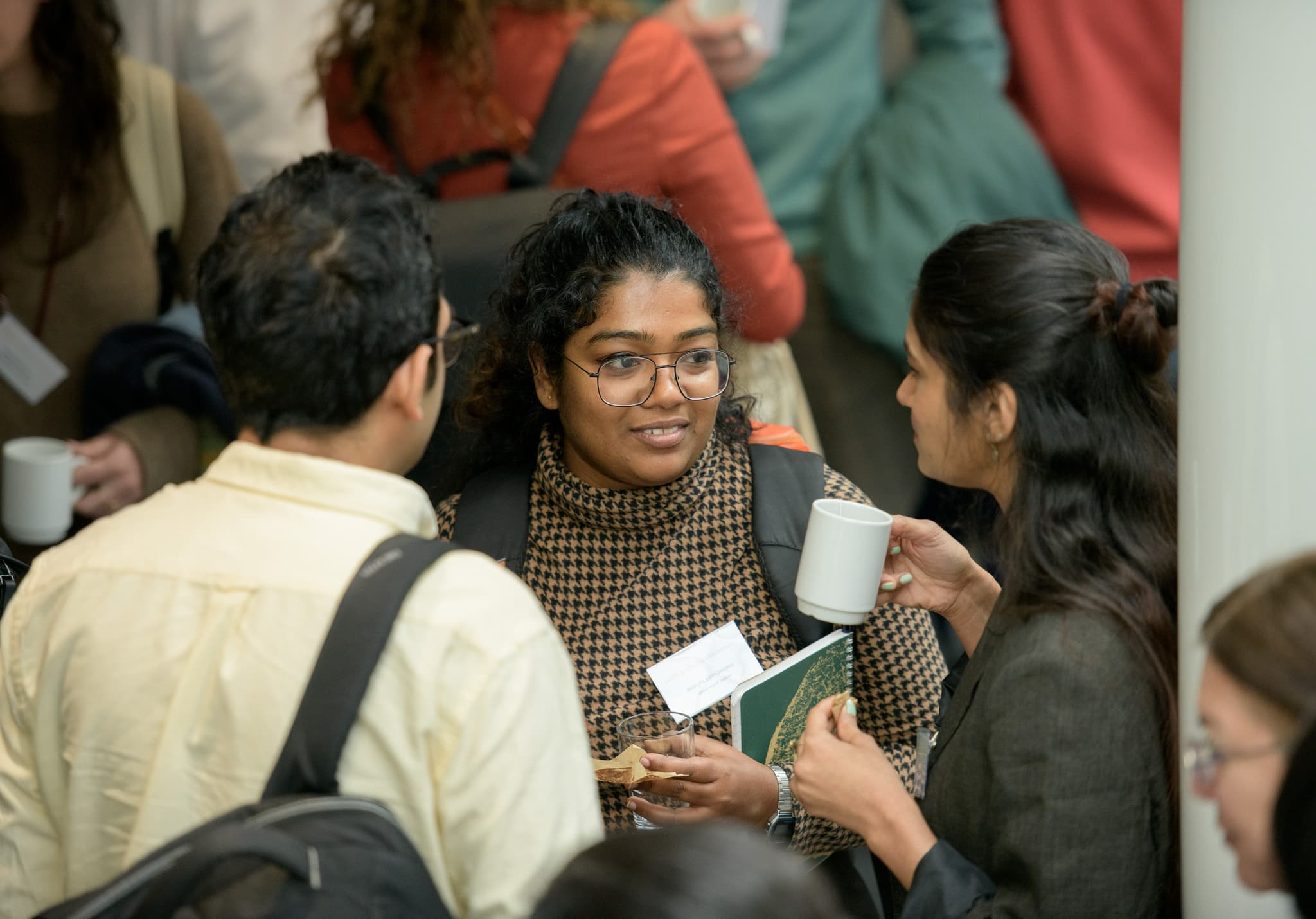
“It’s a wonderful experience to see all these people working toward a common goal,” says Monica Pena Acosta, assistant professor of data-driven urban climate engineering at the University of Twente. In addition to her work as a researcher, she is also a member of the special Domain Acceleration Team (DAT) for Digitalization within 4TU.Built Environment and organized this year’s conference.
A new ecosystem
The fifth edition was hosted by the University of Twente and drew a record number of visitors. “Over the years, we have seen a knowledge ecosystem emerge around digitalisation in the built environment. The people involved share a common ambition: to use this transition to help the sector make better-informed decisions and respond more effectively to societal challenges,” says Pena Acosta.
Prior to the conference, a visit to the municipality and a dinner were organized to get to know each other in an informal setting and break the ice. During the research day, scientists presented recent studies, demonstrated useful tools, and made new connections. “We encourage knowledge sharing and want to inspire scientitst for further research and potential collaborations between different universities,” she says. The conference had six main themes within which researchers presented their work: data management, parametric and data-driven design, process and monitoring, data modeling, scenarios and simulation, and data-driven prediction.
Impact in practice
The presentations focused strongly on how technology can be implemented in practice and what its wider societal impact can be. One example was a digital twin that provides insight into urban sustainability down to the level of individual homes. Municipalities can use such a tool to assess solar-energy flows and explore how solar panels can be used more effectively. Another researcher presented a similar tool for mapping flood risks, making it possible to measure the effectiveness of different interventions. In this way, municipalities are better equipped to develop and implement policy.
“Over the years, we have seen research increasingly shift towards impact, for example by supporting decision-makers with practical tools”, says Pena Acosta. She sees this as a positive development. “We are trying to bridge the gap between technological innovation and practical implementation.”
Connecting data across scales
The challenge of structuring and connecting built-environment data was a recurring theme of the Research Day. Across the sessions, researchers looked at how data from different sources and scales, from city-level models to building-level data and object-specific information within buildings, can be made interoperable. “With the rise of AI and digital-twin technologies, the issue is no longer simply whether data is available, but whether it is structured, identifiable, and connected in a way that allows it to be analysed and used in practice. How do we connect different data sources? How do we keep them clearly structured? And how do we make the resulting tools useful for end users?” says Pena Acosta. These questions were central to discussions on data spaces, building identifiers, data standards, and federated digital infrastructure for the built environment.
Geodata for solutions
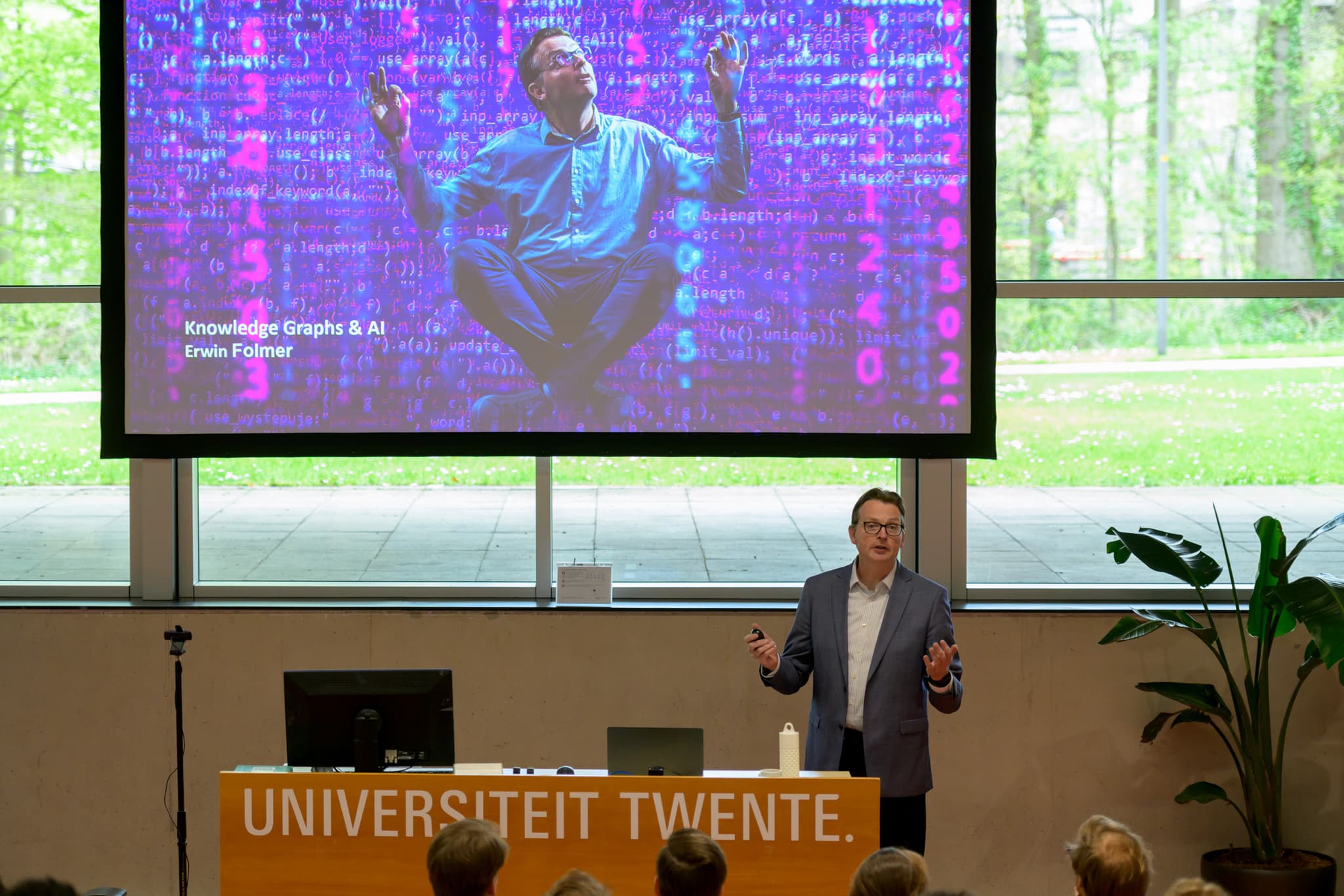
One of the keynote speeches at the conference was delivered by Erwin Folmer, head of the data science team at Kadaster and lecturer in Applied Data Science & AI at Arnhem Nijmegen University of Applied Sciences (HAN). In addition to registering land ownership in the Netherlands, Kadaster is also involved in collecting and making geodata available. The organization makes data on everything located on or in the ground available to everyone via the Kadaster Knowledge Graph. In this way, the public body aims to contribute to solutions for societal problems as developed within universities, according to Folmer.
A system of systems
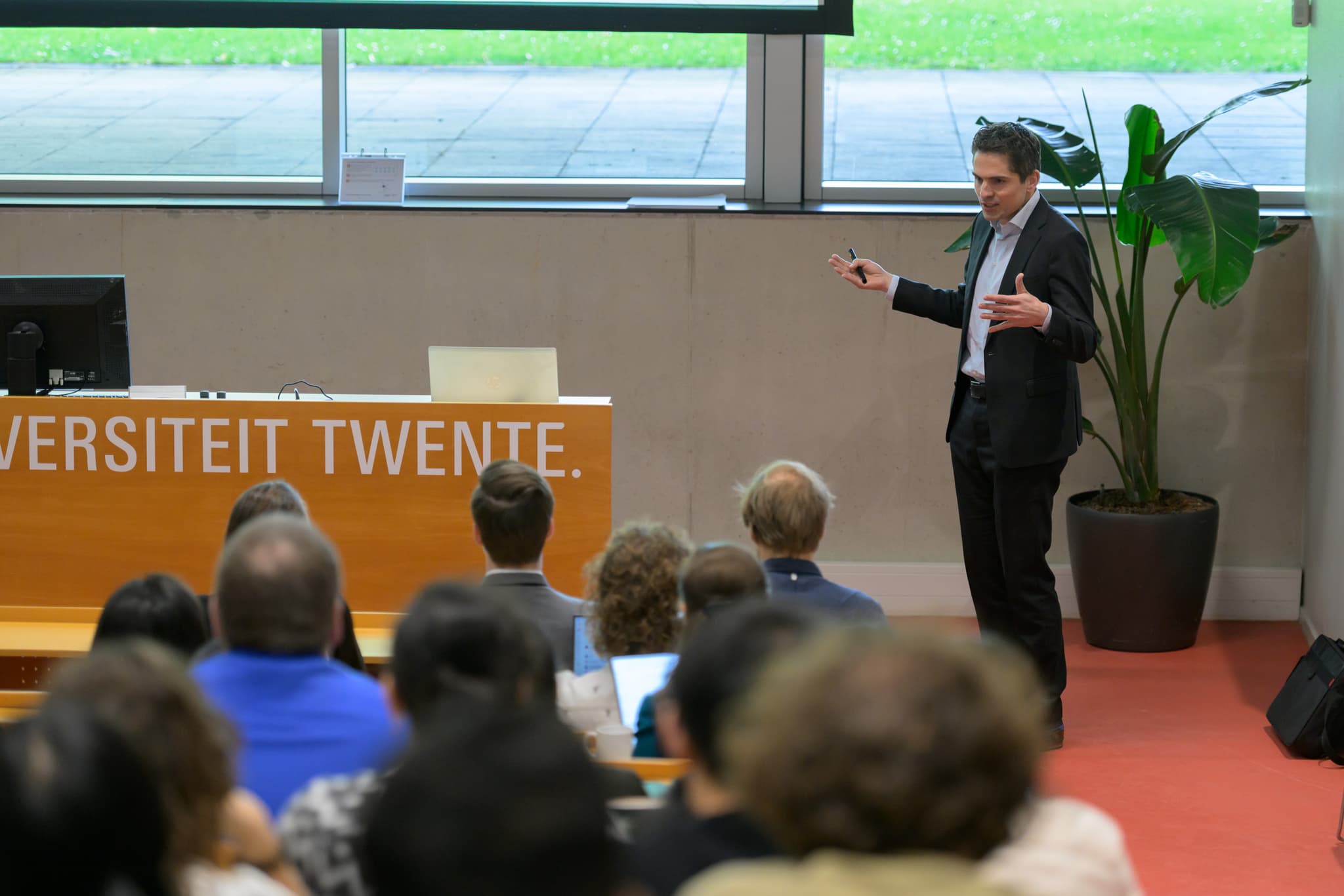
Bart Brink, acting director of TKI Bouw en Techniek, delivered a keynote speech on the national government’s actvities and the opportunities they presents for scientists. The TKI implements the Dutch top sectors policy and promotes collaboration between science, government, and industry. It does so by providing funding for public-private partnerships and, above all, by establishing and implementing various innovation programs in the built environment.
“The built environment is a system of systems; society converges within it,” Brink outlined during his keynote. He demonstrated that economic infrastructure, social infrastructure, and nature gather in the built environment. “Various societal challenges also converge here.” To arrive at effective solutions, digitalization is key, he explains. TKI Bouw en Techniek is focusing, among other things, on the development of AI, with several national dedicated programs. Among them, there is a program to plan home renovations as efficiently as possible.
Increasing productivity
Brink views digitization and the proper use of data as key factors in boosting productivity in the construction industry. This is necessary because productivity has not increased for quite some time. Furthermore, the number of new hiring is minimal, while a relatively large number of people are set to retire in the coming years. Meanwhile, problems such as the housing shortage are becoming increasingly acute. “Data is the foundation for increasing productivity in the construction industry,” says Brink.
Sharing knowledge
In the coming period, the DAT will focus on strengthening the community through small-scale meetings and targeted activities. “We want to meet more often than just once a year”, says Pena Acosta. During these meetings, researchers, students, and professionals exchange experiences on topics such as digital twins, AI, and data-driven decision-making.
The DAT also aims to develop training programmes for professionals in the field. These could focus on practical and emerging themes such as responsible AI, data governance, sensor-based monitoring and simulation tools for planning, design and infrastructure management. “In this way, we want to share our knowledge with the wider community, both within and beyond universities.”
Looking ahead, the DAT sees opportunities to become a more continuous platform for collaboration. Pena Acosta: “By connecting universities, universities of applied sciences, governments and industry partners, the network can support joint research, living labs, student challenges and prototype development. In this way, the annual Research Day can become not only a moment to share results, but also a catalyst for new partnerships and practical innovation.”
Sponsored
This story is the result of a collaboration between 4TU.Built Environment and our editorial team. IO+ is an independent journalism platform that carefully chooses its partners and only cooperates with companies and institutions that share our mission: spreading the story of innovation. This way we can offer our readers valuable stories that are created according to journalistic guidelines.
Want to know more about how IO+ works with other companies? Click here