
The city as a Lego set — every brick has a next life
MAECONOMY wants to make the hidden material value of our built environment visible, tradable, and circular.
Published on May 21, 2026
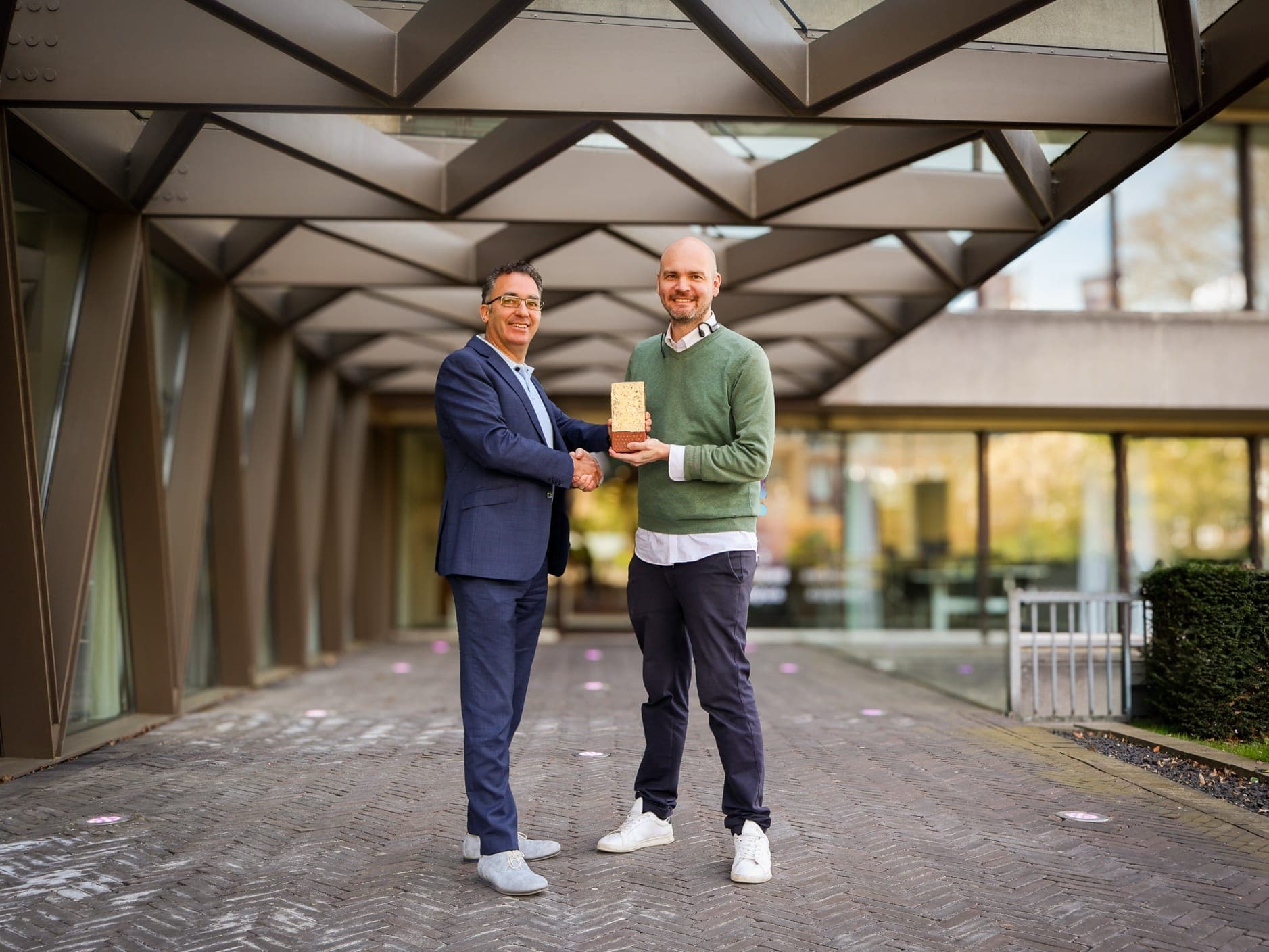
© MAECONOMY

Mauro swapped Sardinia for Eindhoven and has been an IO+ editor for 3 years. As a GREEN+ expert, he covers the energy transition with data-driven stories.
Walk down any street in a city, and you walk past billions of euros of material value — embedded in roads, lampposts, facades, and walls — that nobody is tracking, pricing, or planning to reuse. Vince Meens, founder and CEO of MAECONOMY, has been thinking about this problem for years. His frame of reference? Lego bricks.
"As many of us did, when I was a child, I played with Lego," he says. "Lego taught me not to throw away the bricks after playing with them once. Everybody understands the concept of reusing the same materials. The main question was: why are we not doing that in the real world?"
That question is now a company. MAECONOMY, based in Heerlen in the Netherlands, is building a material-based exchange powered by cities — a platform that maps, values, and trades the raw materials locked inside the built environment. Municipalities are the primary customers, as the system allows them to map it down to the tile level. In April, the company raised €1.5 million in a funding round led by venture capital firm LUMO Labs and Limburg development agency LIOF.
.png&w=2048&q=75)
Investment of the month
Each month, we interview a startup or company that has recently received an investment.
A bottle return system for cities
Meens is precise about what MAECONOMY is actually solving. It is not a technical problem. It is an information problem — and an incentive problem.
"There's no Google where you can just find all the materials in the built environment," he says. Owners, construction companies, and manufacturers all hold data, but none of it is transparent or shared.
Visibility is the other problem: once a material enters a building, it becomes invisible. People see the structure; they stop seeing the steel beams or concrete blocks within it. Meens points to the Dutch statiegeld deposit system for plastic bottles as a model: assigning a small monetary value to each bottle achieved a 97% return rate. The same logic, he argues, can be applied to a lamppost or a street tile.
A forward-looking materials calendar
The platform's foundation is a prediction algorithm that estimates a city's material composition without physically inspecting every building. It combines publicly available data — year of construction, square footage, building type — with detailed datasets from contractors and demolition firms, and layers them with known replacement cycles. Roads are resurfaced roughly every ten to fifteen years; that alone allows developers to forecast when large volumes of asphalt will return to the market.
"You can start predicting what the material outflow of a city will be every year," Meens explains. The result is something like a forward-looking materials calendar — and from there, a marketplace. Future users, such as housing corporations or neighboring municipalities, can reserve materials before demolition even begins.
Wouter Gerards, chief business development officer at MAECONOMY and a trained financial economist, frames the opportunity in economic terms: "By reducing asymmetric information, we reduce market failure." He illustrates it with a concrete example — a brick sold for four cents and bought back three months later for twenty-six cents.
Why municipalities lead
MAECONOMY's primary clients are municipalities. They have enough material volume to make circular matchmaking viable. Moreover, they have the authority to lead by example, shape procurement, and build the public infrastructure layer that the whole system needs. The startup has launched a pilot project with the municipality of Heerlen to map the entire city and its assets.
Gerards, who spent years managing funds for Dutch municipal and provincial governments, saw the dysfunction first-hand. "In a large organization with €500 million worth of buildings, people do not know what's happening because there's no central information system." When MAECONOMY mapped a municipality's assets, internal efficiencies appeared almost immediately — departments unknowingly buying materials that already existed elsewhere in their own estate.
The platform also unlocks something that has long been legally awkward: trade between municipalities. Without transparent pricing and standardized data, procurement rules make inter-municipal exchange nearly impossible. A shared data layer resolves both.
Materials first, products later
A key strategic insight has shaped the startup’s approach to circularity. Most circular economy initiatives focus on reusing products as they are — a window frame, a modular panel. But products have a limited shelf life of relevance. "Twenty years later, maybe nobody wants that exact window frame," Meens says. "But they might want the timber in it."
MAECONOMY focuses first on closing bulk material flows — steel, concrete, asphalt — and treats product reuse as a later-stage goal. The longer-term vision goes further still: pulling manufacturers back into the loop entirely. If the platform locates six hundred lampposts of a specific type across a region, it can approach the original manufacturer and offer them back.
"You get a mechanism like IKEA," Meens says. "If you bring back a kitchen, you get 10% of its value back." Manufacturers are best placed to reprocess what they originally made — and if enough of them come back into the loop, Gerards sees a genuine paradigm shift in how products are designed: built to return, not built to be discarded.
The larger bet
Behind the business model — a combination of data consultancy, protocol licensing, and material brokerage — lies a bigger ambition. Meens believes the chronic unaffordability of housing is, at its root, an information problem. Cities perpetually buy new materials while paying to dispose of old ones, because nobody has connected the two sides of that equation.
The goal is a perspective shift — one in which walking down the street means seeing not fixed infrastructure but a continuous cycle of recoverable value. That street tile won't be here forever. Neither will this lamppost. The city, in other words, is not infrastructure; it is a giant Lego set.