
Imec creates quantum bit using high-NA EUV lithography
The most advanced lithography technology will also play a key role in scaling up quantum technology.
Published on May 19, 2026

Team IO+ selects and features the most important news stories on innovation and technology, carefully curated by our editors.
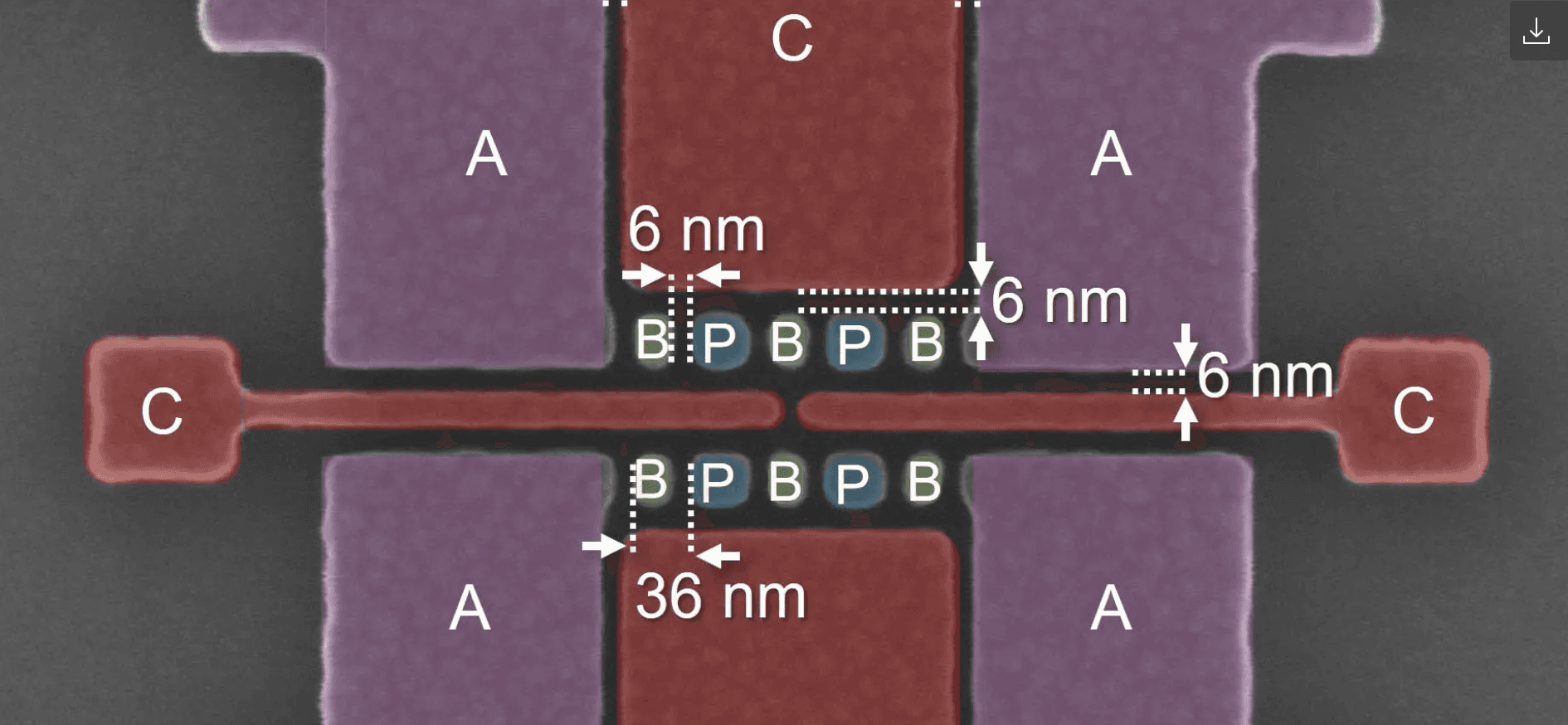
The imec research center has, for the first time, fabricated a qubit (quantum bit) using High NA EUV lithography, an advanced chip manufacturing technique for printing ultra-fine patterns with high precision. This marks a milestone toward the industrial scaling up of more reliable qubits, the basic computational units of quantum computers.
For specific computational problems, such as developing new drugs or simulating physical processes, a quantum computer could perform exponentially better than classical computers. However, before a useful quantum computer can be realized, the number of qubits (the computational units of a quantum computer, comparable to the bits of a classical computer) must be scaled up. A quantum computer requires millions of qubits, which are interconnected, and this in turn demands high reliability and precise control.
Of the various quantum platforms currently being researched, “silicon quantum dot spin qubits” are considered a promising candidate for industrial scaling. Their manufacturing process is largely compatible with the production of standard computer chips (CMOS), a research area in which imec has built up international expertise over the past decades.
Decades of innovation
“We can build on decades of innovation in the field of semiconductors and leverage the ecosystem that has grown around it. This is how we make the leap from lab experiments to large-scale, manufacturable quantum systems. This is where silicon-based qubits have a clear advantage,” explains Sofie Beyne, project leader and quantum integration engineer at imec.
Printing ultrafine structures
Silicon quantum dot spin qubits trap an electron in a silicon nanostructure (the gate layer). The “spin” of the trapped electron is used to store quantum information. The gaps between the different gates must be minimized to limit environmental noise. And imec has now achieved results in this area: high NA delivers superior results when it comes to the uniform and error-free patterning of such ultrafine structures. For example, imec has succeeded in fabricating a functioning network of qubits with apertures of just 6 nanometers.
“With our results, we demonstrate that High NA EUV can be used to make these qubits more precise, which is fundamental to their reliability. This is a significant technical achievement,” says Kristiaan De Greve, imec Fellow and Program Director of Quantum Computing.
Imec and ASML
To achieve this result, the wafers were shipped to the joint High NA lab of imec and ASML in Veldhoven (NL). Now that this most advanced machine is also being installed in Leuven, imec researchers in Leuven are preparing the next steps toward industrial upscaling.
The most advanced lithography technique is crucial for the next generations of advanced memory and computing chips in the era of AI. At the same time, High NA EUV lithography will also play a key role in critical hardware components for future quantum computers.