
The IO+ week: A chip triangle worth building
Every Sunday, our weekly review offers an overview of the most interesting stories around important innovations.
Published on November 15, 2026
Bart, co-founder of Media52 and Professor of Journalism oversees IO+, events, and Laio. A journalist at heart, he keeps writing as many stories as possible.
I live in Eindhoven and recently visited both Munich and Dresden. All three are fascinating cities in their own right, but when I read this week that they were joining forces to help chip startups grow, I found myself wondering why we hadn’t done it sooner. The three regions have too much to offer one another to leave founders looking for everything they need close to home.
Eindhoven brings lithography, precision engineering and integrated photonics. Munich, through TUM Venture Labs and UnternehmerTUM, knows how to help researchers build companies and meet investors. Dresden brings the fabs, suppliers and manufacturing expertise of Silicon Saxony. A startup can have a promising prototype and still need specialised equipment, a way to make its chip at scale and a first industrial customer willing to try it. The European Future Chips Launchpad makes sense because it gives founders a way to look for all three across the regions, with help from people who already know the labs, companies and investors.
Here in Eindhoven, we’ve long wanted the Eindhoven–Aachen–Leuven high-tech triangle to live up to its promise. There’s real work to point to, from TU/e’s partnership with imec to the research behind the Einstein Telescope bid. Even so, I hope this new triangle turns out to be stronger in a practical sense. When the two-year pilot gets underway, as planned in 2027, I’ll be looking for the first founder who can point to a fabrication partner, a first customer or an investor they found through one of the other cities. That’s the kind of connection worth crossing a border for.
And while we're talking about triangles...
The Einstein Telescope could be a triangle or two Ls
One underground triangle can help researchers isolate noise within the instrument. Two L-shaped detectors far apart can help them tell where a gravitational wave came from and distinguish it from a local disturbance. At Maastricht’s ETpathfinder, researchers are already testing technology that either design could use.
https://ioplus.nl/en/posts/einstein-telescope-debate-a-triangle-or-an-l-after-all
Europe’s next vehicle will take more than a carmaker

At Helmond’s Automotive Campus, batteries, charging, software and vehicle engineering are becoming part of the same conversation. The challenge for Brainport is to help companies take what they develop on campus into production across the wider region. That will be on the agenda when Drive Forward brings the mobility industry to Helmond in April.
https://ioplus.nl/en/posts/from-vehicle-to-ecosystem-why-europe-needs-brainport
Ukraine’s warning to Europe about the cost of delay
At the European Defence Innovation Forum in The Hague, Ukrainian speakers asked European partners to move faster. Dutch and Ukrainian teams are already working together on projects such as casualty evacuation. The reporting explores what European institutions and companies can learn from Ukraine about shortening the time between identifying an urgent need and getting something useful into people’s hands.
https://ioplus.nl/en/posts/slow-innovation-is-costing-lives-in-ukraine
Why photonics startups tend to get bought
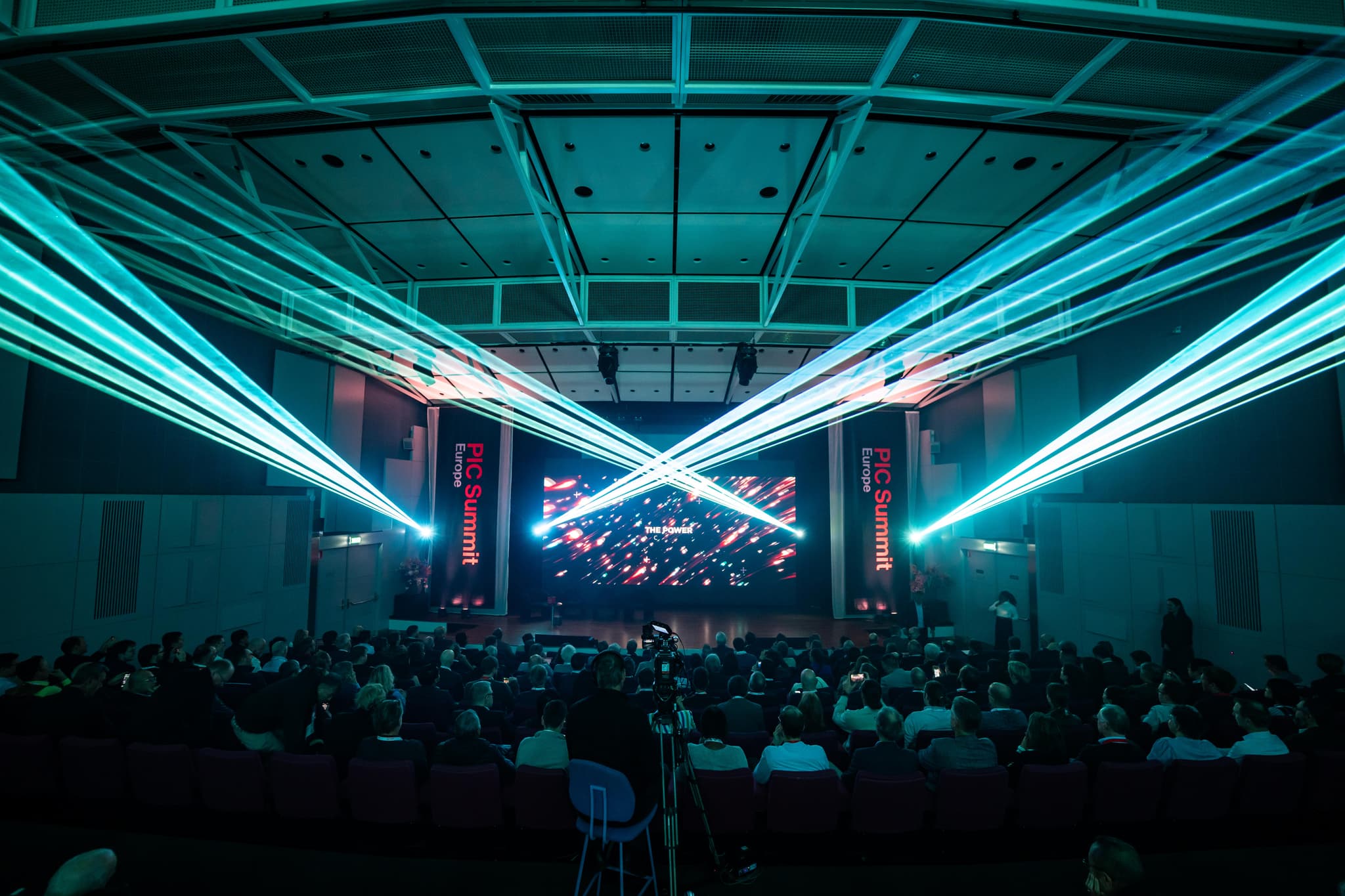
© PIC Summit
At PIC Summit Europe in Eindhoven, investors and founders debated whether to take an early offer or hold out to build a much bigger company. For some photonic-chip designers, the pool of customers is small and a chip that solves a pressing problem can be valuable enough for one of those customers to buy the entire company.
https://ioplus.nl/en/posts/bought-not-listed-europes-photonics-startups-exit-reality
A drone idea and a food tracker win young inventor awards
Philip, Skyler and Abel imagined a drone that could tackle air pollution. Puffy and Josh came up with a tracker to help people spot food that might otherwise go to waste. Both teams won in their age groups at the Young Inventor Award, where getting up and explaining an original idea was part of the challenge.
https://ioplus.nl/en/posts/children-win-young-inventors-award-with-drone-and-food-tracker
Offensys takes home €50,000 at Brabant’s AI Pitch Competition
Nine startups pitched at the Evoluon during AI Summit Brainport. Offensys won the top prize with a platform that helps companies check whether their cyber defences work. Kyvvu came second with technology for keeping AI agents within company rules, and Synthgen took third with synthetic training images for industrial inspection.
https://ioplus.nl/en/posts/offensys-wins-50000-at-brabants-ai-pitch-competition
What European AI sovereignty looks like down the hall
When Ocuma wanted to run its swimming-pool safety software locally, the chipmaker that could help was just down the hall at High Tech Campus Eindhoven. Running the model on Axelera AI’s chip helped cut costs and response times. It’s a concrete example of what Europe gains when its chip designers and AI developers work close enough to solve each other’s problems. It's done at the AI Innovation Center.
https://ioplus.nl/en/posts/the-foundation-for-european-ai-sovereignty-lies-in-eindhoven
Rather listen?
Here's a small selection of last week's highlights in a half-hour podcast:
External Content
This content is from spotify. To protect your privacy, it'ts not loaded until you accept.
Our Other Newsletters
Thank you for reading this newsletter. But there’s more. Subscribing is easy — via the options on the IO+ homepage or simply by clicking one of the newsletters below:
- IO+ Daily (1,200 subscribers)
- Mauro’s Green Corner (monthly, 13,800 subscribers)
- Elcke’s Saturday Data Dive (monthly, 20,550 subscribers)
- Elcke en Mauro’s BIO+ Bites (monthly, 29,300 subscribers)
- Bart’s Saturday CHIPS (monthly, 16,300 subscribers)