
Slow innovation is costing lives in Ukraine
The Netherlands and Ukraine are strengthening their cooperation, but the European defense industry as a whole needs to step up its efforts.
Published on November 13, 2026

Our DATA+ expert and Editor-in-Chief, Elcke Vels, explores AI, cyber security, and Dutch innovation. Her "What if..." column imagines bold scenarios beyond the norm.
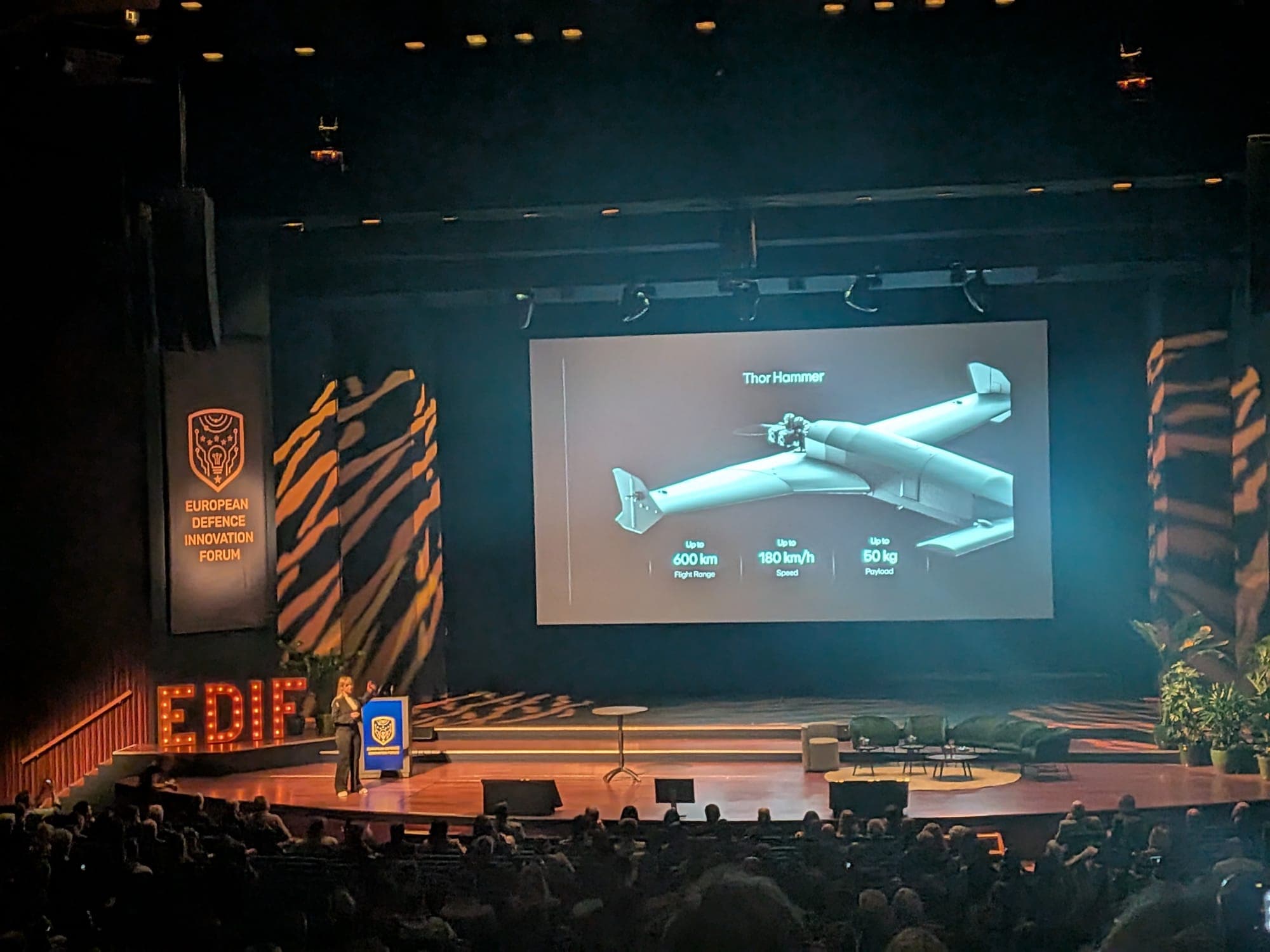
Interceptor drones and flying evacuation capsules; Ukraine and the Netherlands are working on groundbreaking technology that saves lives on the battlefield. But as the war continues, an urgent warning is coming from The Hague: Europe must innovate even faster. Because on the front lines, every delay can cost lives. It is an urgent message that took center stage during the second edition of the European Defense Innovation Forum (EDIF).
The event, organized by the Ukrainian Embassy in the Netherlands, aims to accelerate European defense innovation. The message is clear: cooperation between Ukraine and the Netherlands is growing ever closer, but Europe must pick up the pace significantly. In doing so, it can learn a great deal from Ukraine, which—under the pressure of war—is rapidly developing and deploying new technologies.
Defense Minister Dilan Yeşilgöz emphasized in her speech: “The need to survive brings out something extraordinary in people. It forces you to innovate—and at a completely different pace. Someone might lock up their office at five o’clock and go home. But when you’re under pressure to survive, you keep innovating. That puts you miles ahead of the rest of the world.”
Meanwhile, the Netherlands is indeed working ever more closely with Ukraine, she notes. Last month, for example, hundreds of Dutch military personnel had the opportunity to learn from their Ukrainian colleagues during a workshop. There are also opportunities for Dutch companies to exchange knowledge and technology with the Ukrainian defense industry. A concrete example is the Amsterdam-based technology company Intelic. It developed software that allows Ukrainian military personnel to control various drone systems from a single platform. Intelic now has an office in Kyiv and works directly with Ukrainian drone manufacturers and military units.
The Netherlands can respond at lightning speed
Bohdan Diorditsa of the Ukrainian company VYRIY Industries also emphasized that rapid innovation is of vital importance. The company develops and manufactures unmanned systems for the Ukrainian armed forces, including attack drones and reconnaissance drones.
During his speech, he referred to a moment when the Netherlands was able to adapt at lightning speed: the 1953 North Sea Flood, in which thousands of people lost their lives. When regular communication networks failed, Dutch amateur radio operators stepped in. Using homemade transmitters, they maintained contact between isolated areas and the rest of the country for ten days. According to the speaker, there is an important lesson to be learned from this. Slow decision-making is not an option. Drones and other systems can change within a matter of weeks. That is why he called on European companies to be available in the evenings, on weekends, and on holidays. In times of war, a delayed response can cost lives.
He concluded his keynote with a word of thanks to the Netherlands. While the pace of innovation does need to pick up, Dutch technology has already proven to be of great value on the front lines.
Flying evacuation capsule
The focus was not only on faster innovation but, above all, on the life-saving technology itself. Olena Dushenok, Head of Growth at SkyFall, took the stage. She spoke about the StarGate, one of the innovations from the Ukrainian defense manufacturer. This is an unmanned flying evacuation capsule capable of retrieving wounded soldiers from the battlefield. The drone has six propellers and a medical cabin equipped with a stretcher. With a maximum payload of 150 kilograms and a range of 15 kilometers one way, it can evacuate the wounded from areas inaccessible to ground vehicles. “Before I stepped onto the stage, my team told me that we had rescued the sixth person with our StarGate last night,” said Dushenok.
Many more innovations
There was also plenty to discover on the exhibition floor. For example, the Ukrainian company TAF Industries presented various drones, including the Kolibri-i10: an interceptor drone designed to shoot down enemy drones, such as Russian Shahed attack drones. Holland Turbine Factory (HTF) was also in attendance. The company, which specializes in precision engineering for aviation and heavy industry, showcased technology for gas turbine engines that can be used in drones, among other applications. This innovation is still in the development phase.
The Netherlands is developing its own missile
It wasn’t just about fancy words and demonstrations. Concrete partnerships were also forged during the event. For example, the Dutch companies Guardian Dynamics, Demcon, and Axient Systems, together with the research institute TNO, signed an agreement to develop WARDEN: a new, affordable air defense missile designed to take down drones and other threats.