
Offensys wins €50,000 at Brabant’s AI Pitch Competition
The cybersecurity startup took the grand prize at AI Summit Brainport with a pitch for continuously testing companies’ digital defences.
Published on November 12, 2026
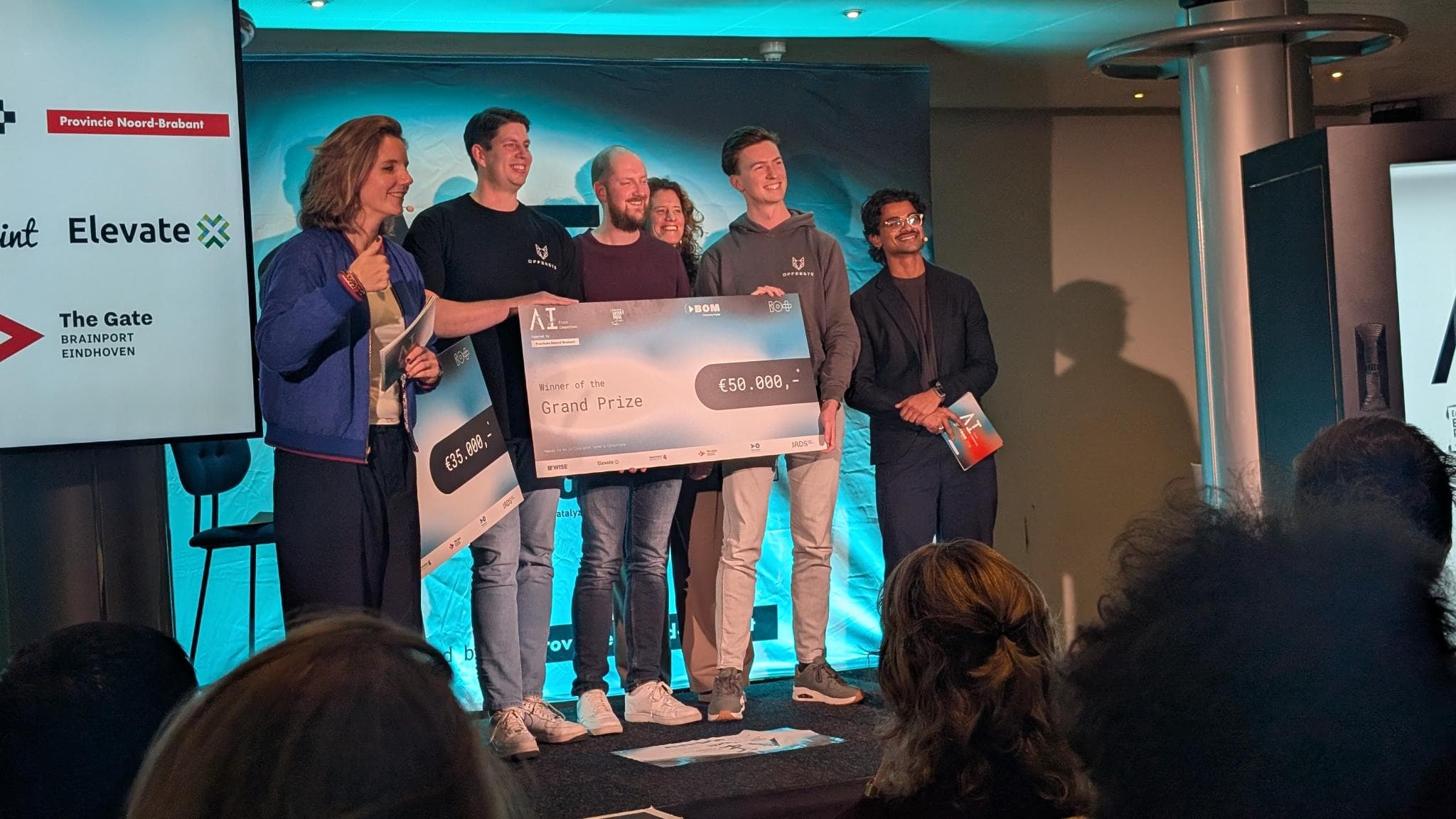
The Offensys team on stage at the Evoluon in Eindhoven after receiving the €50,000 grand prize at the 2026 AI Pitch Competition.
Bart, co-founder of Media52 and Professor of Journalism oversees IO+, events, and Laio. A journalist at heart, he keeps writing as many stories as possible.
A company can spend millions on cybersecurity and still have to guess how its defences will respond to the next attack. IT teams add systems and update software all the time, while security assessments typically capture a single moment. Offensys made that gap the centre of its pitch on Thursday, 12 November, and took home the €50,000 grand prize at the AI Pitch Competition final at Eindhoven’s Evoluon.
Kyvvu took second prize and €35,000 for its work on securing AI agents. Synthgen placed third, winning €25,000 for its approach to training visual inspection systems.
Offensys co-founder Cor Verhoeven pitched a platform that lets companies run controlled simulations in their own IT environments. The idea is to give security teams a clear view of what their tools block, what they flag, and what slips through. “This gives us evidence to start improving their security posture,” Verhoeven told the audience. After making a change, teams can repeat a test to see whether the fix works.
A security test that can keep up with changes
A security check can give a team confidence in the systems it tested that day. By the time the next check comes around, a company may have added a service, changed a configuration or updated a piece of software. Verhoeven argued that the resulting uncertainty persists even at companies with skilled staff and extensive monitoring.
Offensys offers its platform as a hosted service or for installation on a customer’s own infrastructure. In the pitch, Verhoeven described AI as a way to keep the tests relevant as threats evolve. The company is working on using information about a customer’s organisation and sector to help prioritise which scenarios its security team should test. For a team with limited time, that means being able to focus on the threats most relevant to its own systems and check whether its improvements hold up.
Kyvvu and Synthgen round out the top three
Kyvvu is building a security layer that checks what an AI agent is about to do against rules set by the organisation using it. The software takes previous actions into account, so it can flag a risky sequence even when each step would be allowed on its own.
Synthgen tackles a problem in automated visual inspection. Some of the defects a system needs to spot, such as cracks in welds, are too rare to provide many training examples. The startup generates labelled images of those defects. The test is whether those extra examples help inspection systems spot flaws in real images.
Nine finalists and a workshop in Tilburg
The final at AI Summit Brainport capped the third edition of the competition, an initiative of the Province of North Brabant co-organised by the Brabant Development Agency (BOM), Erasmus Enterprise and IO+. Eight startups were selected for the final, with Alzheimer.app joining as a wildcard. The field ranged from UNSEQ, which is developing robots to handle baggage in aircraft holds, to YourNeuroTune, which generates background music for businesses. Read IO+’s profiles of all nine finalists.
In the run-up to the final, the teams went through pitch coaching. At a workshop at the Koning Willem II Stadium in Tilburg, they had 30 seconds to explain what their company did and why anyone should care. Coaches pushed them to identify the problem their product solves and explain why a customer would pay for it. The programme also brought founders into contact with potential investors and partners.
Opening the final, North Brabant provincial executive Martijn van Gruijthuijsen pointed to the competition’s role in attracting startups to the region and finding applications for AI in areas with pressing social needs. His advice to founders was to stay curious as they grew. “Be curious, make mistakes, learn from that,” he told the finalists.