
Why timing is sometimes more important than perfection
In a series of blog posts, Marco Coolen offers a glimpse into his work as a Dutch and European patent attorney at AOMB.
Published on August 30, 2026

Marco, a patent attorney at AOMB since 2013, shares his expertise on IO+ about patents—how they work, why they matter, and when they lose their value.
Two inventors. The same invention. The same day. It sounds like the beginning of a bad joke, but it really happened.
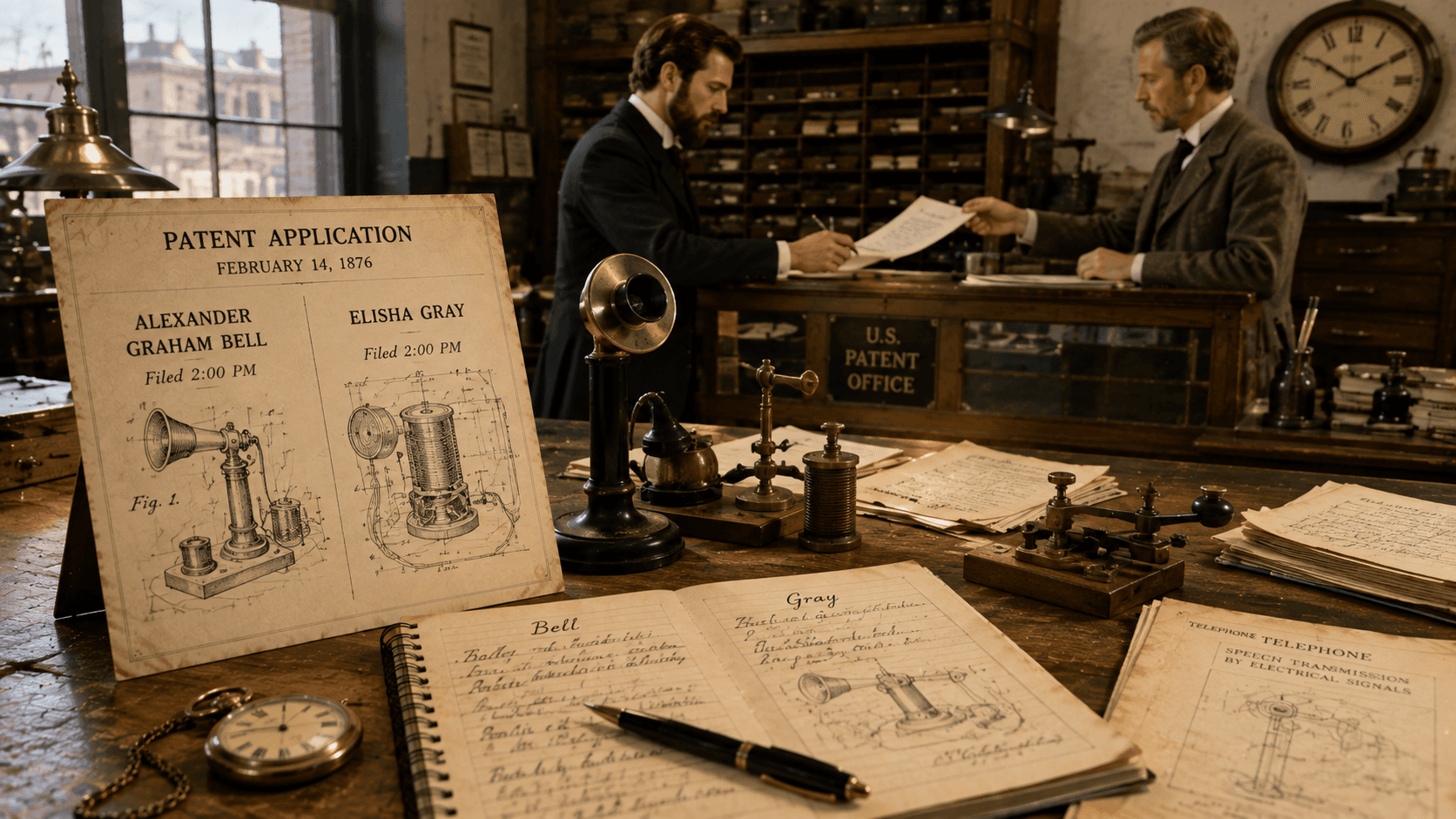
On February 14, 1876, Alexander Graham Bell and Elisha Gray independently filed patent applications for a technology that would allow speech to be transmitted via electricity. What we now know as the telephone.

Marco Coolen, photo © Bart van Overbeeke
Both men were working on the same problem. Both saw the same opportunity. And both were convinced they were the first. Yet today, virtually all of us know the name Bell. For most people, Gray is a footnote in history.
How is that possible?
Because timing is sometimes everything. In the nineteenth century, the U.S. patent system operated differently than it does today. It wasn’t just the content of an application that mattered, but also the moment it was filed. With competing inventions, hours or even minutes could make all the difference. Whoever filed first often had a huge head start.
Bell won that race. And with it, he not only secured a patent but also something far more valuable: a place in the history books.
The Myth of the Perfect Invention
Many entrepreneurs believe that filing a patent application only makes sense once an invention is completely finished. The prototype must be perfect. All teething problems must be ironed out. The final details must be worked out first. That sounds logical, but it’s often exactly the wrong strategy.
Innovation rarely develops in a straight line. While you’re waiting for perfection, competitors are working on the same market, the same technology, or perhaps even the same problem. The story of Bell and Gray shows that the difference between winning and losing can sometimes be surprisingly small.
Protecting and Improving
Filing a patent application doesn’t mean your development stops. On the contrary. Many successful innovations are protected while they are still in full development. The patent captures the essence of the invention, while the product is further refined afterward.
That is exactly why the patent system exists. It gives entrepreneurs the opportunity to secure their position without first having to wait years until everything is fully developed. Those who wait too long run the risk that someone else will claim the same idea first.
How It Works Today
These days, the system has changed in one key respect. When two parties file applications on the same day, the exact time of filing within that day no longer plays a decisive role in many jurisdictions. Both applications are assessed separately based on their content and legal standing.
But that doesn’t mean speed has become less important. On the contrary.
It’s still true that the first application often sets the tone. Those who secure protection early create room to further develop their product, attract investors, and enter the market without having to constantly look over their shoulder.
The real lesson
Entrepreneurs sometimes lose months by waiting for the perfect moment. A perfect prototype. A perfect presentation. A perfect business case. But innovation rarely rewards perfection. Innovation rewards action.
Bell didn’t become famous because his telephone was immediately perfect. He became famous because he acted at the right moment. The history of the telephone therefore teaches us a simple lesson. Don’t wait until your invention is perfect. Make sure you’re on time. Because in innovation, “better” is often important. But “sooner” is sometimes decisive.
The World of Patents
With the help of Dutch and European patent attorney Marco Coolen (AOMB), we can better understand the world of patents. How do they work, why are they important, and when do they lose their usefulness?