
Why the paperclip is a masterpiece of innovation
In a series of blog posts, Marco Coolen offers a glimpse into his work as a Dutch and European patent attorney at AOMB.
Published on July 26, 2026

Marco, a patent attorney at AOMB since 2013, shares his expertise on IO+ about patents—how they work, why they matter, and when they lose their value.
The paperclip is perhaps the most underrated design in the office. A piece of bent wire. That’s all. Or so it seems.
Just like the BIC pen, which I wrote about earlier, the paperclip’s greatest achievement is that it looks as if nothing has ever changed about it. That’s precisely why we forget how much thought, engineering, and refinement went into it.
The first paperclips from the nineteenth century were, in fact, anything but perfect. They did their job, but not particularly well. Some lacked sufficient tension, causing documents to come loose easily. Others quickly bent out of shape or damaged the very paper they were meant to protect.
Functional? Yes. Reliable? Not really.

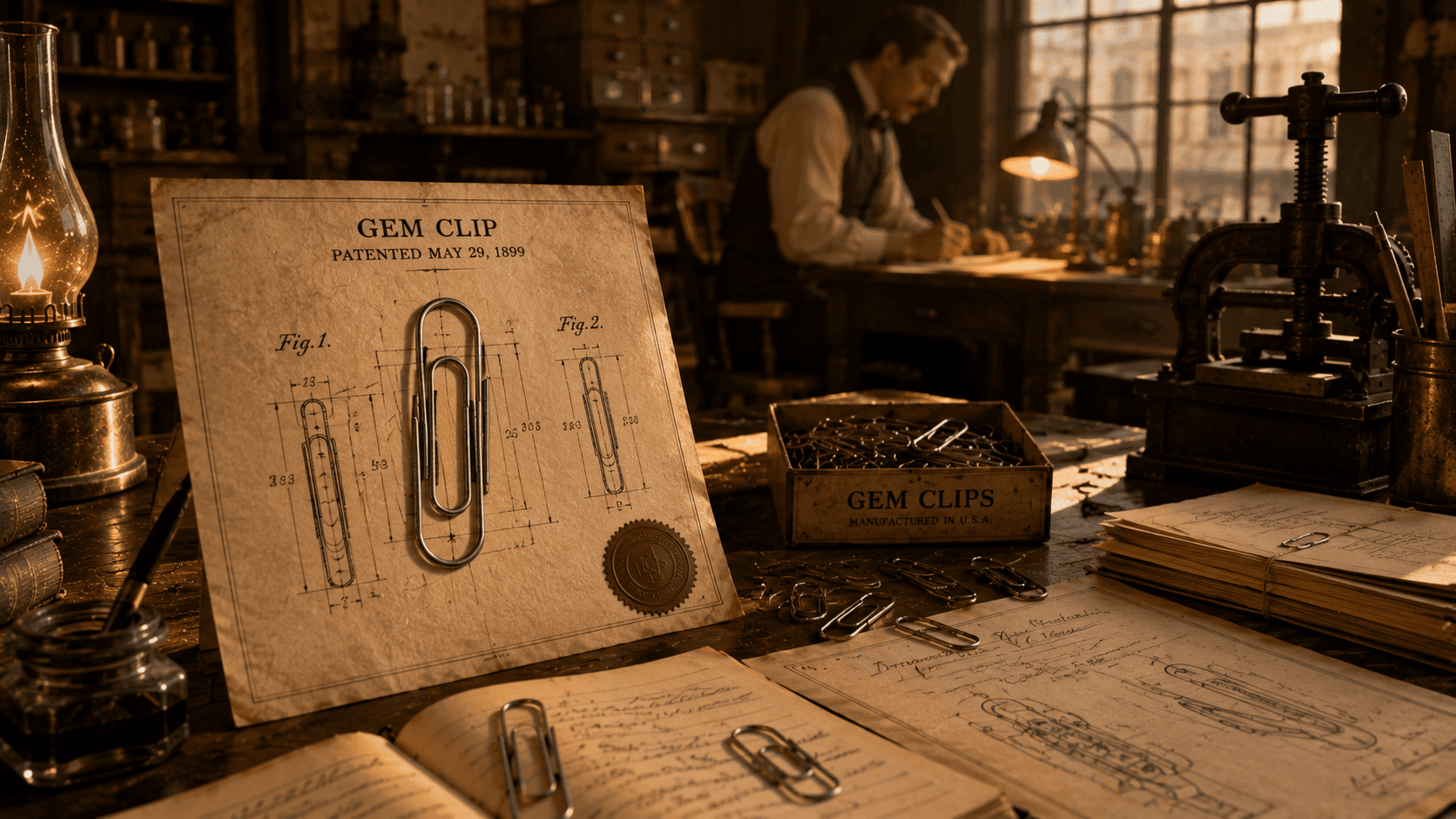
That changed around 1899 with the introduction of the so-called Gem-clip. No revolutionary technology, no spectacular breakthrough. Just a design that was remarkably well-engineered. Two loops, a clever distribution of tension, and just enough springiness to hold paper securely without damaging it.
The strength of the Gem-clip lay not in complexity, but in balance. And that is often a sign of good design. From that point on, major changes faded into the background. But that doesn’t mean innovation stopped. On the contrary.
As with many successful products, progress was mainly evident in a long series of small improvements. Better steel production ensured that the wire thickness became more consistent. As a result, every paperclip had virtually the same clamping force. Later, coatings were introduced to prevent rust, ensuring that clips lasted longer and continued to function smoothly.
In the decades that followed, the dimensions of the loops were subtly adjusted. Barely visible to the naked eye, but enough to reduce deformation and improve grip. Attention then shifted to more efficient production processes, material usage, and recyclability.
None of those improvements made the front page. No one stood in line for the latest generation of paperclips. But together, they did make the product better.
You see this often with successful innovations. We tend to associate innovation with something completely new: a groundbreaking technology, a revolutionary product, or a spectacular invention.
In reality, a large part of innovation consists of refinement—hundreds of small improvements that are barely noticeable individually but make a big difference collectively. That’s exactly why the paperclip is so interesting. From a distance, it seems as though nothing has changed for over a century. The shape has remained recognizable. Its use is the same. The product still does what it’s always done.
But every paperclip that rolls off the production line today is better than its predecessors. Stronger. More consistent. More durable. Produced more cost-effectively. And that is perhaps the most important lesson for entrepreneurs. Not every innovation has to look like a revolution. Sometimes the greatest achievement is precisely that no one notices how much has changed.
Because when something works so well that people forget it was ever any different, you’ve probably created one of the best innovations imaginable.

The World of Patents
With the help of Dutch and European patent attorney Marco Coolen (AOMB), we can better understand the world of patents. How do they work, why are they important, and when do they lose their usefulness?