
Why patent language is never random
In a series of blog posts, Marco Coolen offers a glimpse into his work as a Dutch and European patent attorney at AOMB.
Published on July 19, 2026

Marco, a patent attorney at AOMB since 2013, shares his expertise on IO+ about patents—how they work, why they matter, and when they lose their value.
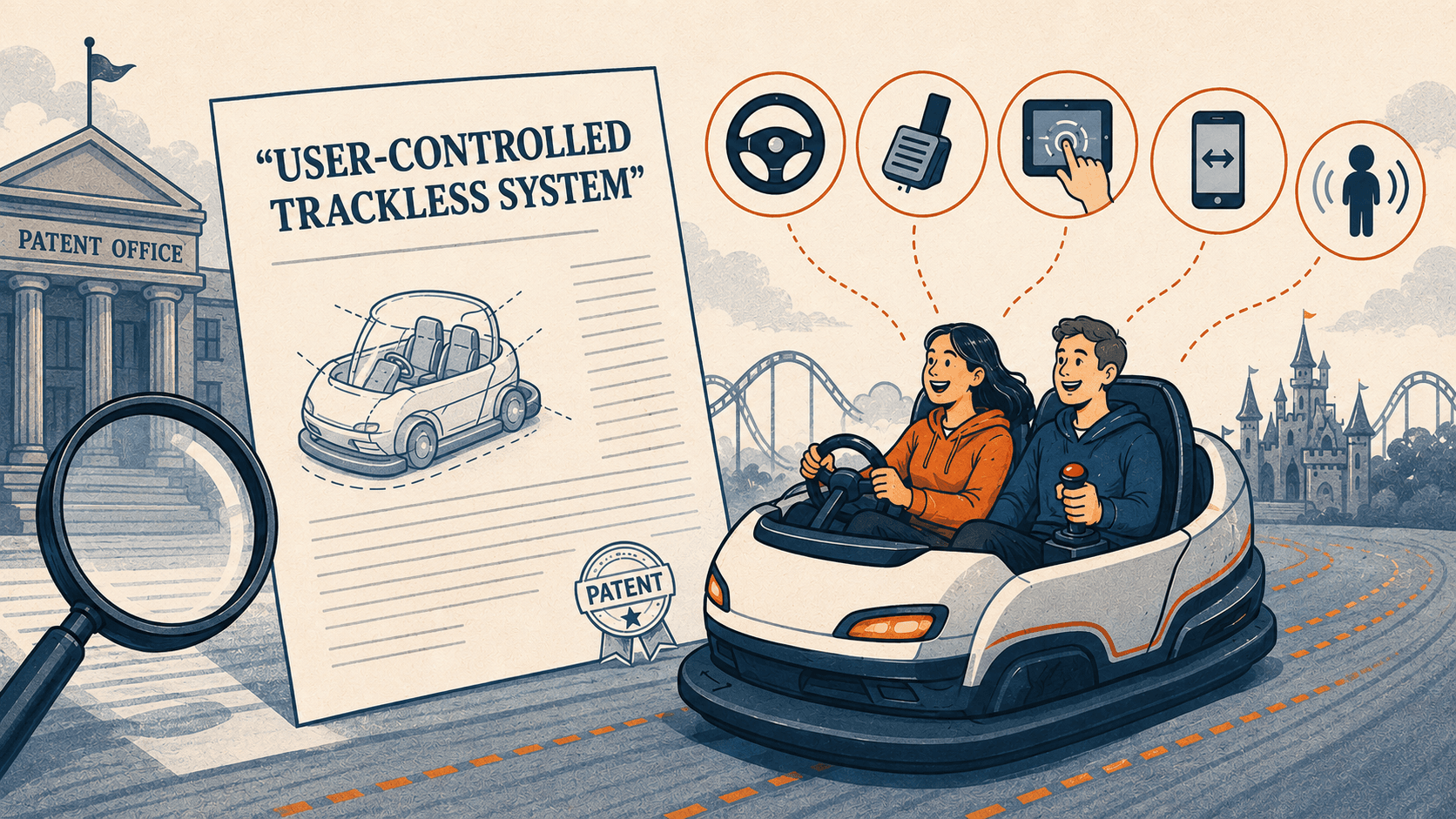
A patent’s name is rarely a coincidence. And certainly not at Disney. In a recent patent application for a new attraction, the term “user-controlled trackless system” appears. At first glance, that sounds like a dry technical description—something an engineer came up with simply because it had to be named somehow.
But that’s not the case. This is strategy.

Disney could just as easily have written: a vehicle with a steering wheel. Or an attraction with a joystick. Or a system where visitors use buttons to influence the ride. That sounds concrete, recognizable, and clear. But that’s exactly why they don’t do it.
By referring to “user-controlled”, they detach the invention from its form. It doesn’t matter how the user exercises control. It could be with a steering wheel, a pedal, a touchscreen, a phone, or a sensor that detects movement. As long as the user has influence over the system, it remains within the scope of the patent application.
So that single word doesn’t narrow the patent—it actually broadens it. And that’s exactly what you want.
Many entrepreneurs describe their invention as if they were writing a manual. They explain what they envision, where each component is located, and how the current prototype works. That’s understandable, because that’s how you talk about a product internally. But in a patent, that level of specificity can work against you.
If you say something is controlled by a joystick, a competitor might switch to a touchscreen. If you say a vehicle runs on rails, someone could develop a rail-free system. If you say a sensor is located at point A, someone else might place it at point B.
That’s why patent language isn’t just about describing what currently exists. It’s about capturing what the invention actually does.
So Disney isn’t simply protecting an attraction here. They’re protecting the principle: a system in which users can influence their route within controlled limits, without the vehicle being tethered to a traditional track. Today, that might be a Cars attraction. Tomorrow, it could be an entirely different experience, with different vehicles, different controls, and a different world surrounding it.
The wording defines the scope of the playing field. That’s also why patents are often so difficult to read. They use words that sometimes seem vague, but that vagueness is usually not a matter of carelessness. It’s a deliberate attempt to leave room for variations that haven’t been built yet but are based on the same idea.
A good patent protects more than just the prototype. It protects the idea behind it. And that is precisely why drafting it is a craft. A single word that’s too specific can later open the door to competitors. A single well-chosen abstract concept, on the other hand, can provide years of protection.
At Disney, they know this better than anyone. In a patent, language isn’t just packaging. Language is the attraction.

The World of Patents
With the help of Dutch and European patent attorney Marco Coolen (AOMB), we can better understand the world of patents. How do they work, why are they important, and when do they lose their usefulness?