
Verkor sparks new hope for a European battery ecosystem
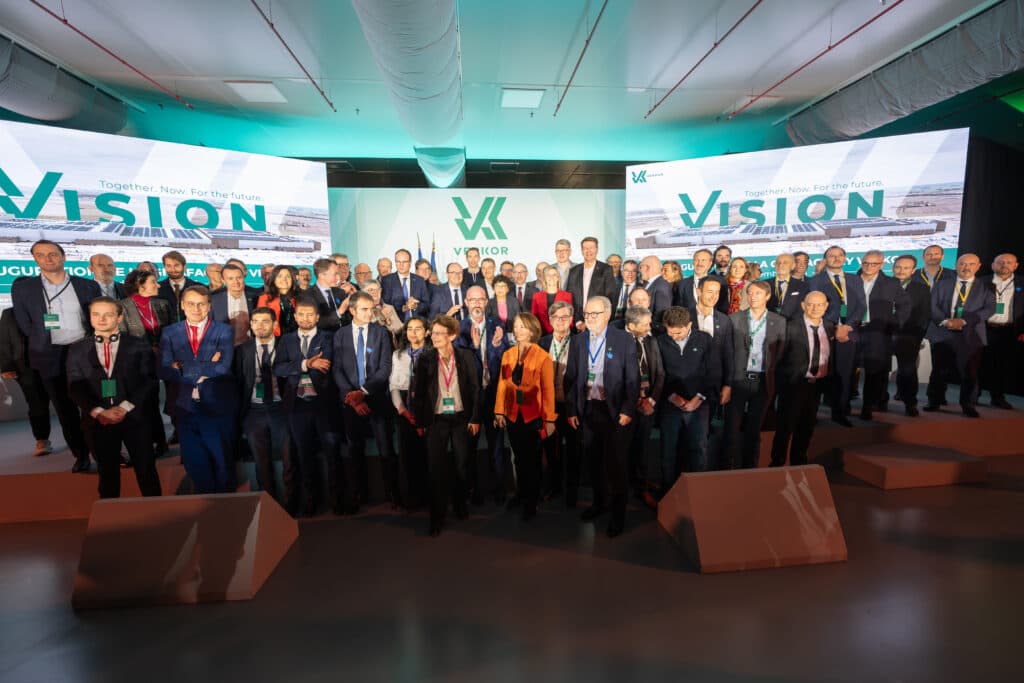
French startup Vektor opened its gigafactory, offering new hope for establishing a robust European battery ecosystem.
Published on December 15, 2025
© Verkor

Mauro swapped Sardinia for Eindhoven and has been an IO+ editor for 3 years. As a GREEN+ expert, he covers the energy transition with data-driven stories.
Vektor, a French company developing lithium-ion battery technology, opened its first gigafactory in Bourbourg, Dunkerque, north of France. It is a significant milestone for the company, founded in 2020, which has secured backing from the Paris government and automaker Renault along the way.
The plant will initially produce 16 GWh of battery capacity per year—enough to power around 270,000 electric cars—and plans to reach 50 GWh of production capacity by 2030. The first batteries will be commercialized next year and will be integrated into the Alpine A390 model. Alpine is a subsidiary of Renault.
The factory contributes to an already thriving ecosystem in the Hauts-de-France region. In late 2024, Automotive Cells Company began production at a plant in Douvrin. Last July, the Chinese-Japanese venture AESC (Automotive Energy Supply Corporation) started operations at a plant in Douai. By 2030, the plants combined will reach 150 GW/h production capacity, setting itself as Europe’s battery valley.
Vektor’s rise as Europe’s leading homegrown battery producer
A robust battery supply chain is key to Europe's future. At the moment, EV battery production is dominated by China, which produces three-quarters of all batteries sold globally. The two Chinese brands CATL and BYD retain the largest market share. According to EV Volumes, in 2023, the two accounted for more than half of global battery production.
Benoit Lemaignan, CEO of Verkor, stated: “This project embodies Europe’s energy transition and the industrialization in France and Europe of the key technologies that make it possible. It demonstrates that decarbonization and value creation in our territories can go hand in hand. Driven by strong political ambition, this milestone symbolizes Verkor’s transition into a European industrial company and opens the way for the imminent delivery of our batteries.”
In five years, the French organization secured €3 billion to support the creation of the plant in Dunkerque and of an innovation center in Grenoble, where the company originated. Days before the gigafactory opening, Vektor announced it had secured a 12-year contract with French utility company EDF to supply nuclear-generated electricity.
A new hope for Europe
Therefore, Verkor’s rise gives new hope for the European battery ecosystem, which in 2025 saw the fall of what was considered its only hope in the global race for electric vehicles (EV) battery production, Northvolt. Despite having raised $15 billion, more than any other European startup, the Swedish company went bankrupt in March.
The company, pressured by high expectations, was trying to accomplish three goals simultaneously: establish production at its sole plant, meet demand, and build new plants. Northvolt had secured important offtake agreements with Volkswagen, Scania, and BMW. The latter, months before the bankruptcy announcement, canceled a €2 billion contract amid a slow ramp-up in production.
In August, the American battery firm Lyten acquired Northvolt’s assets, including the manufacturing plant in Skellefteå, Sweden, and its energy storage business in Poland. The US company, backed by carmaker group Stellantis and FedEx, plans to restart production in 2026.
Uncertainty from policymakers
As Europe works to build its own battery supply chain, lawmakers are adding uncertainty. On Friday, the European People’s Party (EPP), led by Commission President Ursula von der Leyen, announced a review of the 2035 combustion engine ban.
The law, passed in 2023, allows only zero-emission vehicles starting in 2035. However, pressure from Germany and Italy for revisions—including e-fuels and biofuels—has grown. In March, the Commission also softened emission targets, giving automakers until 2027 to comply.
The EV industry warns that such changes would leave the EU further behind China, which leads both in battery production and EV brands like BYD. Last week, E-Mobility Europe and ChargeUp Europe, supported by Polestar and Volvo, urged the Commission to maintain its zero-emissions goal despite industry lobbying, reported Reuters.
Meanwhile, Verkor is trying to translate ambition into action. The new plant marks a critical step toward establishing a robust domestic battery supply chain, supporting both decarbonization and industrial growth. As China continues to dominate global production, Verkor’s trajectory positions Europe to reclaim a foothold in the EV battery race.