
To fly without kerosene, we need charging networks at the runway
"The Netherlands should not wait until electric aircraft are parked at the gate, but start preparing airports as quickly as possible."
Published on March 29, 2026
Dr. ir. Nando van Arnhem, Vaeridion's Head of Flight Physics © Nadia ten Wolde

Maarten Steinbuch is a high-tech systems scientist, entrepreneur and communicator. He holds the chair of Systems & Control at Eindhoven University of Technology, where he is Distinguished University Professor. His research spans from automotive engineering to mechatronics, motion control, and fusion plasma control.
Commercial electric aviation could become reality within just a few years. The Netherlands was quick to adopt electric driving, thanks in part to the rapid rollout of a nationwide charging network. Let’s repeat that success and start preparing our airports now, writes Professor Maarten Steinbuch.
In a brand-new production hangar at Oberpfaffenhofen Airport, the Dutch-German electric aircraft manufacturer Vaeridion recently opened its first production site and battery testing facility. The promise it made there was striking: within two years, its fully battery-electric aircraft will take to the skies from that very hangar.
Vaeridion showcased a mock-up of the cockpit and cabin of its Microliner: a nine-seater with a practical range of 400 kilometers. The new battery testing facility will be used to develop sixty battery packs, together delivering 600 kilowatt-hours, mounted on the aircraft’s wings. Alongside those batteries stood a megawatt charger in the hangar during the presentation. Not as decoration, but as infrastructure. As a statement: this aircraft will truly fly, carry passengers, and recharge.
The Vaeridion Microliner is designed for commercial aviation. It is expected to be fully certified and operational by 2030. That means that within four years, travelers could book a ticket for an electric flight, for example from Amsterdam to Hamburg, or from Eindhoven to London. Or connect quickly to more distant destinations. City-to-city electric flying as the backbone of a new European mobility system. Nine passengers, two pilots, 400 kilometers, without kerosene. Simply book, board, and fly.
© Vaeridion
Demonstration flights
And Vaeridion is not alone. The American company Beta Technologies will bring its Alia CX300 to the Netherlands at the end of May for demonstration flights from Schiphol Airport, Lelystad Airport, and Den Helder Airport. This five-seater aircraft has already been flying experimentally for some time, with a 225 kWh battery and a range of 500 kilometers. Consumers interested in electric flying will have their first options within four years. Meanwhile, the new Dutch cargo airline e-Smart Avia plans to operate freight flights using the Beta Alia CX300.
Different airport requirements
What these aircraft have in common is that they require fundamentally different airport infrastructure than what we are used to today. They don’t need kerosene pumps, but charging plazas. Not fuel trucks, but smart chargers. And of course battery storage, preferably combined with on-site electricity generation via solar panels or wind power.
Ground infrastructure at the airport must therefore evolve alongside aircraft in the air. And that is precisely where the urgency and opportunity for the Netherlands lie. Just as the country once led the world in standards for electric vehicle charging, it can now do the same for electric aviation.
Several locations in the Netherlands are already developing infrastructure for electric flight. At Teuge International Airport, fast chargers, a 500 kWh battery storage system, and rooftop solar panels are already in place. At Lelystad Airport, both aircraft and ground handling equipment can fast-charge near the control tower. Charging stations are also being installed at Den Helder Airport. Encouraging signs.
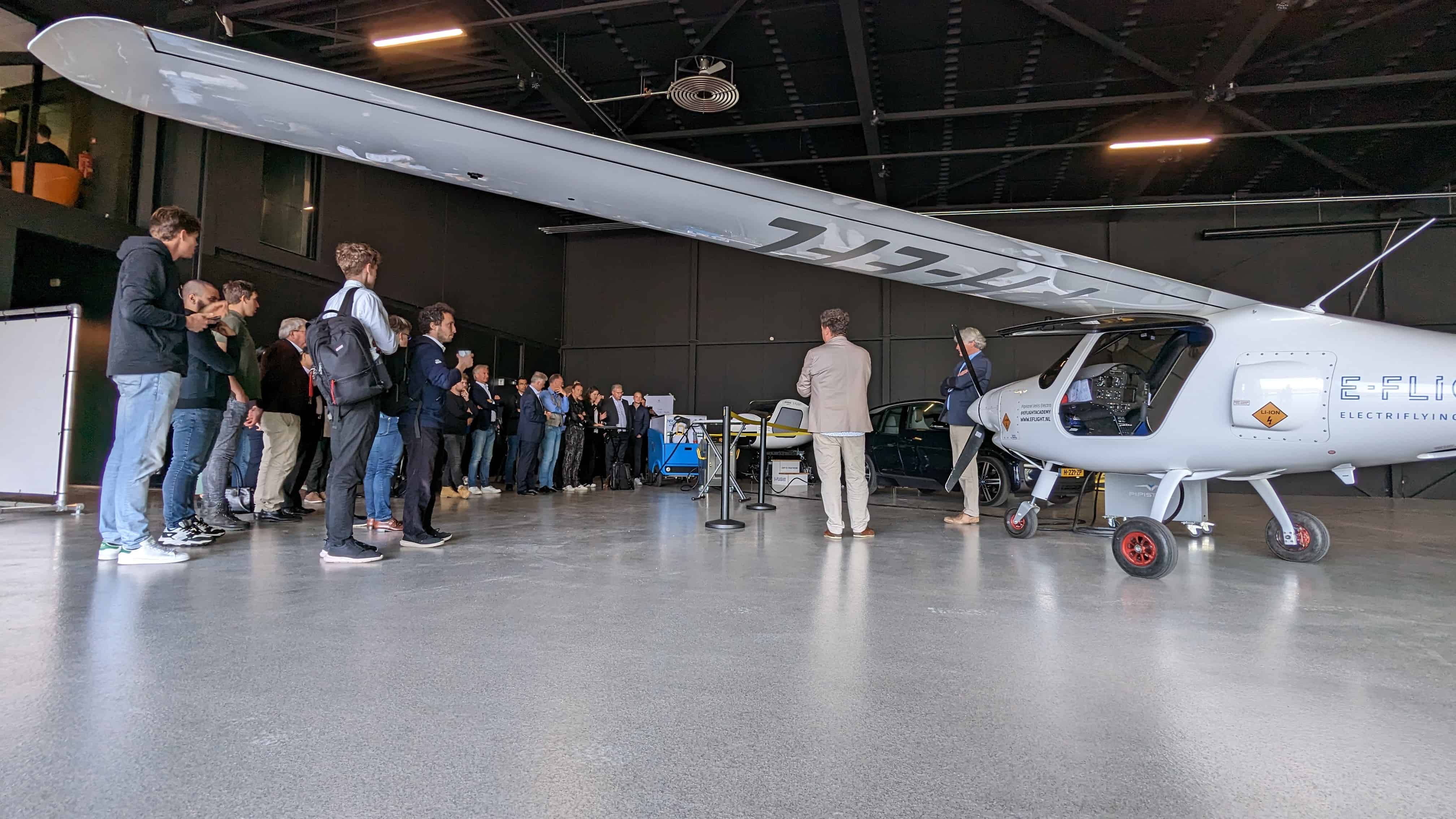
Electric flying: a sustainable solution for regional mobility within Europe
The entire sector around electric flying gathered in Teuge to discuss the next steps on the path to a successful and climate-friendly future.
A vast network
Europe has at least 2,000 airports suitable for regional flights. In principle, each could become a charging hub and energy node. Together, these airports form a vast, untapped mobility and energy network for point-to-point electric aviation.
Fifteen years ago, it wasn’t electric cars that were missing, it was charging stations along the highways. Fortunately, the Netherlands acted early. Protocols were established, charging networks were built, and expertise was exported. The global positions now held by companies such as ABB and Fastned are partly rooted in Dutch startup knowledge and proactive national policy. The same is now happening in commercial logistics: truck charging stations along major European highways, with the ElaadNL playing a key role in advancing the Megawatt Charging System (MCS) as a standard.
The Netherlands should therefore not wait until electric aircraft are parked at the gate, but start preparing airports as quickly as possible.
The Netherlands as frontrunner
An engineer always looks at what is possible, not just at what already exists. And what is possible is concrete: a European network of 2,000 airports, each acting as a hub for electric aviation, all connected through smart charging infrastructure with local energy generation and storage.
The runways are already there. The aircraft are coming. If we start now, the Netherlands can repeat its success story in charging infrastructure, but this time not along highways, but along runways. The technological, commercial, and strategic advantages of such a position are significant. We can start today.