
The IO+ week: What happens after the pilot?
Every Sunday, our weekly review offers an overview of the most interesting stories around important innovations.
Published on November 29, 2026
Bart, co-founder of Media52 and Professor of Journalism oversees IO+, events, and Laio. A journalist at heart, he keeps writing as many stories as possible.
All value starts with the ability to innovate, Lotte de Groen (TNO Vector) wrote in her op-ed this week. But she's worried about where we're now. “Our ability to generate prosperity depends on how quickly we innovate. That’s where we’re falling short now.”
You can set aside money for an extra nurse tomorrow. The ward will still be short a nurse if there’s nobody to hire. You can raise enough capital for a new production line and still have to wait for a connection to the electricity grid. Those examples from Lotte de Groen’s op-ed for IO+ stayed with me this week. I fully agree with her argument. If we want to keep good healthcare accessible and give businesses room to grow, we need to get much better at putting useful innovations to work.
At IO+, we cover plenty of promising pilots. I’m often just as curious about what happens six months later. Did the nurses who tested a remote monitoring app get any of their time back? Who pays to introduce it on another ward? De Groen, who leads TNO Vector, makes the case for involving the people who use, fund, and regulate a technology while its design can still change. A nurse can tell you early on which alerts are worth interrupting someone for. That’s a conversation worth having before the pilot starts.
I’d love to write more follow-up stories about an idea that worked in Enschede and is now part of everyday care in Groningen or Rotterdam. By then we can ask what changed for patients, how much time staff actually gained and what it took for another hospital to adopt it. And if a Dutch company can sell that same solution abroad because it has proved itself here, there’s your economic growth, too.
Read the whole op-ed here:
Enjoy your Sunday, but first take a look at some of the other highlights that we published this week.
Sustainability deserves a better pitch
In her column, Jazine ten Houten wonders why sustainability is so often sold as a list of things we have to give up. Better insulation can cut household bills, greener streets can cool cities in summer, and buying fewer things on impulse can leave money for things we actually enjoy. Her column asks what would change if businesses and governments put those everyday gains at the centre of the conversation. https://ioplus.nl/en/posts/the-poor-marketing-of-sustainability
A European scale-up’s IPO starts years before listing day
At TU Eindhoven, Euronext Amsterdam CEO René van Vlerken challenged the assumption that ambitious European tech companies should head to Wall Street. He pointed to higher listing costs and disappointing post-IPO returns for European firms that went public in the US. His argument starts long before the IPO. The investors who write the big growth cheques often shape where a company eventually lists. https://ioplus.nl/en/posts/debunking-the-wall-street-myth-firing-up-europe
Smart vehicles need roads and systems they can talk to
A self-driving truck in a port has to fit into a wider operation, from moving cargo to sharing information with the infrastructure around it. That takes agreement on who shares data, which standards everyone uses and who’s responsible when something goes wrong. It’s one of the questions on the agenda at Drive Forward in Helmond on 14 and 15 April 2027. https://ioplus.nl/en/posts/the-battle-for-mobility-is-about-the-system-not-the-vehicle
Europe wants to turn quantum research into industry
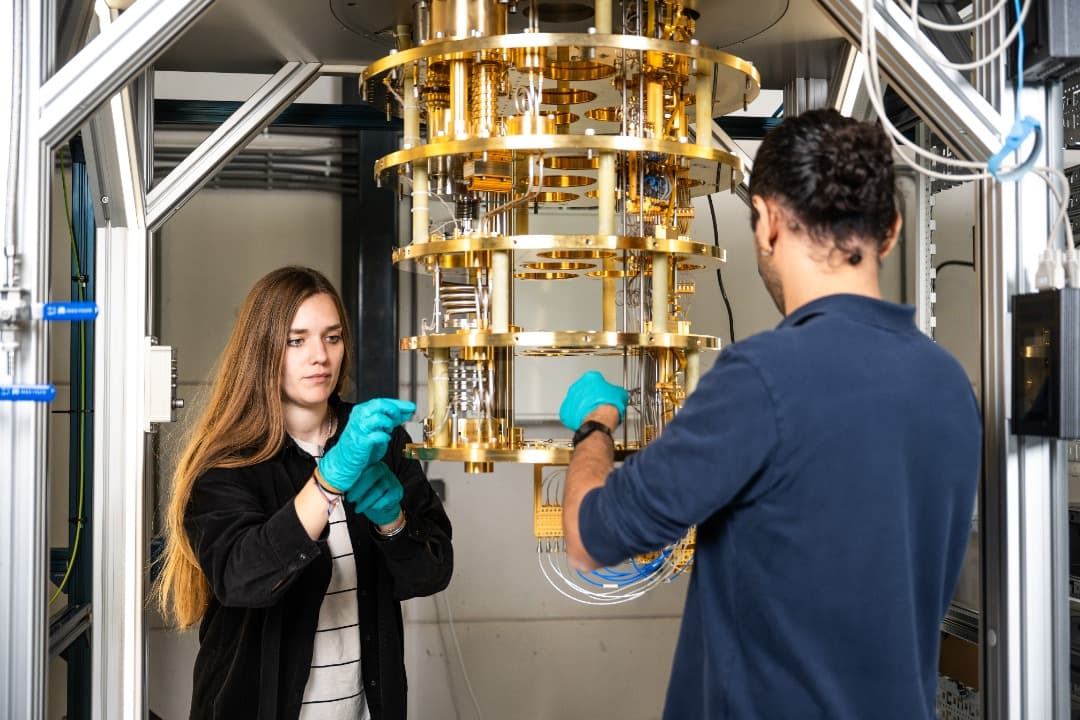
The European Commission’s proposed Quantum Act aims to turn Europe’s strength in quantum research into industrial capacity by 2030. The plan brings together research, investment and public procurement to help companies scale and reduce dependence on suppliers outside the EU. It also sets out a coordinated move towards encryption designed to withstand future quantum computers. https://ioplus.nl/en/posts/eu-quantum-act-europes-plan-to-lead-quantum-tech-by-2030
The Netherlands puts €150 million into technical training abroad
The Dutch government’s five-year Knowledge Empowers You programme will support technical education in seven partner countries, including India, Malaysia and Vietnam. Semiconductors are a priority. The money will go towards developing curricula and practical training, with local schools and businesses working together to give students skills employers need. https://ioplus.nl/en/posts/chip-talent-crunch-netherlands-bets-150m-on-global-south
How long could your organisation run without IT?
In a Dutch survey by Markteffect for IT provider Worldstream, 65% of organisations said a complete IT failure would bring operations to a standstill within four hours. Only a quarter had a fully functional alternative for critical IT processes if their infrastructure or cloud provider became unavailable. If your organisation has a continuity plan, when did you last test whether it works? https://ioplus.nl/en/posts/dutch-organisations-overestimate-their-digital-resilience
What would a hospital robot actually save?
At the TechMed Event in Twente, Islam Khalil asked what it would take for hospitals to treat ten times as many patients with the same staff. That thought experiment led to some practical questions about robotics. Can a robot take work off a nurse’s hands? And if it saves a few minutes at a time, can staff use those minutes to see more patients or improve their care? https://ioplus.nl/en/posts/can-robots-help-hospitals-treat-ten-times-more-patients
Cold fusion and the patent application that came too soon
In 1989, two scientists announced that they had achieved nuclear fusion at room temperature. Other researchers couldn’t convincingly reproduce the results. Patent attorney Marco Coolen returns to the episode for a lesson in timing. A patent application needs to explain the invention in enough detail for someone with the relevant expertise to carry it out. A promising result gives you a reason to investigate further. https://ioplus.nl/en/posts/cold-fusion-and-the-patent-application-that-came-too-soon
Rather listen?
Here's a small selection of last week's highlights in a half-hour podcast:
External Content
This content is from spotify. To protect your privacy, it'ts not loaded until you accept.
Our Other Newsletters
Thank you for reading this newsletter. But there’s more. Subscribing is easy — via the options on the IO+ homepage or simply by clicking one of the newsletters below:
- IO+ Daily (1,200 subscribers)
- Mauro’s Green Corner (monthly, 13,800 subscribers)
- Elcke’s Saturday Data Dive (monthly, 20,550 subscribers)
- Elcke en Mauro’s BIO+ Bites (monthly, 29,300 subscribers)
- Bart’s Saturday CHIPS (monthly, 16,300 subscribers)