
The innovation you do not see
In a series of blog posts, Marco Coolen gives an inside look into his work as a Dutch and European patent attorney at AOMB.
Published on April 26, 2026

Marco, a patent attorney at AOMB since 2013, shares his expertise on IO+ about patents—how they work, why they matter, and when they lose their value.
The BIC pen may well be the most underestimated product in the world. Always the same image: a transparent tube, a blue cap, and a tip that simply writes. It seems as if nothing has changed for decades.
But that image is completely wrong.
Behind that simple pen lies a long series of technical improvements. Not one spectacular invention, but a stack of small solutions that together have made it one of the most successful products ever.

Marco Coolen, photo © Bart van Overbeeke
The beginning
The basis of the ballpoint pen was laid by László Bíró. He wanted to make writing more reliable. No stains. No mess with ink. Simply a pen that does what it is supposed to do.
The initial idea was simple: a small ball in the tip that brings the ink onto the paper in a controlled way. BIC later adopted that idea and did something that is often more difficult than innovating: continuing to improve without recognizably changing the product.
Small steps, great effect
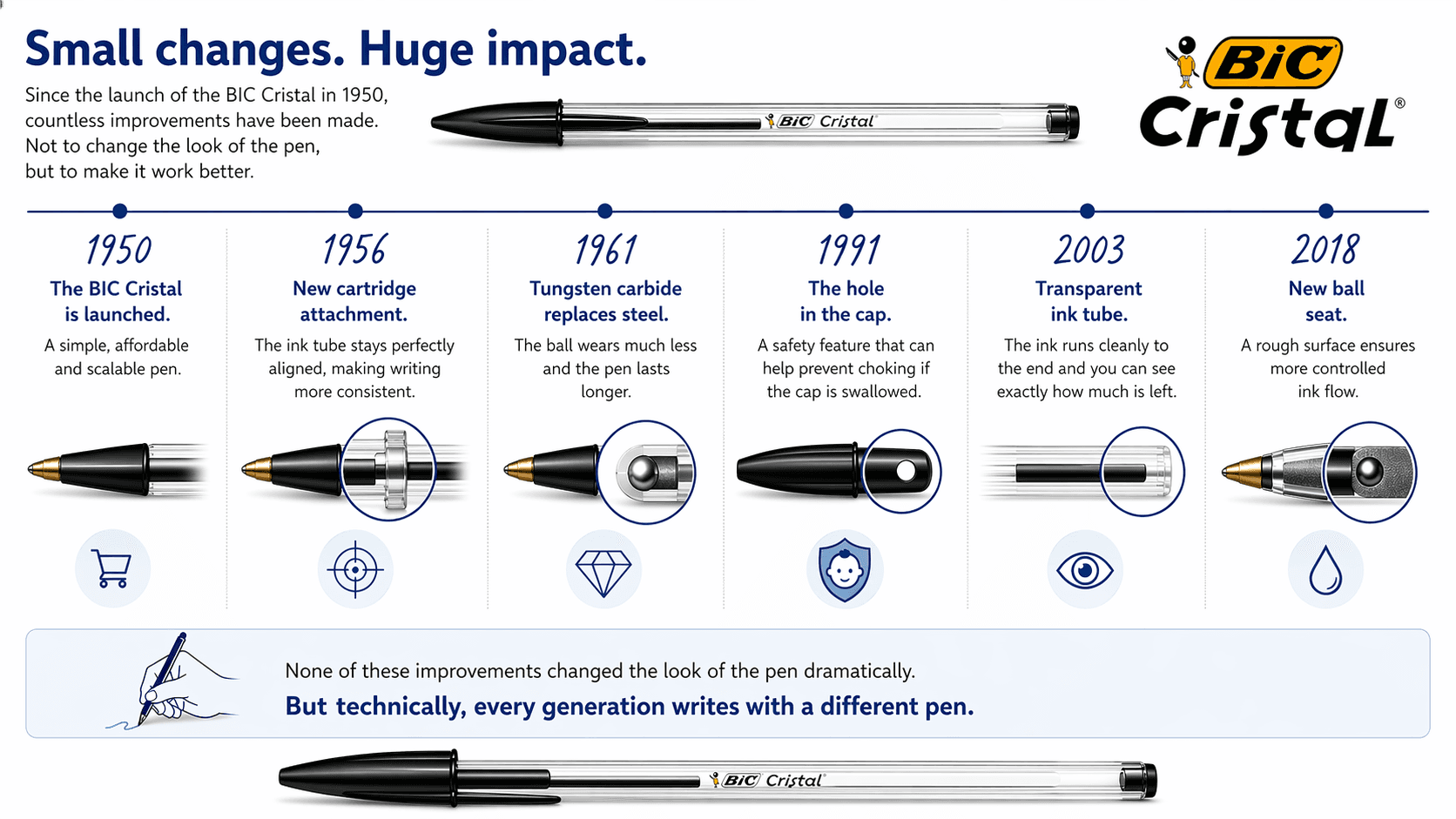
Since the launch of the BIC Cristal in 1950, countless adjustments have been made. Not to make the pen look different, but to make it work better.
A few examples:
1950 – The BIC Cristal appears.
A simple, inexpensive, and scalable pen.
1956 – New attachment of the cartridge.
The ink tube remains perfectly aligned, making writing more consistent.
1961 – Tungsten carbide replaces steel.
The ball wears down much less and the pen lasts longer.
1991 – The hole in the cap.
A safety measure that can prevent choking if someone swallows the cap.
2003 – Transparent ink tube.
The ink empties cleanly and you can see exactly how much is left.
2018 – New seat for the ball.
A rough surface ensures a more controlled ink flow.
None of these improvements drastically changed the appearance of the pen. But technically speaking, every generation writes with a different pen.
The power of invisible innovation
That may well be the most important lesson of the BIC pen: innovation does not always have to be visible. Sometimes progress lies in small improvements that users barely notice, but that make the product more reliable, safer, or cheaper.
For companies, that is often the most sustainable form of innovation. Instead of developing a completely new product every time, you build further on a proven foundation. Every improvement makes the system a little better.
Protecting what matters
Many of these kinds of small improvements are technical enough to be protected. A different choice of material, an improved construction, or a more precise operation.
On their own, those adjustments may seem small. But when they return in millions of products, they represent enormous value.
The real innovation
From a distance, it seems as if the BIC Cristal has remained the same for more than seventy years. But beneath the surface, almost everything changed.
That is innovation in its most elegant form: not loud, not spectacular, but consistently better. And perhaps that is the reason a simple pen became a worldwide icon.