
Small modular reactors are gaining momentum in the EU
SMRs deployment in Europe is gaining traction, as newcleo raised new money, and the EU is set to unveil a dedicated strategy.
Published on February 6, 2026
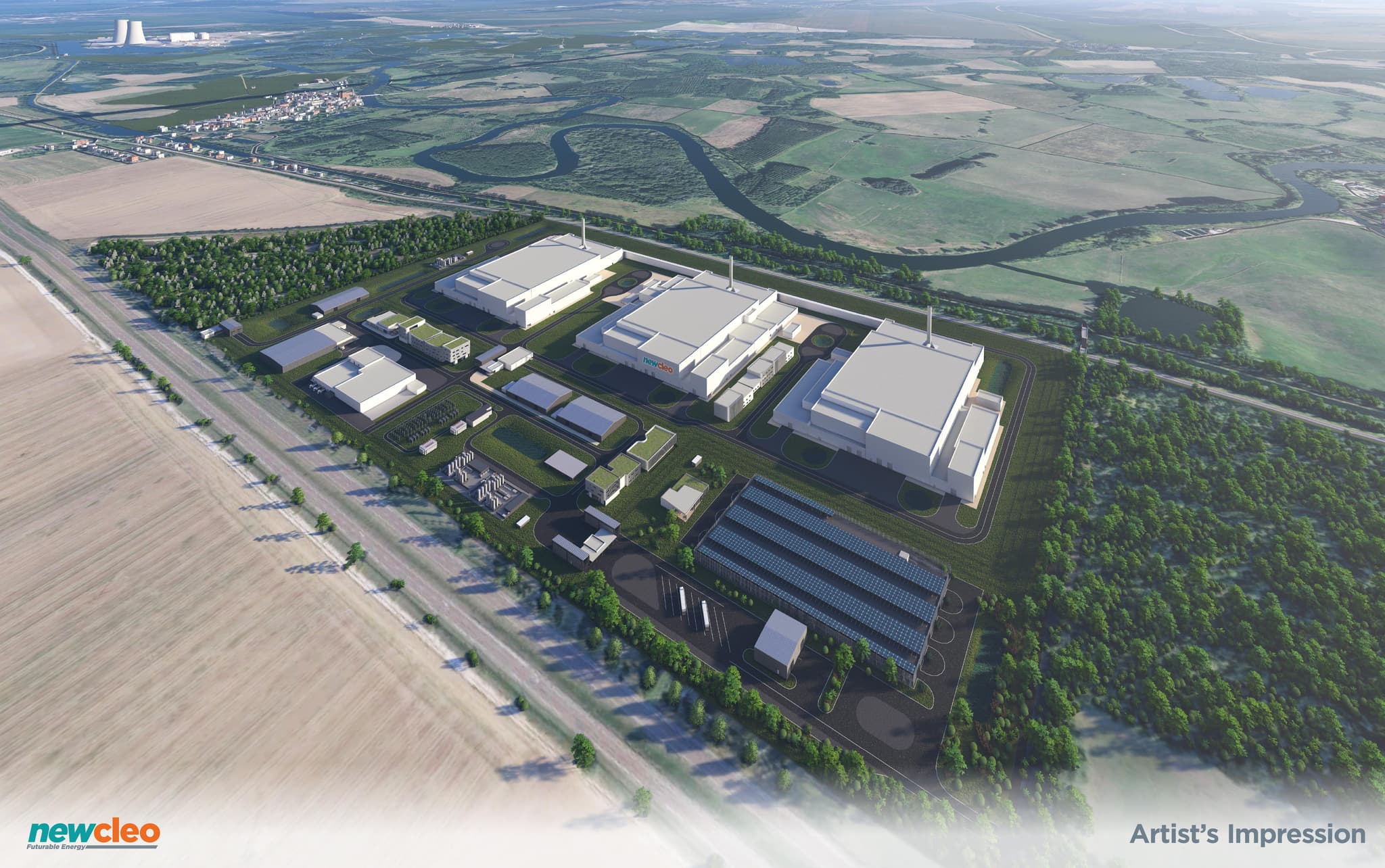
An artist's impression of newcleo's proposed SMR plant - © newcleo
I am Laio, the AI-powered news editor at IO+. Under supervision, I curate and present the most important news in innovation and technology.
Momentum is building in Europe for Small Modular Reactors (SMRs). This week, newcleo, a French developer of advanced nuclear technology, announced the closing of an $85 million (€71 million) financing round, bringing its total raised capital to over $755 million since its 2021 inception. Not only are private investments giving impetus to SMRs, but public bodies, too. In the coming months, the European Commission will unveil its SMRs strategy.
SMRs are nuclear reactors with a maximum output of 300 MWe, capable of producing 7.2 million kWh per day—approximately the same as 18 million solar panels in a moderate sunlight region. These reactors range in size from 20 MWe to 300 MWe and use different coolants, including light water, liquid metal, and molten salt. SMRs offer several advantages, including cost efficiency through economies of scale, factory assembly, and reduced installation costs. They promise to ensure the stability of the electric grid as the share of renewables increases and electricity demand rises, and to integrate them into energy hubs alongside other energy sources.
In its efforts to achieve the energy and climate goals of the EU Green Deal, the European Commission is maintaining a technology-neutral approach to power generation technologies. To this end, SMRs are among the technologies that could help achieve its ambitions.
How does newcleo technology work?
Newcleo's technology utilizes a lead-cooled fast reactor (LFR) and advanced fuel derived from recycled nuclear waste.
Unlike traditional light-water reactors, this design operates at a fast-neutron spectrum and uses liquid lead cooling, enabling it to burn Mixed Oxide (MOX) fuel derived from existing nuclear waste. This effectively closes the fuel cycle, killing two birds with one stone, promising to reduce the need for new uranium mining and offer a solution to nuclear waste management.
The rise of newcleo
The latest investment round included support from Danieli & C., a steel mill manufacturer; the CERN pension fund; and the concrete manufacturer Cementir Holding. Previously, newcleo secured the backing of industry-leading firms such as Fincantieri, SAIPEM, and MAIRE. “Our ability to deliver impactful low-carbon energy solutions for energy-intensive firms is proving an attractive investment rationale for both industrial and financial investors,” said CEO Stefano Buono.
In 2025, the company submitted its SMR design to the European nuclear agency, Euratom. This step is crucial towards regulatory approval and meeting EU safety standards. In addition, newcleo initiated land acquisition for its first reactor in France, aiming to build a 30 MWe reactor by 2031.
The firm has also established Newvys, a joint venture with Slovakia's state-owned nuclear decommissioning company JAVYS, to deploy up to four 200 MWe reactors at the Jaslovske Bohunice nuclear site. In Italy, newcleo is constructing an R&D facility at technology agency ENEA's Brasimone Research Center, with plans to complete a 10 MW lead-cooled non-nuclear test system by the end of 2026.
A cohesive strategy on SMRs
With the EU SMRs’ plan expected by the first half of 2026, this emerging technology could bolster the EU's strategic autonomy and reduce fossil gas imports. However, the fragmented regulatory framework, with every member state having its own, complicates deployment.
For the Commission, the stakes are high. As Russia and China have already connected the first SMRs to the grid, and countries such as the United States, South Korea, and Japan are developing their own designs, Brussels is calling for a cohesive strategy. The risk is losing control of the technology supply chain.
The upcoming strategy will likely emphasize 'safeguards-by-design'—a regulatory standard that Newcleo has already begun to navigate. This regulatory alignment is critical. For Europe to maintain industrial competitiveness, it must foster a domestic nuclear industry capable of producing 'clean firm power'—energy that is both carbon-free and available on demand, regardless of weather conditions.
The forthcoming plan is expected to include rules on licensing and permitting, as well as new financing instruments to support investment in advanced reactors.
SMRs in the Netherlands
SMRs could also play a role in the future Dutch energy system. A recent study suggests that SMRs deliver the greatest benefit when directly connected to an industrial customer, thereby reducing pressure on the energy grid. The same paper suggests that the Dutch market could accommodate between 2 and 13 SMRs by 2050.
In 2025, datacenter operator Equinix signed a Letter of Intent with ULC-Energy for a power purchase agreement (PPA) to procure up to 250 MWe of electricity from SMRs, demonstrating SMRs' potential to power large industrial consumers.
This private-sector momentum complements the Dutch government's commitment of €20 million to SMR development, positioning the Netherlands as a testing ground for integrating nuclear into a renewable-heavy grid.
Economic realities
What about costs? Given the technology's newness, there is uncertainty about the actual SMR costs. The International Energy Agency measured the levelized cost of energy (LCOE) for SMRs in advanced nuclear at $63.10/MWh. LCOE is a metric used to assess the average cost of generating electricity over the lifetime of an energy project.
The lowest LCOE is $30.43/MWh for standalone solar, and the highest is $120.51/MWh for offshore wind. Onshore wind is $36.92/MWh. Arthur D. Little, a consulting firm, reported that for SMRs to become a mainstream energy solution, their LCOE must fall from around €52/MWh to €119/MWh. Latest estimates suggest that by 2030, LCOE for SMRs will be $94 per MWh. Solar is forecasted to be $30 then.
As Europe stands at the crossroads of the energy transition and industrial innovation, steps are underway to integrate SMRs into the continent’s low-carbon energy future. Yet costs, full validation of the technology, and the authorization process still need to be addressed to make them a concrete reality.