
Quantum computing can’t do without MicroAlign’s tech
MicroAlign is working on technology to align optical fibers with extreme accuracy. Their tech is key to the future of quantum computing.
Published on March 30, 2026
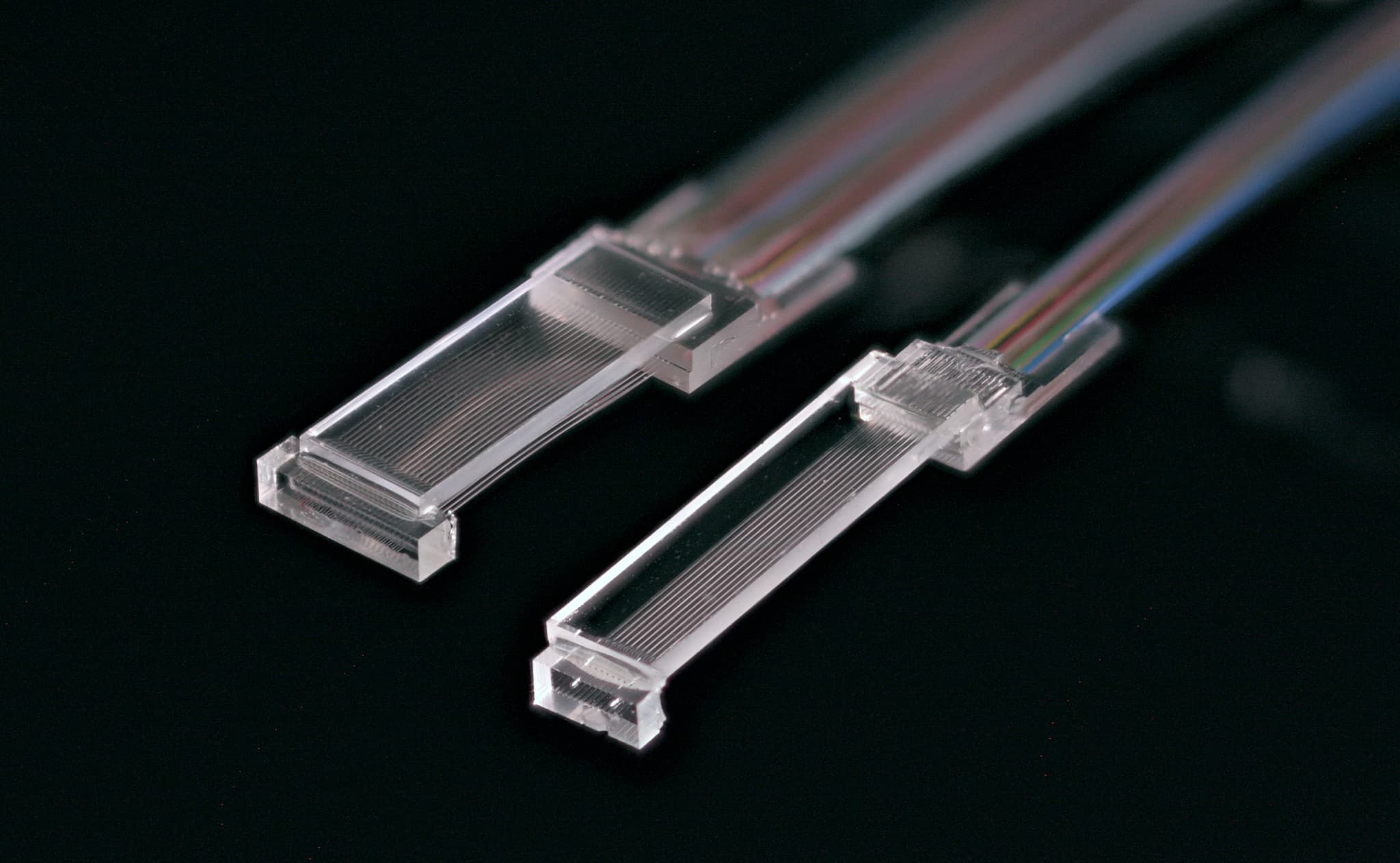
MicroAlign's fiber array - © MicroAlign

Mauro swapped Sardinia for Eindhoven and has been an IO+ editor for 3 years. As a GREEN+ expert, he covers the energy transition with data-driven stories.
A strand of human hair can be up to 100 micrometers (µm), as much as a standard optical fiber. Now, imagine positioning many of them close to each other with a precision 1000 times smaller than the size of a hair. That’s what MicroAlign, an Eindhoven-based photonics startup, does daily. They are working on a problem unknown to many, yet that underpins some of the most advanced computing infrastructure on the planet.
“The portion of space where light travels in optical fibers is just a few micrometers,” explains Marco Fattori, holding up a cable containing 12 optical fibers. He is the CTO and co-founder of the company. “When you need to connect two fibers, you need extreme accuracy, else the light just scatters, and it’s lost.”
.png&w=2048&q=75)
Investment of the month
Each month, we interview a startup or company that has recently received an investment.
Why fiber alignment matters
Fiber optic cables carry the bulk of the world’s digital data, think of internet traffic, server connections in data centers, and quantum computing. Getting light from a fiber into chips that encode information through light (photonic chips) is a whole other story. Doing it for a single fiber has been possible for years now.
Yet, as technology advances, optical fiber cables contain tens of fibers bundled together in arrays that connect to chips. Standard fiber arrays use a self-alignment manufacturing approach in which fibers sit in pre-formed precision channels called V-grooves. However, this method can’t achieve the level of precision essential for demanding applications such as quantum computing.
MicroAlign ensures nanometer-precise fiber alignment for each fiber, minimizing light loss during transmission between fibers and chips. In quantum computing, this means making fewer computational errors.
How does MicroAlign technology work?
At the heart of the Eindhoven startup’s technology is a fiber array. It is a precision-engineered cable in which the multiple fiber cores, through which light passes, are aligned with high precision down to the nanometer level. Arrays plug into photonic chips, creating a network of interconnected chips.
But how can MicroAlign achieve such an alignment precision? It uses a MEMS-based actuator (Micro-Electro-Mechanical Systems) that independently moves each fiber during the manufacturing of the fiber array.
Light is shone through the fibers and measured in real time; the system adjusts each fiber until the signal is maximized, then locks the fibers in place using ultraviolet light-sensitive glue. The whole alignment process takes a few minutes, and, crucially, that time doesn't increase regardless of the number of fibers in the array.
“Alignment time is the same, whether you have 12, 24, or 48 fibers,” underlines Fattori. “Each fiber has its own actuator, so they all move simultaneously.” The co-founder says this approach results in precision performance that is three to five times better than conventional alternatives.

Marco Fattori
CTO at MicroAlign
He co-founded MicroAlign along with Simone Cardarelli in 2021.
A quantum computing enabler
MicroAlign’s fiber arrays represent a significant advantage for quantum computing. While in some telecom applications, losing some optical loss is manageable, in quantum computers, every photon counts.
"In quantum computing, photons are generated, and they need to arrive at the other side for the calculation chain to perform a computation," Fattori explains. "If some are lost along the way, the computation fails. The system detects when protons are lost, and it has to redo the computation. The fewer losses you have, the more likely all your photons arrive — and the fewer times you have to repeat computations."
In this way, MicroAlign’s technology is an enabler; without sufficiently low losses, some calculations are not feasible. Therefore, some of the startup's early customers are quantum computing companies. Fattori underscores that their fiber array is a drop-in replacement for standard options, meaning customers can use it directly without redesigning their setups.
From research to impact
MicroAlign’s origins trace back to 2019. The two co-founders, Simone Cardarelli and Marco Fattori, were both busy with their PhD in photonics and integrated circuits, respectively. Cardarelli was studying fiber alignment and sought Fattori’s help in creating a micro-electromechanical systems (MEMS) device.
Their first tests laid the foundation for a device that enabled precise fiber alignment. Having validated the concept, MicroAlign was founded as an Eindhoven University of Technology (TU/e) spinoff.
In the first two years, the goal was to commercialize the MEMS alignment tool itself, allowing customers to use it to assemble their connections. However, to use the tool effectively, customers had to share detailed information about their chip designs. That created a knowledge-sharing barrier, prompting MicroAlign to pivot to using the developed technology to produce fiber arrays themselves.
A company that grows—and faces new challenges
Fast-forward to today, and the company employs 20 people. “We are going through a transition moment. MicroAlign is growing, we have products and customers, and we are also working to industrialize our production process,” says Fattori.
Last month, the company was selected by the European Innovation Council (EIC) to receive a €2.5 million grant. With this funding, MicroAlign will accelerate the industrialization of its fiber array production process, reducing manufacturing times and increasing volumes.
Technical challenges remain. Particularly, the startup is working to expand channel counts—a 36- and 48-version are in development—and reduce the pitch, the space between fibers. In fact, the industry is moving towards higher fiber density.
"Customers with more fibers need to pack them more densely," Fattori explains. "A larger chip area means higher costs and also a greater risk of the chip bending or warping, which introduces more losses. Density is really a cost and reliability issue."
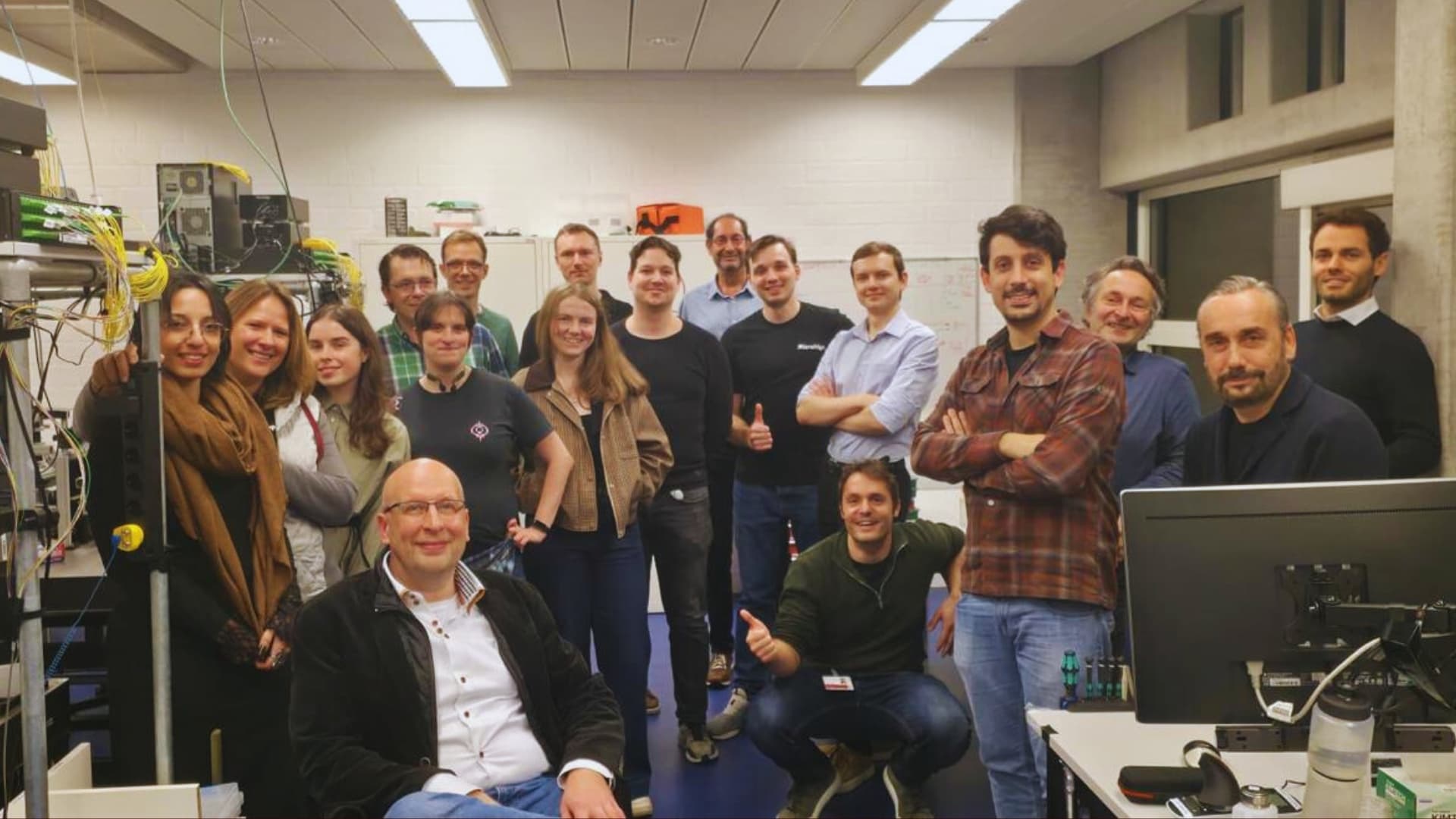
MicroAlign's team © MicroAlign
The industry standard
Fattori dreams big and hopes that MicroAlign will become the world’s leading provider of high-precision fiber arrays. At the same time, he acknowledges how difficult it is to work in the photonics industry, which can get quite fragmented in terms of standards and requirements.
Different manufacturers use different fibers, channel counts, or connectors. This lack of standardization means developing tailor-made solutions for each customer. "So, entering new markets means developing new variants of the same product for every different fiber type, every different specification. It's like fighting on many fronts at once," he underscores.
For now, the focus will be on diving deep into the markets where the technology is needed the most, building a track record, and using it to expand.
The passion for complex engineering challenges underlying fiber arrays keeps Fattori motivated, as does the energy he receives from the startup’s team every day. And partly, he says, the moments when a customer tells him their MicroAlign fiber array is inside a quantum computer. "That's when you step back and think: we made a quantum computer’s critical component. That's a strong source of motivation."