
Photon Bridge makes laser manufacturing LEGO-simple
This week, we spotlight the winners of the G&A Award 2026. Today: Photon Bridge.
Published on July 14, 2026
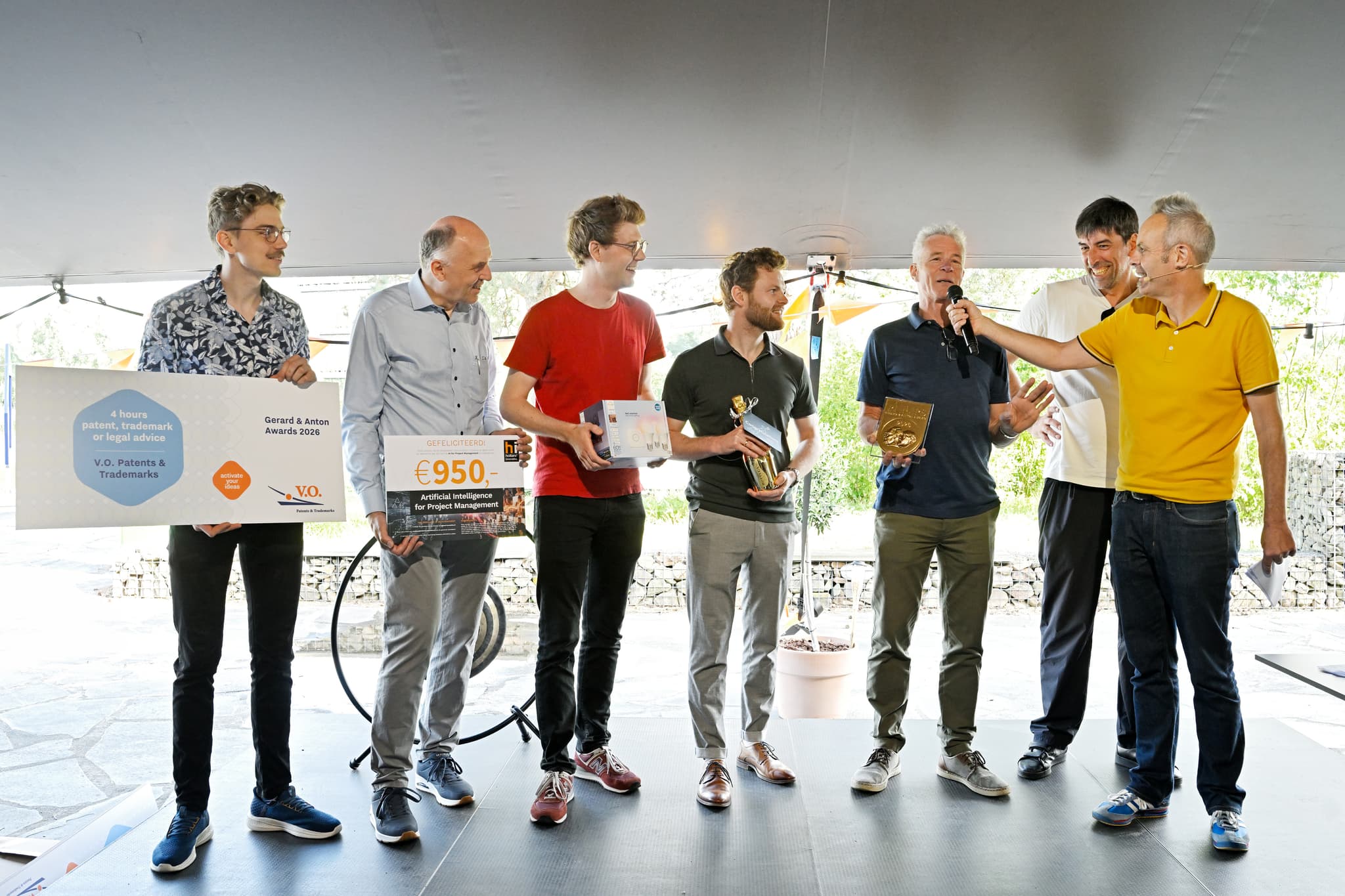
© Bart van Overbeeke Fotografie

Mauro swapped Sardinia for Eindhoven and has been an IO+ editor for 3 years. As a GREEN+ expert, he covers the energy transition with data-driven stories.
As electrical interconnects that sustain AI and data traffic communications approach their limits, copper wires can no longer keep up. AI infrastructure operators are racing to move ever more data at ever higher speeds, driving surging demand for optical interconnects across data centers worldwide. Light offers a powerful alternative for carrying information. Photon Bridge is building laser light sources that enable these connections.
Founded in 2020 by Rui Santos and Xaveer Leijtens, the company was born out of a hard truth the two founders learned by working in the sector. Building light-based chips today using a simple material approach doesn’t deliver performance, and assembling and packaging discrete optical components one at a time is a process that doesn't scale. Photon Bridge has found an alternative way. "The next major challenge in photonics is no longer proving the technology; it is proving it can be manufactured at scale," Santos says.
About Photon Bridge
A performing laser source
The G&A winner is combining two approaches: silicon photonics and high-performance semiconductor laser chips. Silicon photonics, which excels at routing light around a chip, provides the waveguide and routing layer. This layer essentially serves as the circuitry's plumbing, guiding the laser light from point to point.
The result is a compact, high-power light source that delivers multiple wavelengths simultaneously and is manufacturable at the volumes AI infrastructure demands. Achieving such superior performance while simplifying the manufacturing process has been a goal the industry has pursued for some time.
“Our biggest milestone to date was the demonstration of packaged laser prototypes delivering optical performance more than five times better than what is currently available on the market,” states Santos.
Ease of manufacture
Alongside performance, Photon Bridge has an edge in straightforward assembly over other manufacturers that focus primarily on photonic performance. “Much like connecting LEGO bricks, which means lower cost, higher yield, and a supply chain that can scale with customer demand rather than bottleneck it,” underlines Santos.
Photon Bridge's solution is a small mechanical trick that makes a big difference: a flexible interface, like a tiny spring-loaded arm, that lets the laser chip find its own correct position on the silicon waveguide. Normally, lining up a laser this precisely would require robots capable of nanometre-level accuracy for every single unit.
Here, the design itself absorbs small placement errors and self-corrects mechanically, so that level of precision isn't needed. As a result, the laser engines can be assembled using standard off-the-shelf manufacturing equipment rather than expensive custom-built tools.
In an industry where high optical quality and easy assembly are usually traded off against each other, demonstrating both at once was, in Santos's words, proof "that the trade-off is not inevitable."

G&A Awards 2026
Every year, we award 10 rising startups based in the Brainport region. In this series, you can get to know this year's winners better.
Eindhoven as the place to be
None of what Photon Bridge has built so far happened in isolation. The company traces its roots to Eindhoven University of Technology. The founder credits the surrounding Brainport ecosystem, with its dense concentration of semiconductor, photonics, and precision-manufacturing expertise, as instrumental to the company's progress.
Organizations like PhotonDelta, alongside investors and industry partners, have helped the startup move from prototype toward product. "The Netherlands has created a unique environment where deeptech startups, research institutions, manufacturers, and investors work closely together to accelerate innovation," he says.
Moving towards scale
The journey is just at the beginning, though. Like many other deep tech companies, bridging the gap between lab success and industrial development is one of the most difficult endeavors.
The broader photonics industry still lacks mature manufacturing capacity, packaging infrastructure, and supply chains, gaps that no single company can close alone. And for an early-stage hardware startup, the difficulty is even greater. Proving lab successes can translate into industrial development takes both time and capital, particularly when convincing customers requires real devices and real data, not promises.
Photon Bridge is steadily moving forward. “We are advancing toward volume manufacturing, working closely with foundry and packaging partners to industrialize our processes ahead of first commercial shipments,” underlines Santos. The company is preparing to sample its packaged laser sources to lead customers across the AI infrastructure and optical networks industries later this year — an important proof point on the road to first commercial shipments.
The next step is to carry that early validation into commercial reality by completing customer qualification, conducting reliability testing, and scaling its manufacturing ecosystem with industry partners. The ultimate goal, Santos says, is to remove manufacturability as the last major barrier to widespread adoption of photonic interconnects across AI infrastructure.