
Philips’s Léon Kempeneers: ‘In healthcare, trust is the product’
AI can be part of the answer to improve healthcare systems worldwide, but not without making it trustworthy.
Published on October 28, 2026
© Philips
Mauro swapped Sardinia for Eindhoven and has been an IO+ editor for 3 years. As a GREEN+ expert, he covers the energy transition with data-driven stories.
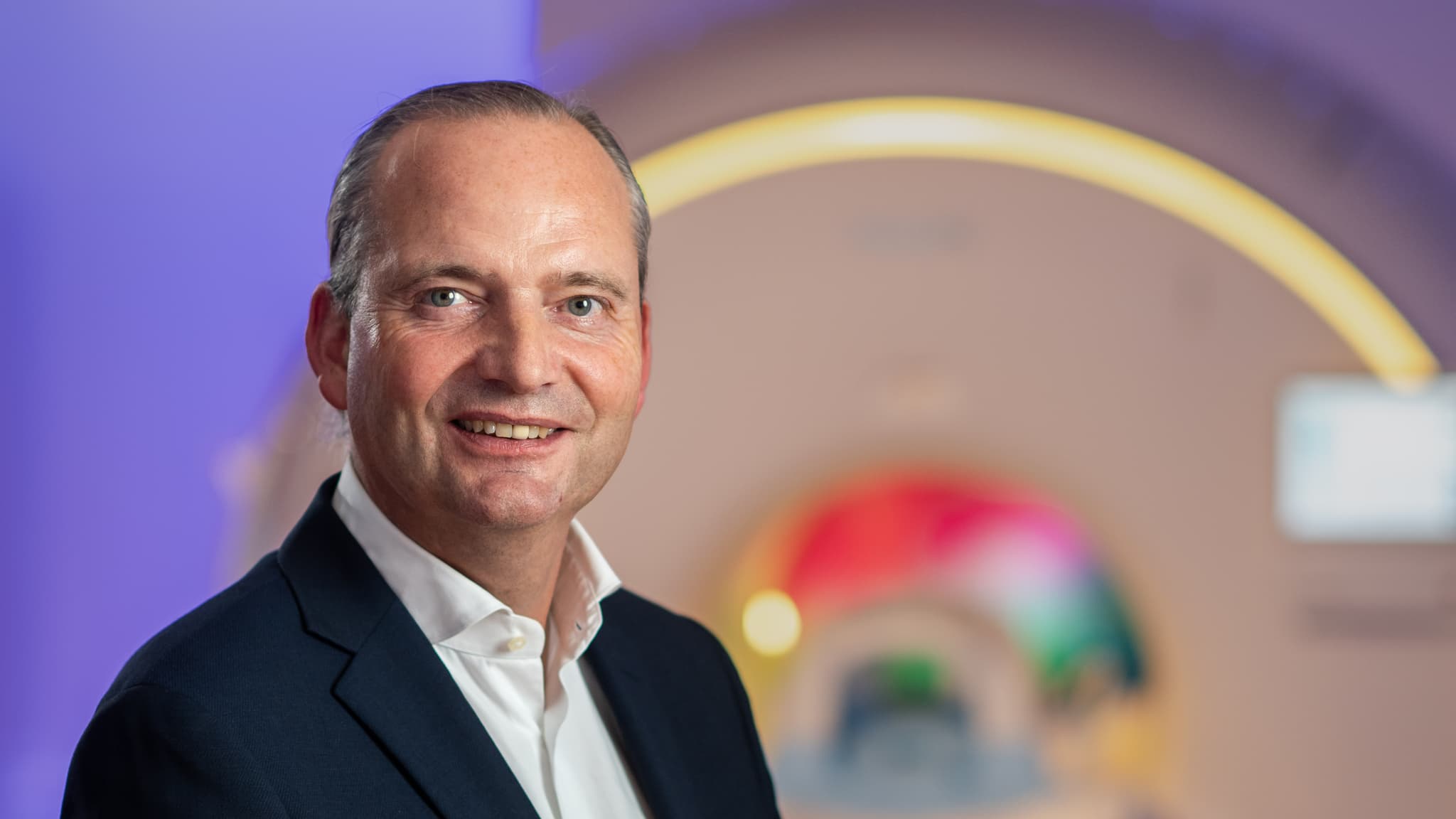
Healthcare systems in the most developed countries face a similar conundrum: an aging and shrinking workforce for an older population that needs more care than ever. Léon Kempeneers, managing director Benelux and country leader Netherlands at Philips, sees AI as part of the answer, but only on one condition.
"In other fields, trust may be a feature of AI," he says. "In healthcare, trust is the product."
Empowering clinicians with AI is one of Philips's main focuses right now. To gauge opinions on AI of both practitioners and patients, the organization, for its Future Health Index, surveyed more than 2,000 healthcare professionals and 20,000 patients in ten countries.
AI: clinicians optimistic, patients more hesitant
In the Netherlands, 91% of healthcare professionals are optimistic that AI can improve patient outcomes, and 63% say their workflows have already become more efficient. A quarter save at least 88 hours a year.
"AI can help professionals work more efficiently and support clinical decision-making, freeing up time for patients," Kempeneers says. "In my view, that enables better care for more people."
Patients are more hesitant: only half of Dutch patients share that optimism. Yet when AI turns up in the consulting room, they take it in their stride. Only 10% of Dutch clinicians have seen a patient lose trust in their care after learning AI was involved, compared with 39% globally.
Shadow-AI
Not everything is rosy, though. Some 63% of surveyed Dutch clinicians use personal AI tools when the solutions they have at work don’t meet their needs. At the same time, 83% of healthcare professionals say AI training at their institution is missing, limited, or inconsistent. Kempeneers is concerned about it, as feeding work into unsanctioned tools is the kind of practice that can erode the trust he considers essential.
His remedy is not more national rules. "In the Netherlands, we have a tendency to overdo it: gold-plating. That isn't necessary," he says. "Let's stick to the good EU rules, work together and stop gold-plating.” The EU rules in question include the AI Act and the Medical Device Regulation, which already govern clinical AI.
Within that framework, he draws a hard line. Clinical AI is not generic, he stresses. It is built for specific clinical needs and must meet evidence requirements, pass validation, and undergo regular oversight before it reaches patients. "Everything should comply," he says. "If it doesn't, we shouldn't use it."
People-led, AI-powered
However disruptive AI may be, Philips keeps its focus. “We are a people-led, AI-powered company, not the other way around," Kempeneers says. "Technology is always a means, not a goal."
The same line of thought appears in his advice to medical institutions that want to adopt AI and look for quick wins. In his view, the most effective uses are the very focused, targeted ones. "Don't make it too broad, or you get stuck," he says. "Make it really tangible, implement it, and get the right training."
For example, he mentions SmartSpeed Precise, Philips's AI software for magnetic resonance imaging (MRI). At the Antoni van Leeuwenhoek cancer hospital in Amsterdam, the system cut scan time by 60% — from 23 to 9 minutes. Although results may vary by patient and exam, the time reduction didn’t reduce scan quality. This way, more patients can be seen in the same amount of time.
A cure for 'pilotitis'
Much of Kempeneers’s agenda runs through the MedTech Growth Plan. It is the sector’s contribution to the Wennink report on the Netherlands’ future earning capacity, coordinated by Philips — which remains the largest health tech company in the country. The plan was unveiled last December, and in July the government set aside €102.5 million for the initiative, and Philips committed €50 million more.
By 2035, the goal is to create 11,000 new jobs, generate €5 billion in extra annual exports, and to launch and scale 75 startups and scale-ups. The ambition is to position the country as a European leader in the sector and place it in the global top three.
Per Kempeneers, one obstacle the Netherlands must overcome to truly grow is a sort of malaise, which he calls pilotitis. This is repeatedly running similar pilots that, in his view, aren’t necessary. If something works in Eindhoven, he argues, Groningen, Rotterdam, and Maastricht should adopt it rather than reinvent it. "Proudly copy it, proudly adopt it, implement it in every region," he adds.
At the same time, goodwill alone won’t be enough to achieve the MedTech Growth Plan’s goals. “A coalition of the willing is nice, but we need to move the needle," he says, calling instead for a "coalition of the active" of hospitals, universities, government and companies. No single player can carry it: "We can't, hospitals can't, universities can't, the government can't, a startup can't. You have to work together."
Open doors
Innovation remains at the core of Philips’s activities. The health tech giant structures these efforts around three connected business platforms: diagnostics, minimally invasive treatment, and monitoring. External partners and companies can plug into all three platforms, along with their technologies and resources.
Examples include regional command centers that oversee every MRI scanner in a region, ‘not only the Philips ones,’ and home-monitoring devices from smaller firms such as Eindhoven-based Healthdot, which connect to Philips’s monitoring platform.
Having founded two medtech startups, Kempeneers is well aware of the dynamics of this world and is keen to share advice with budding entrepreneurs. “Focus and set yourself apart,” he says. Doing everything at once is not feasible for a startup, and not a good idea for a large organization either, he reckons.
More care
Test innovations at home, scale them nationally, then sell them globally: that is the logic of the plan, which aims to serve patients and the economy at the same time. “As a country we’d earn much more in MedTech, and that can flow back to government and to healthcare,” he says. “That’s the positive cycle I see.”
Ambitious targets are easy to set; 2035 is still nine years away. Kempeneers says he doesn’t expect the goals to arrive all at once. “It won’t suddenly be 2035 with every goal met; there’s a road to get there,” he underlines. Progress will be tracked “quarter after quarter, year after year.” For a country prone to pilotitis, that may be the real test: not whether the plan works in one hospital, but whether it still does in the tenth.