
Perovion aims to scale flexible perovskite solar cells
This week, we spotlight the winners of the G&A Award 2026. Today: Perovion Technologies.
Published on July 16, 2026
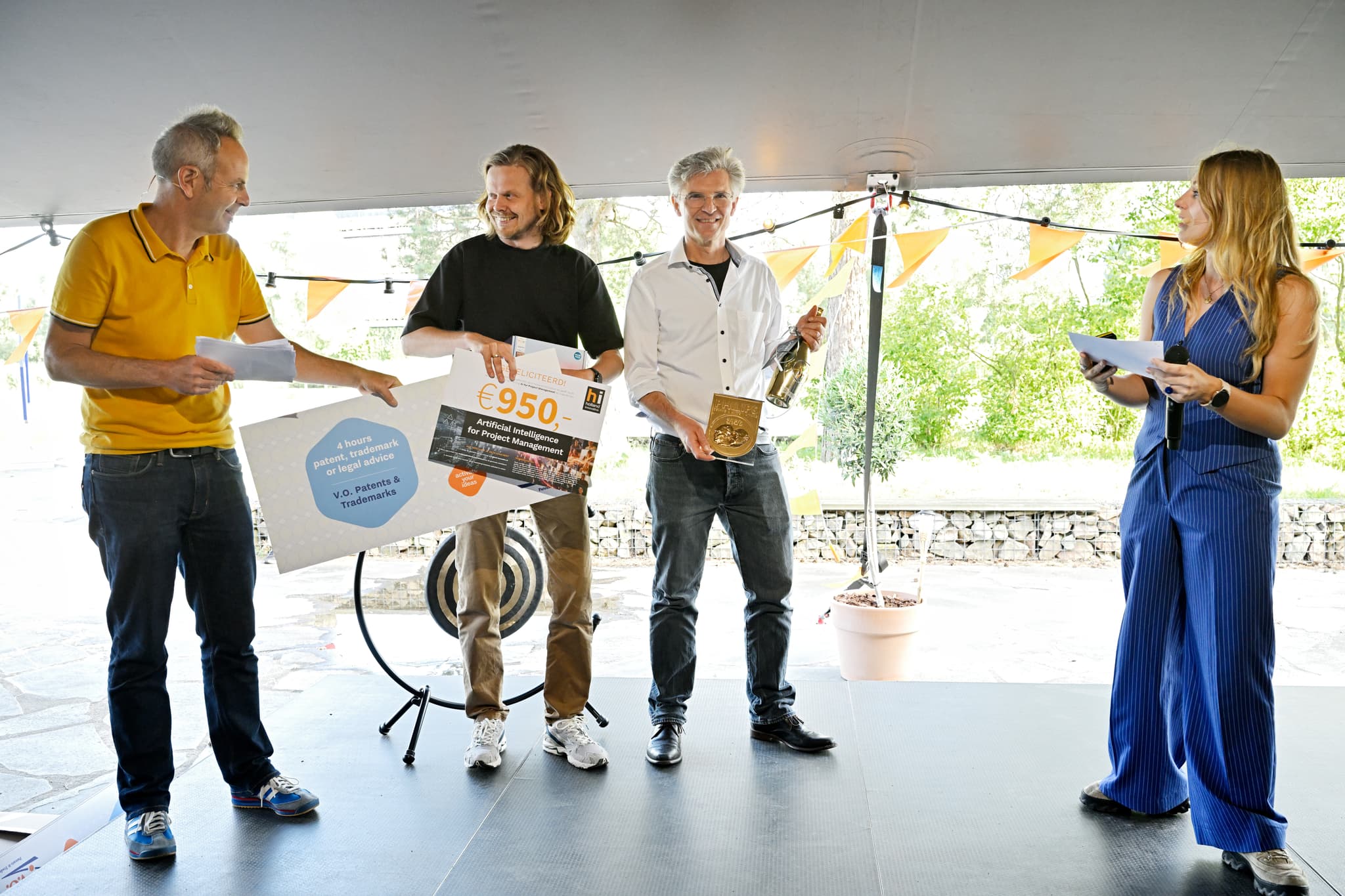
© Bart van Overbeeke Fotografie

Mauro swapped Sardinia for Eindhoven and has been an IO+ editor for 3 years. As a GREEN+ expert, he covers the energy transition with data-driven stories.
Conventional silicon panels are built around thick, rigid silicon wafers encapsulated in glass. They are sturdy and resistant, yet heavy and inflexible. They work well on rooftops and standing structures, but not on many other surfaces that can’t support their weight, such as curved facades, vehicles, and light roofs. Perovion is working on perovskite solar cells, an emerging solar technology that promises lighter, more versatile solar panels.
“Perovion develops and industrializes flexible perovskite solar cells that can be manufactured through roll-to-roll production,” explains co-founder Stefan van de Beek. “We focus specifically on the 'front end’ of the value chain: production of the active solar cell stack on flexible foil. That foil can then be processed by partners into complete modules and end products.”
About Perovion Technologies
Perovion’s foundation
The startup builds on years of research carried out at the Netherlands Institute for Applied Scientific Research, TNO, within the solar energy program Solarge. Perovion has taken that knowledge and is working on a pilot line to produce perovskite solar cells at the High Tech Campus Eindhoven.
Unlike silicon, perovskite, a thin-film semiconductor, can be deposited in fine layers of flexible foil. What comes out is a lightweight, bendable solar cell that can be applied to a surface without a heavy mounting structure.
Perovion specializes in producing these solar cells using a roll-to-roll production process. Similar to a printing press, foil runs continuously through successive coating, deposition, and laser steps. This logic is fundamentally different from how the solar panel manufacturing industry works and opens the door to high production volumes.
The tech works – it’s now time to scale
“The underlying technology has been proven: working flexible perovskite cells have been produced, and important technical proof points have been achieved in terms of efficiency, stability, and roll-to-roll manufacturability,” says Van de Beek.
All energies are now focused on further developing this innovation toward demonstrator projects and industrial production. To this end, the startup is partnering with organizations across the solar value chain to translate the technology into concrete applications.

G&A Awards 2026
Every year, we award 10 rising startups based in the Brainport region. In this series, you can get to know this year's winners better.
New technologies don’t succeed in isolation
Developing a pioneering technology also means exploring markets that do not exist. Markets for flexible PV — lightweight roofing, façades, mobility, off-grid systems — exist in potential but still need to be built, and the technology has to be scaled and validated with care before commercial promises can be made.
“That's why this market requires close collaboration across the chain. A solar foil is only valuable once it can be properly integrated into a module, product, or application,” highlights Perovion’s co-founder.
Van de Beek underscores that Perovion is building not only solar cell technology but also a production process and an industrial value chain. Creating that means establishing partnerships with companies working on coating technologies, encapsulation, and systems integration. “Brainport means tapping into an environment where many of these players are located close to each other and know how to scale complex technology,” he adds.
What comes next
The company is now working to raise its first round of funding. Having proved that the technology works, the focus is now fully on reproducing the roll-to-roll breakthrough at an industrial scale.
“What we mainly need is to further scale up: capital, technical capacity, and access to production facilities. There is also a need for long-term policy that helps new European solar energy technologies develop,” the co-founder underlines.
Van de Beek particularly underscores the importance of the latter point. Perovion feels a responsibility to develop technology to strengthen the European solar industry. “New photovoltaic technologies, such as flexible perovskite, offer an opportunity to rebuild industrial capacity and technological autonomy,” he concludes.