
ONWARD Medical begins testing spinal implant for walking
ONWARD Medical has implanted its first patient in a new trial testing an implant to restore walking after paralysis.
Published on September 3, 2026
© ONWARD Medical

Team IO+ selects and features the most important news stories on innovation and technology, carefully curated by our editors.
ONWARD Medical, a Dutch neurotechnology company, has reached a milestone. The company performed the first implantation in a new clinical study. The study will test whether an implanted spinal cord stimulator can help people stand and walk again after a spinal cord injury.
The procedure took place at the Centre Hospitalier Universitaire Vaudois (CHUV) in Lausanne, Switzerland, led by Dr. Jocelyne Bloch, the hospital's head of neurosurgery. It marks the start of the EIGER study, a feasibility trial that will enroll up to 12 participants at CHUV and the Swiss Paraplegic Centre in Nottwil to test the safety and early effectiveness of ONWARD's experimental ARC-IM® system. The study is financially supported by a grant from the Swiss innovation agency Innosuisse.
A first for ONWARD Medical
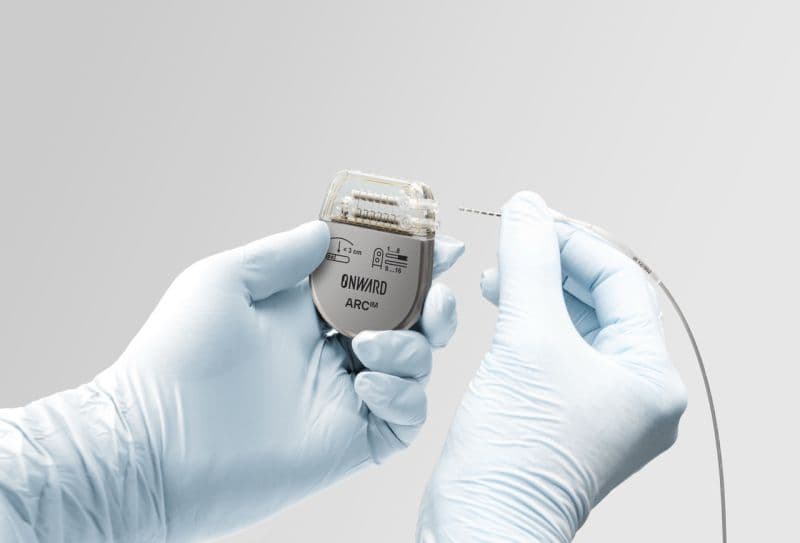
Unlike the company's existing ARC-EX® system, which stimulates the spinal cord non-invasively through electrodes placed on the skin, ARC-IM is implanted directly in the body. It pairs an implanted pulse generator with a lead placed near the spinal cord to deliver targeted electrical stimulation to the circuits controlling leg and trunk movement, with the goal of helping patients regain motor function.
EIGER is notable for including, for the first time in one of ONWARD's mobility studies, people with subacute spinal cord injuries — those sustained less than six weeks before joining the trial — alongside patients with chronic injuries of more than a year. CEO Dave Marver described the study as an important step toward a larger "pivotal" trial that could eventually support bringing the implant to market.
Growing momentum
The announcement builds on a string of recent milestones for the Eindhoven-headquartered company. In November, the US Food and Drug Administration cleared ARC-EX for use at home as well as in clinics, allowing patients with incomplete spinal cord injuries to continue stimulation therapy for hand strength and sensation outside a medical setting. That clearance followed strong results from the company's Up-LIFT pivotal trial, published in Nature Medicine, which found that 90% of participants saw improved arm or hand strength and function, with benefits observed in patients up to 34 years after their original injury.
ONWARD has also been expanding ARC-EX's footprint in Europe. In January, the system reached its first clinical users on the continent, starting with a Swiss rehabilitation center and followed shortly after by NeuroMove, a nonprofit neurorehabilitation training center in Amsterdam. ARC-EX is CE-marked in the EU and FDA-cleared in the US, though it remains a prescription-only device operated by trained rehabilitation professionals or, at home, by patients and caregivers.
The implantable ARC-IM platform being tested in EIGER is still experimental and not yet available for commercial use. Beyond mobility, ONWARD is developing the same underlying technology for other applications, including a separate global pivotal trial called Empower BP aimed at correcting blood pressure instability after spinal cord injury, and early-stage work combining ARC-IM with a brain-computer interface, ARC-BCI, to help restore movement more naturally.