
LEGO started as a copy, but became big thanks to systems thinking
In a series of blog posts, Marco Coolen offers a glimpse into his work as a Dutch and European patent attorney at AOMB.
Published on August 9, 2026

Marco, a patent attorney at AOMB since 2013, shares his expertise on IO+ about patents—how they work, why they matter, and when they lose their value.
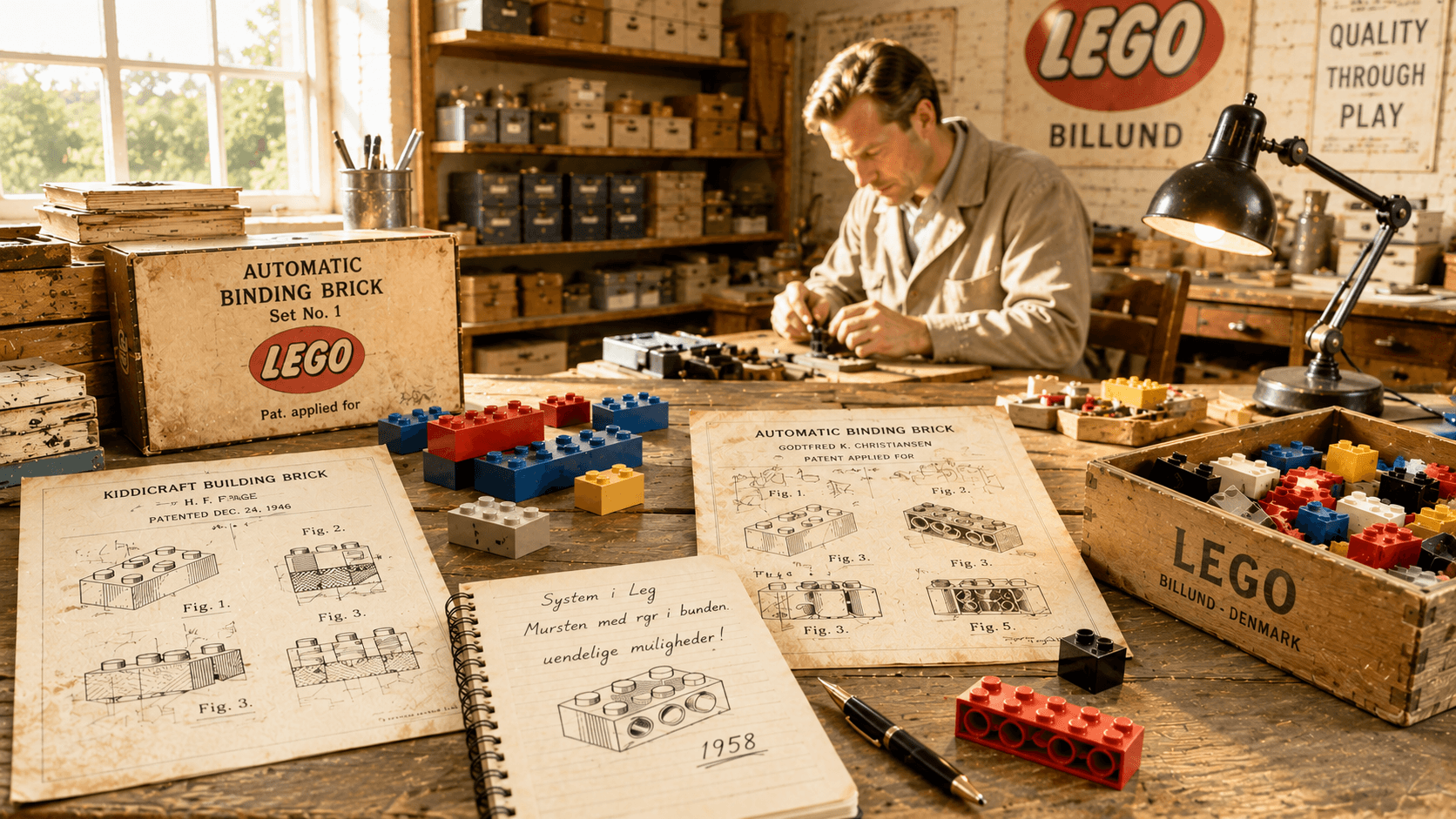
You might think that LEGO started with a brilliant idea. In reality, the success story from Billund began with something far less romantic: a copy. The first plastic building blocks with studs didn’t come from LEGO, but from Hilary Fisher Page. In the 1940s, he developed his Kiddicraft blocks and secured them with patents. So when LEGO introduced the Automatic Binding Brick in 1949, it wasn’t an entirely new invention. It was primarily a first step in a direction that already existed.
But that alone doesn’t guarantee success. Because copying an idea is one thing. Turning it into a system is something else entirely. The real breakthrough didn’t come until 1958—not through a spectacular new product, but through a small technical adjustment to the bottom of the brick: tubes.

Those tubes changed everything. Suddenly, the bricks clicked firmly into place, yet they were also easy to take apart. That may seem simple, but that’s exactly where the power lay. The connection was strong enough to build large structures, yet flexible enough to start over again and again.
From that moment on, LEGO was no longer just a toy. It became a platform—a system in which every brick could work together with every other brick. And there’s an important lesson here for entrepreneurs. The value lay not only in the brick itself, but in its repeatability—in the way the pieces fit together—and in the fact that new bricks continued to connect with old ones.
That became even more pronounced when LEGO switched to ABS plastic in 1963. That material was sturdier, more durable, and more reliable. As a result, building bricks remained compatible for generations. A brick from the 1960s still fits onto a brick from today.
That’s no coincidence. It’s strategy. Many companies think that innovation is mainly about the initial idea. But often, the real difference only begins afterward—in the refinement, in the scalability, and in the consistency of production.
Do you want to copy, stay ahead, or compete? Then technology is just the beginning. You also have to think about how your solution will work reliably time and time again. Whether parts will continue to fit together. Whether customers can build on what they’ve purchased before.
That’s exactly what made LEGO so strong. Not a single brick. But the system surrounding it. Individual building blocks are fun. But only when everything clicks does something lasting emerge.
And that applies just as much to tech companies. A product can be smart, but a platform creates dependency, repeatability, and long-term value. LEGO shows that you don’t always have to be first to win the market. Above all, you have to be the one who makes the system work.

The World of Patents
With the help of Dutch and European patent attorney Marco Coolen (AOMB), we can better understand the world of patents. How do they work, why are they important, and when do they lose their usefulness?