
Inside a repair line giving batteries a second life
Battery repair is set to become the standard in the EU. IO+ visited a battery repair line.
Published on December 23, 2025

© IO+

Mauro swapped Sardinia for Eindhoven and has been an IO+ editor for 3 years. As a GREEN+ expert, he covers the energy transition with data-driven stories.
The battery is the essential, and more expensive, component in all electric vehicles, from cars to scooters and e-bikes. For this reason, repairing it is crucial to foster circularity and reduce our carbon footprint. Batteries contain precious materials, such as lithium, that require significant inputs and are sourced through unstable supply chains.
“Battery repairability is a highly sensitive topic in Europe, as it is essential to improving our resilience to shocks in the global material supply chain,” illustrated Marcin Chojnacki, an innovation officer at the European Institute of Innovation & Technology (EIT) Urban Mobility.
To this end, the MOBIRE project, co-funded and supported by the EIT, explored how to enhance battery repairability, integrate the battery passport, and ensure compliance with battery regulations. Project partners are the battery repair company NOWOS and the micromobility sharing operator Dott.
As part of the project, the partners have developed a battery repair line at NOWOS’ headquarters in Amersfoort. In the past months, thousands of batteries from used Dott vehicles have entered the repair line. 80% of them could be restored. The partners offered the press an exclusive look into how this repair line works.
How batteries get repaired
The battery repair process follows a series of thorough, precise steps and takes about three minutes to complete. Once it enters the loop, each battery is registered on a digital system. This ensures traceability. In this same step, the technician also accesses the battery management system (BMS) by connecting it to a laptop, where ad hoc software is used to retrieve all information. In this way, one can precisely understand each unit's issue.
Then, the battery is removed from its casing for a visual inspection to determine whether the damage is mechanical (e.g., the casing or the discharge port) or electronic. “Mechanical repairs represent around 20 to 30% of the failures that we see,” explains Benjamin Guerpillon, chief operating officer at NOWOS. Within the MOBIRE project, a method has been developed to extract the casing without breaking it, facilitating reuse.
The battery diagnostic information is uploaded to the system, and the battery proceeds to the next station, where electronic repairs, such as soldering broken contacts, are performed. After the repair is complete, the battery undergoes a quick charge and discharge test to verify that all components are functioning correctly. The batteries can be sealed again with silicone.
Lots of regulations are coming up
The final step in the process is creating the Battery Passport. Under the EU Battery Regulation, the EU Battery Passport is an electronic document set to track and provide access to information about a battery’s composition, origin, and environmental impact. By February 2027, all batteries must include a QR-coded label to access this data.
NOWOS can do so by importing all information it has on each cell, including the manufacturer and repairs performed. From there, a label with a QR code is printed and affixed to the battery, enabling immediate battery identification.
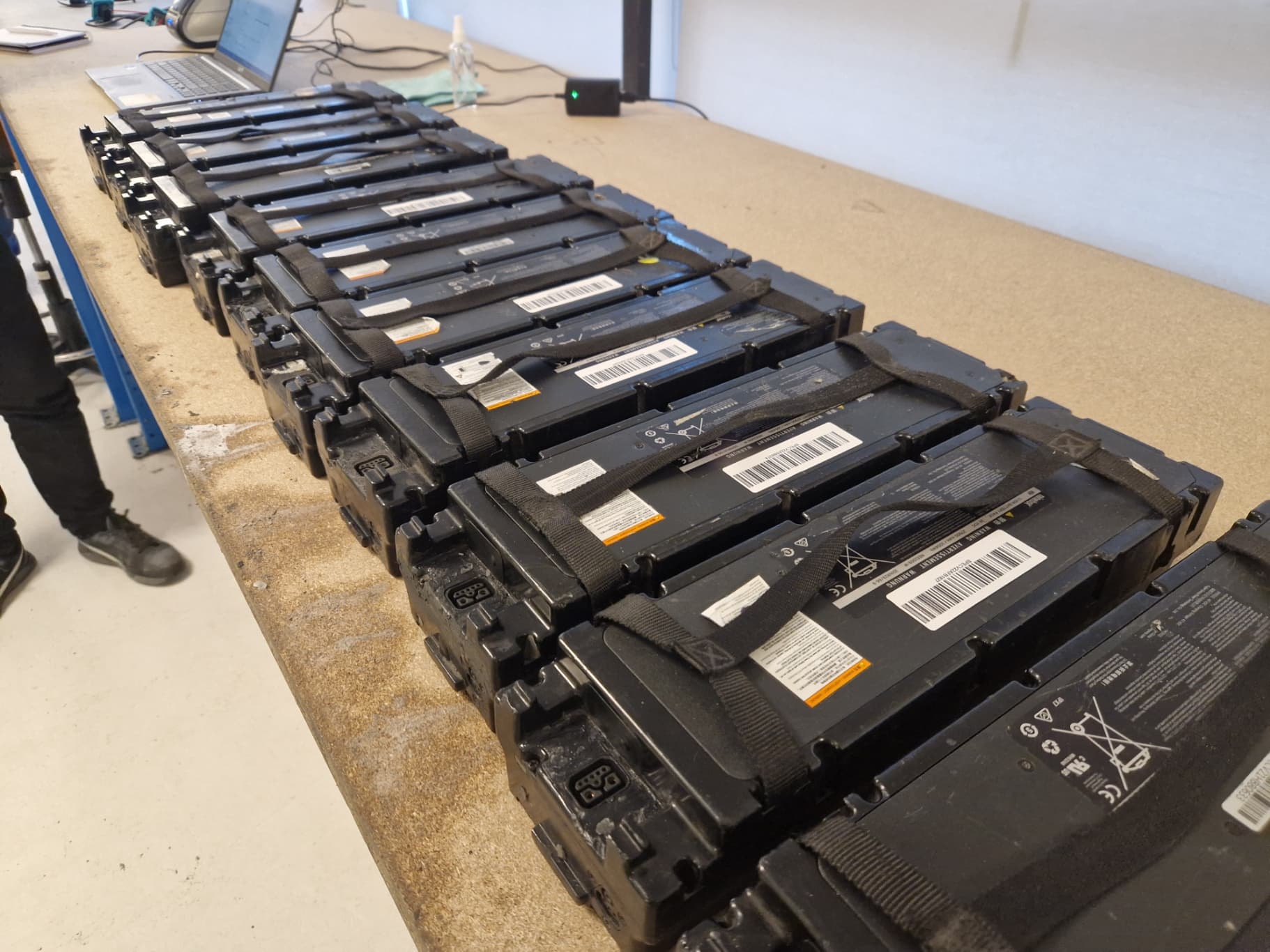
A stack of batteries labeled with the Battery Passport - © IO+
The European Union's Right to Repair Directive (R2RD) establishes a legal right for consumers to have defective products repaired even after the legal guarantee period has expired. It applies to devices such as vacuum cleaners, washing machines, and phones. Manufacturers must inform customers of their rights and establish repair services.
“As the demand for LMT (Light Modes of Transport) surges, so will the number of batteries requiring repair. Europe needs to build the right domestic capacity to do so. In parallel, it is equally important to strengthen the European battery ecosystem and extend the service life of micromobility vehicles. Many of them, and their batteries, are often thrown away, even though they have minimal damage,” explained Chojnacki.
More rules for battery material sourcing
Recycling as a last resort
In the NOWOS approach, recycling is the very last resort. Each battery module is thoroughly tested, and parts are replaced when needed. “People talk about recycling but hardly about repair,” stated Sten van der Ham, chief commercial officer (CCO) of the company.
Since 2019, the company, based in Amersfoort, has pursued a mission to create a circular economy for lithium-ion batteries, focusing on diagnostics and repair. In the last five years, NOWOS specialized in servicing micromobility batteries, working with bike manufacturers such as Stella, and sharing mobility services such as Swapfiets and Dott.
At the Amersfoort plant, approximately 40,000 batteries are processed each year. The company is also present in France, where it operates a repair hub, and in the UK, where it has a repair partner. Following a €6 million fundraising in April, the company is now seeking to expand its operations and then possibly enter new markets.
Repairability brings economic benefits
Dott, operating in over 400 cities across Europe and the Middle East, prioritizes repairability. “Four years ago, we started refurbishing vehicles, creating a repair center of our own,” explained Maxim Romain, president and co-founder of Dott. “Although we could do some fixes to the batteries, we didn't have enough technical expertise to operate some others. So we turned to NOWOS, as we aimed to improve the repairability rate from 20 to 80%.”
Regulation is not the primary reason the mobility-sharing company is taking these actions regarding repairability. “Having vehicles that drive longer saves us money and helps reduce our carbon footprint,” he stated.
Thanks to refurbishing, Dott could double the lifetime of its first-generation scooters to eight years. The newer ones could reach 15 years, according to the Dott's official. What is still missing? “What we truly need are good designs that allow for batteries and components to be repaired,” Romain concluded.