
If they patent here, why don’t you patent there?
In a series of blog posts, Marco Coolen offers a glimpse into his work as a Dutch and European patent attorney at AOMB.
Published on January 18, 2026
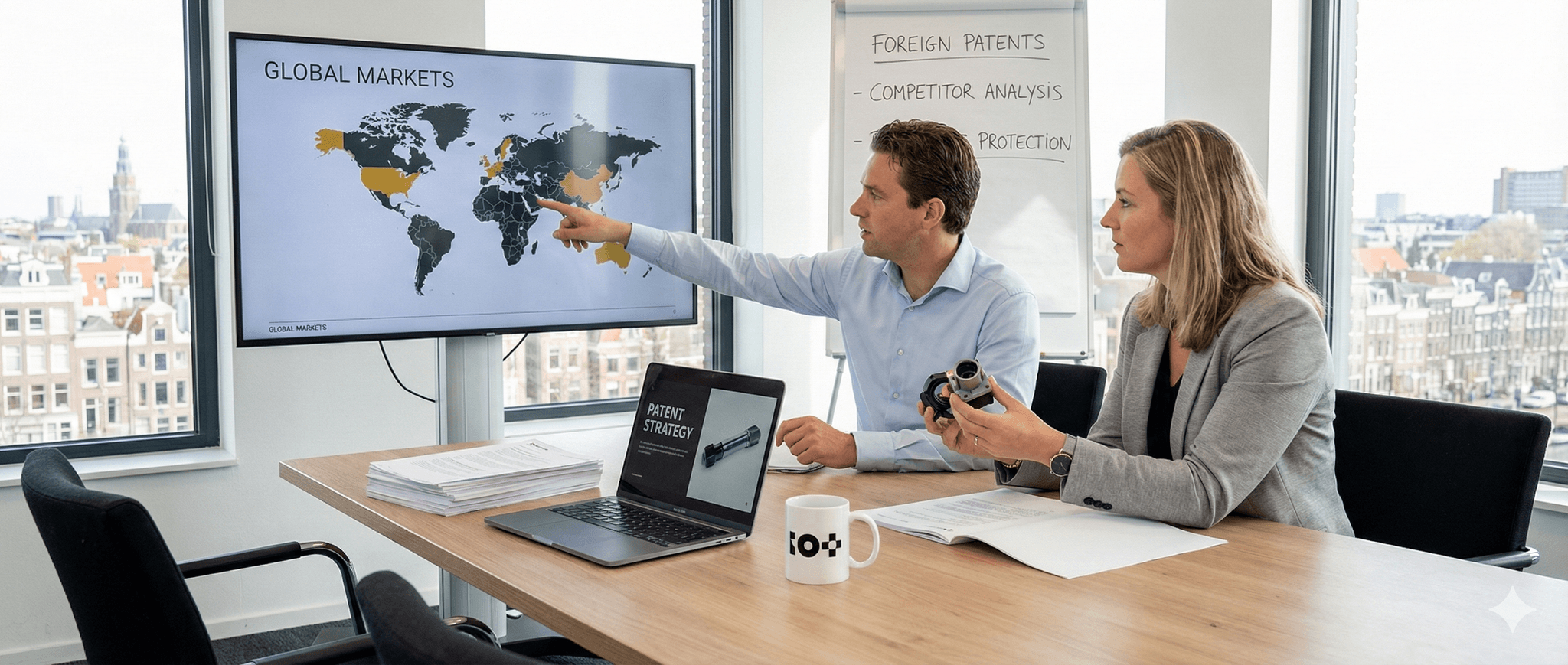

Marco, a patent attorney at AOMB since 2013, shares his expertise on IO+ about patents—how they work, why they matter, and when they lose their value.
In the Netherlands, more than 90% of all patents are owned by foreign parties. Not a typo: 90.4%, to be precise. And no, that’s not a fun fact for a pub quiz. It says something fundamental about our vulnerability as a small country in a big world.

Marco Coolen, photo © Bart van Overbeeke
Small country, significant risks
The explanation is pretty simple. The Netherlands has a modest innovation base: a handful of large tech companies, a strong knowledge infrastructure, and a vibrant SME sector. But compared with giants like China, the US, or Japan, we simply cannot file the same number of patent applications. Additionally, many Dutch companies still hesitate to patent.
Multinationals don’t hesitate. They roll out patents in every market that matters to them. Not because they plan to build a factory everywhere, but because they want protection everywhere. Any country they operate in is a country where their technology must be protected. It’s that straightforward.
A checkbox for multinationals, a hurdle for local players
With European and international patent systems, it has become increasingly easy to request protection in multiple countries. For large companies, the Netherlands is just another box to tick: manageable, predictable, and economically relevant.
For Dutch SMEs, that exact checkbox feels more like a hurdle. Patents are still often seen as expensive, complex, or something to deal with “later.” Many entrepreneurs prefer secrecy — or do nothing at all. Until they discover that a foreign party has filed a patent on something similar, and suddenly they are the ones who have to prove they were there first.
Protect yourself, or be pushed aside
If foreign companies consider your market significant enough to file patents in, why wouldn’t you? Don’t assume you’re safe because you “only operate locally.” That competitor based on paper in Silicon Valley or Shanghai may already be active in your field — and their protection often applies here as well.
The risk is that you get overtaken or simply sidelined. While your knowledge, your innovation, and your invention deserve protection.
The market is global. Are you?
The Dutch market may be small, but our entrepreneurial spirit certainly isn’t. Look at export figures, at innovation coming out of SMEs, at international collaborations. We think big. And that’s precisely why we also need to think big when it comes to protection.
A patent is not a bureaucratic luxury. It’s a strategic shield. Against copycats. Against third-party patents. Against the idea that, as a local player, you’ll always come second.
So the next time you hear that “more than 90% of patents are in foreign hands,” don’t shrug it off. Think instead: maybe it’s time to claim my place.