
How Team CASA builds the future of sustainable living
Accelerating the energy transition in buildings: Team CASA’s mission. Founder Antoine Post and current team captain Mihnea Mateescu open up.
Published on December 4, 2025
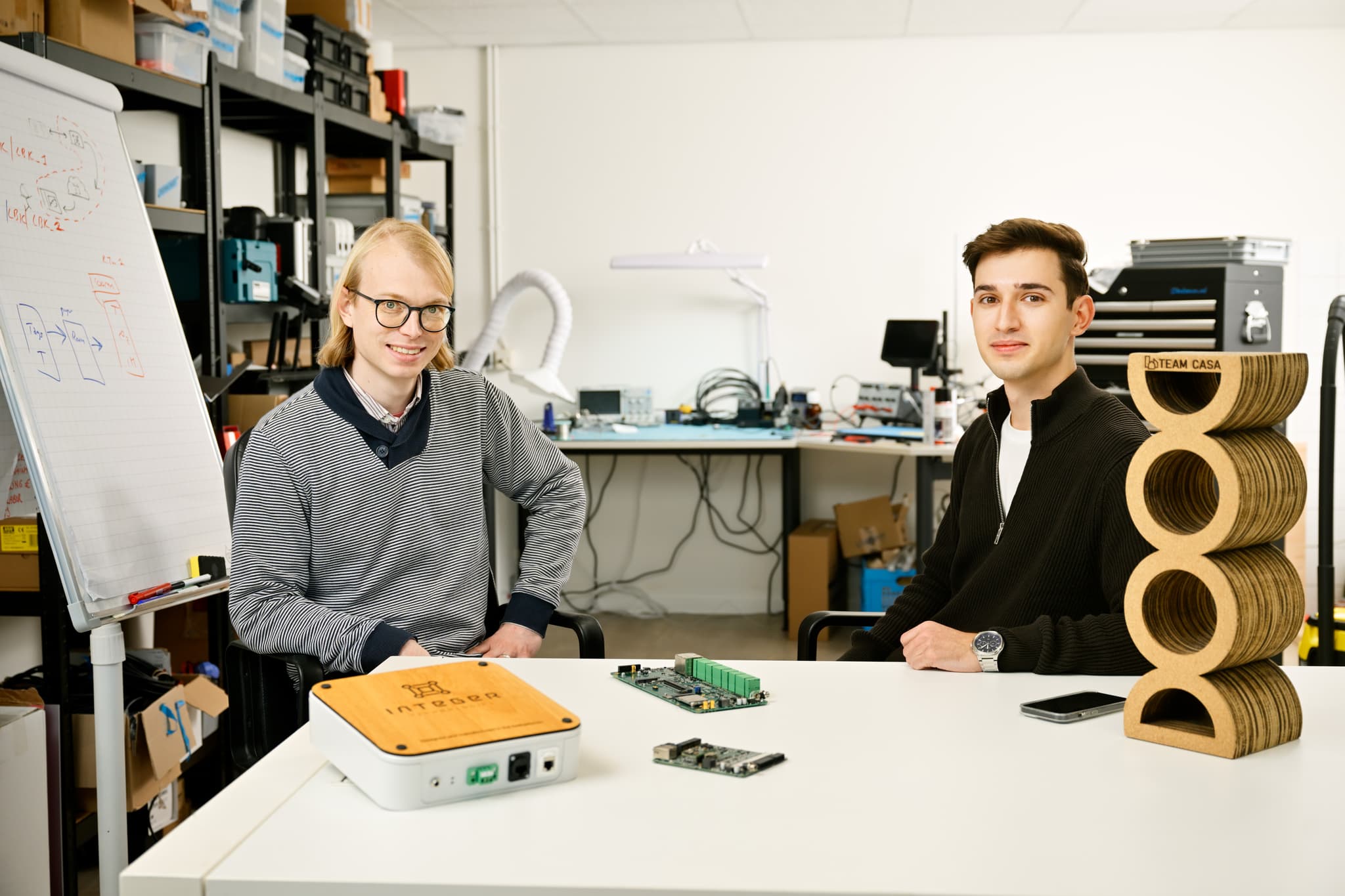
On the left, Antoine Post, and on the right, Mihnea Mateescu - © Bart van Overbeeke Fotografie
Mauro swapped Sardinia for Eindhoven and has been an IO+ editor for 3 years. As a GREEN+ expert, he covers the energy transition with data-driven stories.
Back in 2016, Antoine Post was a bachelor’s student in applied physics at the Eindhoven University of Technology (TU/e). After joining TU/e’s honors academy, he came up with the idea of forming a student team to develop a sustainable housing concept. Other students liked his idea, and shortly after, Team CASA came to be.
Team CASA is one of the student teams at Eindhoven University of Technology (TU/e) with the mission of accelerating the energy transition in the building industry. The students aim to do so by developing alternative, affordable, and sustainable living solutions.
Mihnea Mateescu is a third-year bachelor student at the TU/e’s architecture course and is the current team captain of Team CASA. He has been in charge for slightly over a year, stepping in at a difficult moment for the team, with only a few members still in after the previous projects. The mission remains the same: developing sustainable building projects.
TeamCaptains Then & Now
In the series TeamCaptains Then & Now, we talk with a former and current team manager of student teams within the 4TU Federation. Students from the four technical universities in the Netherlands each year prove their innovative strengths in various student teams. How is/was their experience? What are their most important lessons? And what does that mean for their future?
The origins
It was a five-year-long journey from September 2016 to finally accomplish the mission of the first cohort of Team CASA: constructing a sustainable apartment building. The concrete-free dwelling consists of three apartments and is made of steel and wood. The construction uses an ingenious heating and cooling system, thanks to an innovative integration of solar panels and a heat pump.
“The goal was never to build a student team, but to build a housing concept that could inspire the market,” says Antoine. “From finding a place to construct, to dealing with budgeting issues following the rise of steel prices after COVID-19 hit, we saw it all.”
“We started from scratch as a student team, having the vision of starting construction in two years---even though we were well aware such a timeline was unrealistic. From there, we created our own team culture. Seeing everyone giving their contribution in their own way was truly cool,” he recalls.
Same vision, a different project
The current team captain admits that it has been challenging to recruit new energy and learn to work as a team. To strengthen connections among group members, the students last year took part in an architectural competition, which proved preparatory for the project the student team is currently working on.
“We partnered up with Meteor, a recently opened cafè on the TU/e campus, to design a study area. We are developing both an indoor and an outdoor area. Central to our project is the use of recycled materials, as well as the modularity and adaptability of the elements that we will include in the design,” Mihnea illustrates.
To this end, the students are working on custom-made furniture made from biobased materials such as cork and studying smart, innovative lighting solutions to enhance the ambience and help students focus. This year’s goal is to complete this project while exploring new technological possibilities. “Think of furniture that, thanks to embedded sensors, would adjust the seating to the posture of the person who is sitting,” he explains.
Generating impact beyond a student team
For Antoine, his experience at the helm of Team CASA will always be more than just an extracurricular activity during his studies. Not only does he still live in the house, but he also, together with one of the other team members, Pau Brossa Rodriguez, started Integer Technologies.
What struck the most with the companies that visited CASA 1.0 once completed was the control system, the building’s brain, that managed and optimized the use of solar panels and the heat pump. “We were asked if we could replicate a similar system for office buildings. And that’s how Integer was born,” recalls Antoine.
Integer Technologies has indeed advanced those technologies. The startup can now count on an eight-person team and has created a smart box that controls heating, ventilation, and air conditioning systems. Currently, Integer’s technology is being used in 10 buildings.
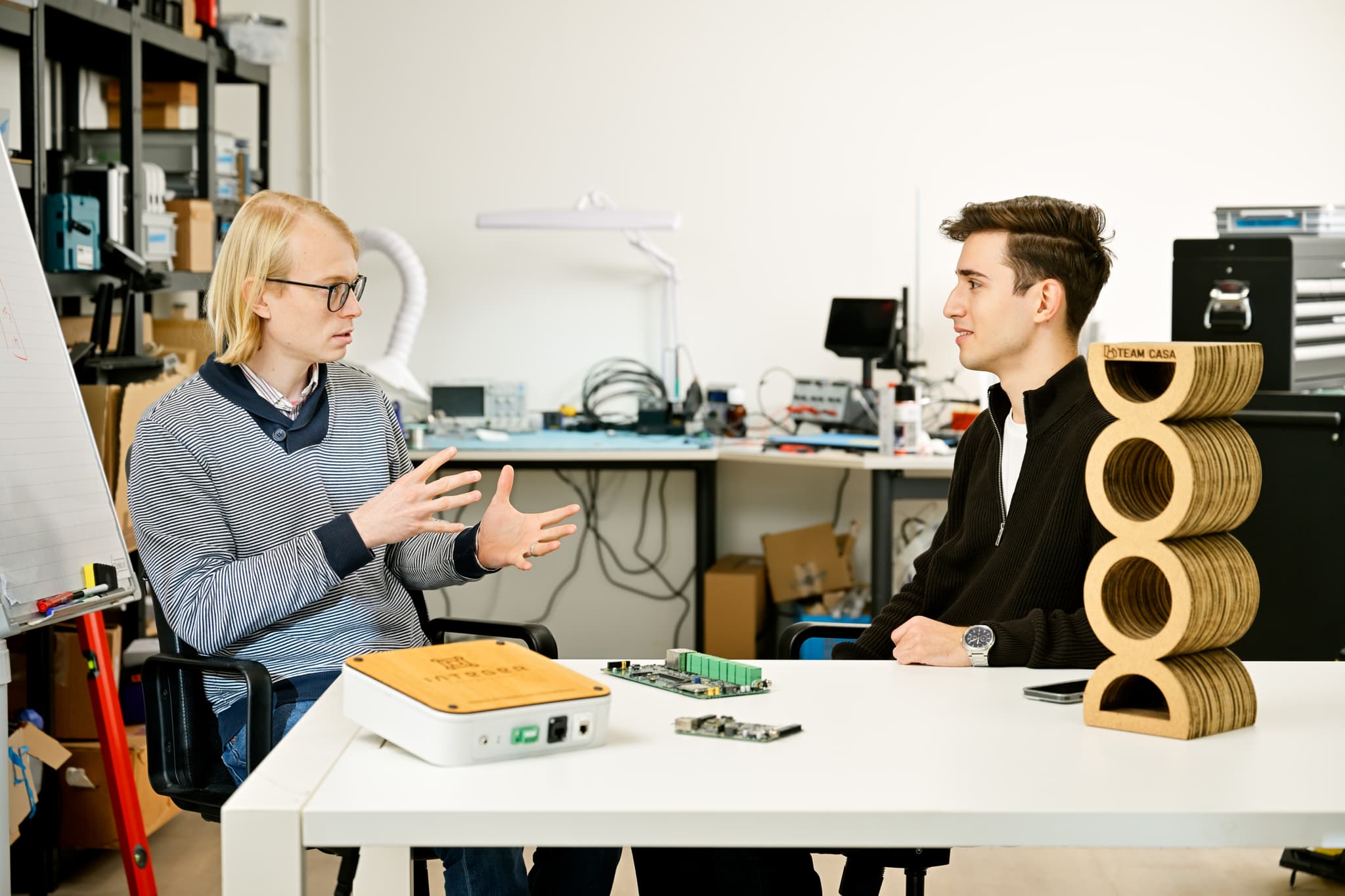
Antoine and Mihnea discussing their Team CASA experiences - © Bart van Overbeeke Fotografie
The people factor
Being part of any team undoubtedly involves a strong people component. In the position of team captain, both Antoine and Mihnea had to learn how to manage a group of people and put everyone's best talents to work for the team.
Antoine sees a student team as a collection of people with different backgrounds, skill sets, and attitudes. “Some join a team because they like the mission, some others because it would look good on their resume, or simply because they want to be part of something.”
“What was important for me was to turn the diversity into a strength and allow some sort of controlled chaos. Overall, what matters is for people to have fun. Being paid doesn’t count, as long as people enjoy being part of the project,” he continues.
As a bachelor’s student, having a sneak preview of how an architectural project is executed and how to interact with stakeholders is surely enriching for Mihnea. At the same time, he also believes he has improved his teamwork skills and has been recognized as the captain, gaining everyone’s trust. “As a team captain, you learn the difference it can make, sometimes, to make decisions. Involving all 15 of us in the discussion every time slows us down.”
Extra learnings
Skills development, hard work, and fun are the main ingredients behind every student team. The two team captains can only advise other students to join one. “Being part of a student team gives you an edge. It allows you to acquire some extra experience that one wouldn’t have, while making you grow as an individual,” says Mihnea.
According to Antoine, being part of a student team means learning in a radically different way than while studying for exams. “Most importantly, this experience exposes you to many more factors, such as working with companies and institutions, that one would never get exposed to as a student.”
Sponsored
This story is the result of a collaboration between 4TU.Federation and our editorial team. IO+ is an independent journalism platform that carefully chooses its partners and only cooperates with companies and institutions that share our mission: spreading the story of innovation. This way we can offer our readers valuable stories that are created according to journalistic guidelines.
Want to know more about how IO+ works with other companies? Click here