
Europe’s future hinges on cities' ability to innovate
As more people will move to cities, keeping them as livable as possible is a priority. Innovation can help in many ways.
Published on December 17, 2025
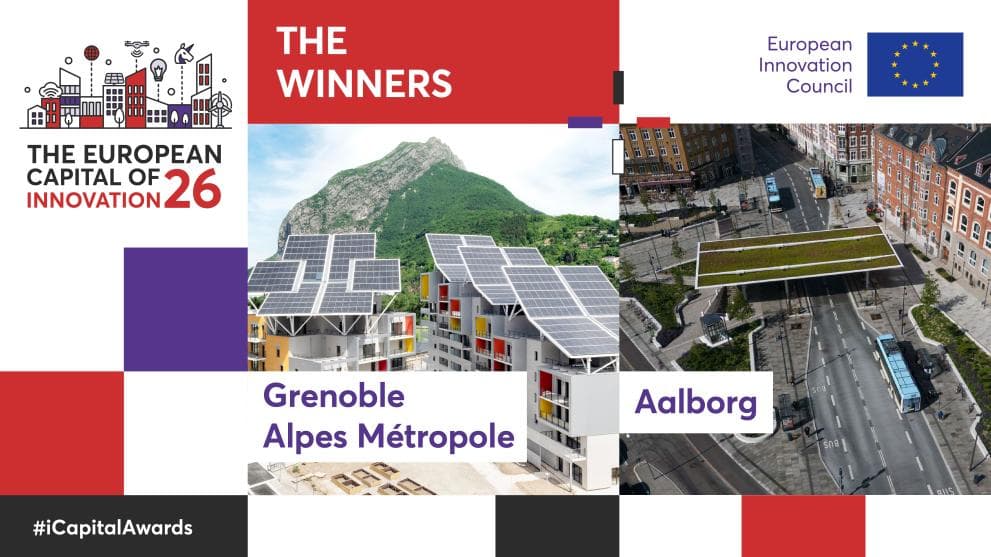
© EIC
Mauro swapped Sardinia for Eindhoven and has been an IO+ editor for 3 years. As a GREEN+ expert, he covers the energy transition with data-driven stories.
By 2050, up to 85% of the European Union's population will live in cities. Keeping urban areas liveable for everyone in the long term requires innovation. Some European cities are leading the way. The French city of Grenoble is Europe’s innovation capital for 2026, having been recognized for its approach to sustainable urban development, innovative infrastructure, and community-driven innovation.
During the Cities Innovate Summit held in Turin on December 3-4, representatives from European cities gathered to discuss ways to innovate in urban environments. The meetup was also a chance for the European Commission to hand out the European Capital of Innovation Awards (iCapital).
.png&w=2048&q=75)
Grenoble: top-notch research and participatory governance
The jury praised Grenoble’s combination of cutting-edge research with participatory governance. In fact, the city is one of Europe’s hotspots for research, home to the European Molecular Biology Laboratory (EMBL), the European Synchrotron Radiation Facility (ESRF), and the European Magnetic Field Laboratory (EMFL).
The city is home to 23,000 researchers and ranks as the world’s 7th-largest tech hub. As a result, the city’s ecosystem is strongly deeptech-focused. Deeptech companies develop innovations grounded in fundamental scientific research. 44% of the 475 startups active in Grenoble are in deeptech—three times the national average.
The region is striving to keep innovation-driven transitions inclusive, ensuring that both urban and rural communities benefit. "Innovation must be accessible to all," said Florent Cholat on stage. He is a councillor for the Grenoble metropolitan area.
In 2022, Grenoble was the first French city to start a Metropolitan Citizen Climate Convention. This initiative brought together more than 100 randomly selected citizens to propose actions to reduce greenhouse gas emissions and achieve carbon neutrality by 2050.
Rotterdam: citizen involvement and fertile startup ground
Rotterdam finished second. Maaike van Asten, Rotterdam’s Director of Economic & Sustainability Affairs, underscored that the prize recognizes the work done over the past years. “Our city is in a constant transition, and in these past few years, we have been transitioning from being home to the largest port to the smartest one,” she said.
An initiative highlighted during the ceremony is CityLab010, a program that supported over 250 innovative projects to make the city greener, more inclusive, and safer. Placity.net, for instance, is an AI-powered smart-city and placemaking platform designed to help residents and decision makers connect and shape the city’s urban development.
At the same time, the city has also worked to establish a thriving startup scene. In 2019, after gathering input from the ecosystem, the municipality launched Up!Rotterdam an integrated program to help startups and scale-ups access financing, talent, and markets.
How to further stimulate this vision? “Everyone thinks in terms of risk. I think it would be more fruitful if we could think in terms of opportunities and act together with other stakeholders to keep giving impetus to our ecosystem,” Van Asten added.
From an industry-based economy to a knowledge-based one
The Danish city of Aalborg won the Rising Innovative City category, awarding towns with up to 250,000 inhabitants. The city was recognized for its effective integration of technology into urban planning and for fostering a vibrant innovation ecosystem across multiple sectors.
The city, once an industrial powerhouse in the country, is now undergoing a reconversion. One of the town's highlighted initiatives is an extensive carbon capture plan, with CO2 sequestered from industrial plants and used to produce aviation fuel. "We want to produce sustainable aviation fuel for Europe and beyond," said Mayor Lasse Frimand Jensen.
Another contender in this category was the Spanish city of San Sebastian. The Basque town has also worked to transform itself into a life sciences and technology hub. “Over the last 25 years, we have worked to move from an industry-based economy to a knowledge-based one,” stated Jon Insausti Maisterrena, the city’s mayor.
The official of the Basque city also highlighted how San Sebastian is now home to over 6,800 researchers, working in 30 centers distributed across the urban area. This move towards knowledge also meant reinforcing the education system. Approximately one-third of the city’s residents hold a university degree.
Cities cannot do it all by themselves
A shared message came from the representatives: cities cannot bear the burden of all societal transformations alone. “We cannot succeed alone,” said Aalborg’s mayor. “Fostering public–private partnership is the starting point, and we must lead by setting concrete targets and taking action—not just talking.” San Sebastian’s mayor also echoed this view.
Momchil Sabaev, Director of the European Innovation Council (EIC) and SMEs Executive Agency (EISMEA), presented the prize on stage. “Cities matter more than ever for Europe’s future. The future of Europe’s transformation hinges on cities, and the Commission intends to invest in them.”
To this end, the Commission recently unveiled its new Agenda for Cities, a strategic vision to empower cities to tackle local challenges and contribute to broader EU goals. The agenda identifies three areas of action: continuous dialogue, simplification and capacity building, and investment.
As Europe navigates the digital and the energy transition, cities need to be on the front line, becoming innovation test labs and embracing new technologies. The real challenge will be to scale local breakthroughs into shared progress, ensuring that cities, towns, and villages can help shape the future—and that no one is left behind.