
Cold fusion and the patent application that came too soon
In a series of blog posts, Marco Coolen offers a glimpse into his work as a Dutch and European patent attorney at AOMB.
Published on November 22, 2026

Marco, a patent attorney at AOMB since 2013, shares his expertise on IO+ about patents—how they work, why they matter, and when they lose their value.
In 1989, it seemed for a brief moment that the world had found a solution to virtually all of its energy problems. Two scientists presented a discovery so spectacular that the international press pounced on it en masse. Nuclear fusion at room temperature, without the massive facilities and extreme temperatures normally required. Clean, virtually unlimited energy from a relatively simple laboratory setup. The end of energy bills seemed within reach.

Marco Coolen, photo © Bart van Overbeeke
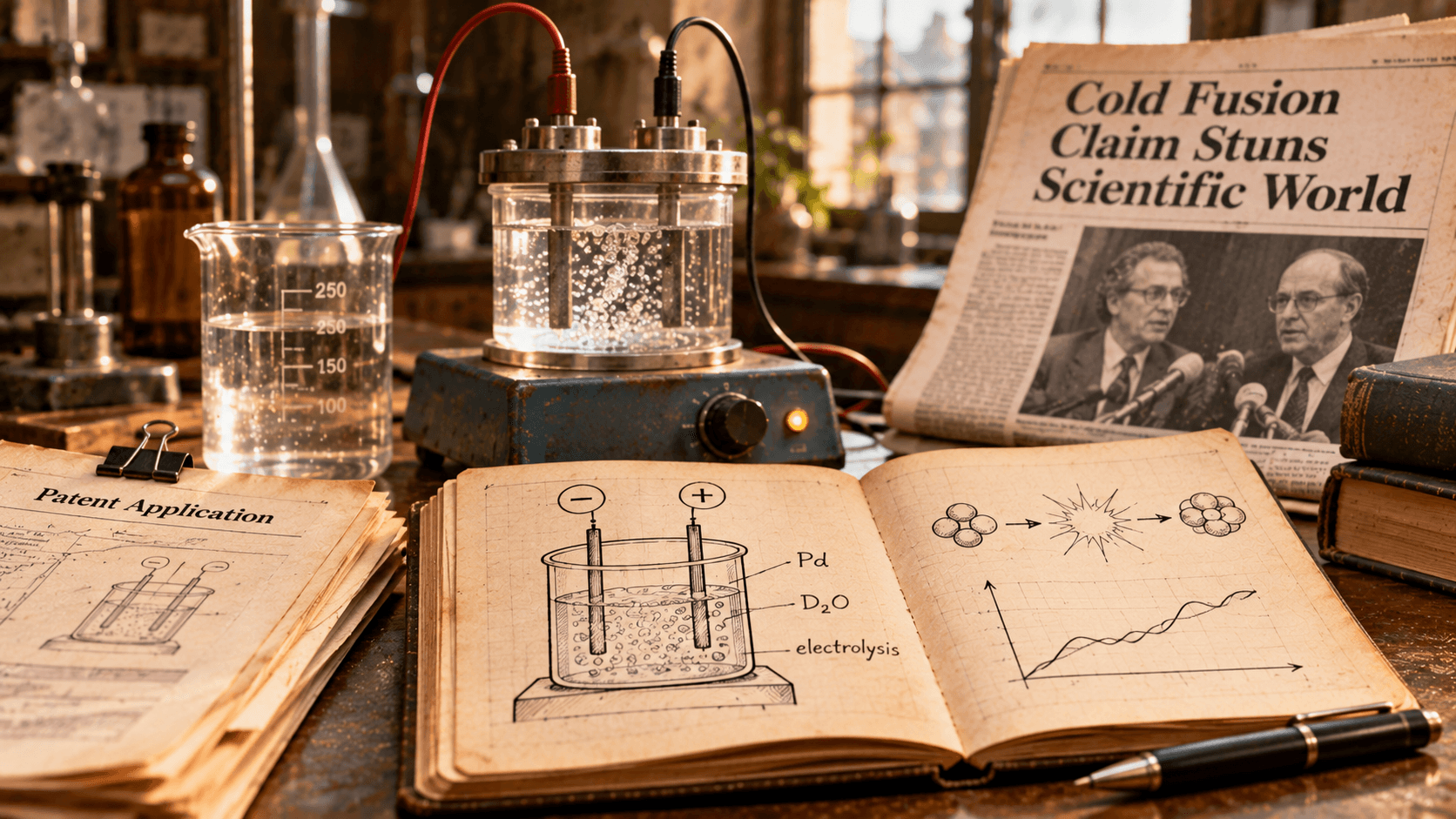
Researchers Martin Fleischmann and Stanley Pons announced their discovery at a press conference at the University of Utah. Their experiment centred on palladium, heavy water, and electrochemical processes. According to the researchers, the process generated more heat than ordinary chemical reactions could explain. They were convinced that the explanation had to be nuclear fusion.
The news sent shockwaves through the scientific community. Scientists around the world immediately set to work to replicate the experiment. After all, if the results were accurate, it would not only transform the energy sector but potentially the entire global economy. One problem remained: independent researchers could not convincingly replicate the spectacular claims.
The initial euphoria gave way to scepticism. The scientific evidence proved insufficient, and cold fusion slipped from promising breakthroughs into the category of the most famous scientific controversies. Meanwhile, they also filed patent applications to protect the alleged technology.
And that’s where this story touches on an important principle of patent law.
A patent is not, in fact, a reward for a brilliant idea. It is an agreement between the inventor and society. In exchange for a temporary exclusive right—typically for a maximum of twenty years from the filing date—the inventor must disclose his technical solution. And not just in a general way. The description must be sufficiently clear and complete to enable a person skilled in the art to carry out the invention.
Obvious?
That sounds obvious, but in practice, things often go wrong. Entrepreneurs get excited about an initial experiment, an unexpected result, or a promising hypothesis. The commercial potential seems enormous, and the fear that a competitor might run off with it is understandable. So they quickly draft a patent application.
However, the technology sometimes turns out to be insufficiently developed. The results are inconsistent, essential process conditions are missing, or the description focuses primarily on what the invention is supposed to achieve. An ambitious promise, however, is not the same as a workable technical solution.
That does not mean, however, that you can only file a patent application once your product is fully developed or commercially ready. A working prototype is not always necessary. Nor does an invention have to be reproducible by every researcher without any difficulty. What matters is that the application contains the necessary technical information and that the claimed functionality is substantiated with sufficient credibility.
The history of cold fusion shows just how great the difference can be between a spectacular claim and a demonstrable invention. Enthusiasm, media attention, and commercial expectations cannot replace technical reality.
My advice to entrepreneurs is simple: protect your invention promptly, but not before you know what you’re protecting.
An idea may well have rough edges. But a patent application must contain more than just the hope that it will someday work.
The World of Patents
With the help of Dutch and European patent attorney Marco Coolen (AOMB), we can better understand the world of patents. How do they work, why are they important, and when do they lose their usefulness?