
Can gut bacteria remove forever chemicals from your body?
A Danish company is launching a bacteria-filled capsule that helps remove forever chemicals from your body.
Published on March 6, 2026
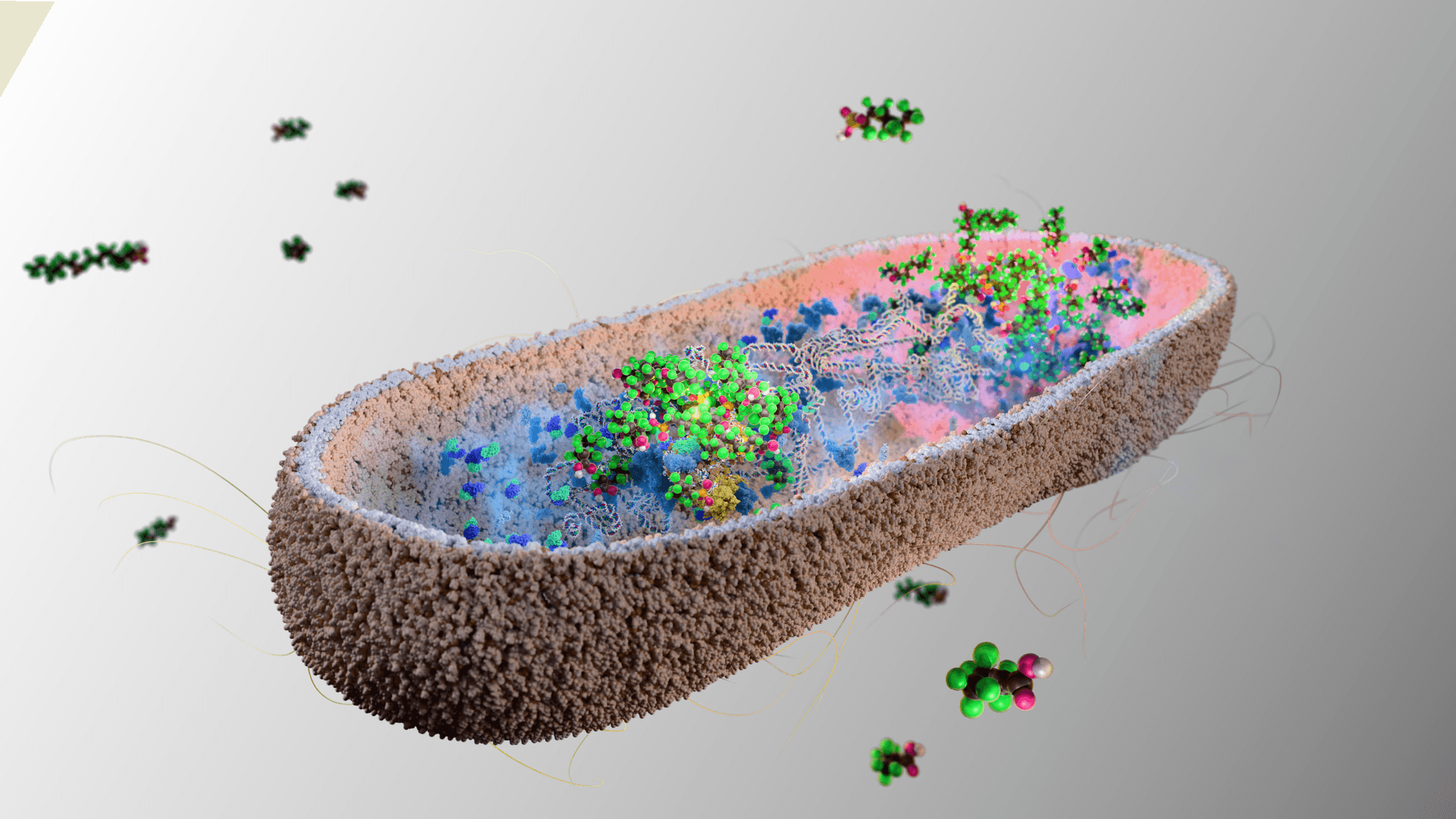
llustration showing gut bacteria accumulating perfluorononanoic acid – a forever chemical – as dense clumps. © Peter Northrop - MRC Toxicology Unit

Mauro swapped Sardinia for Eindhoven and has been an IO+ editor for 3 years. As a GREEN+ expert, he covers the energy transition with data-driven stories.
“PFAS contamination is similar to smoking. They might not kill you, but they certainly make your life shorter,” states Peter Holme Jensen, CEO and co-founder of Cambiotics. The company is pioneering against the so-called forever chemicals, which, as research showed, are in the blood of every Dutch citizen.
Hailing from Copenhagen, the company is developing a new dietary supplement that removes substances through the digestive process. Research conducted on mice by cofounders Dr. Anna Lindell and Professor Kiran Patil at the University of Cambridge’s MRC Toxicology Unit found that two species of human gut bacteria can effectively clamp PFAS and help eliminate them from the body.
Forever chemicals, scientifically known as PFAS (per- and polyfluoroalkyl substances), are a group of thousands of human-made chemicals found in cooking pans, coats, and food packaging. Their water- and grease-repellent properties make them unique. At the same time, these same properties make them hard to break—they can persist for thousands of years in the environment.
Given the extensive use in the past decades, PFAS now contaminate soils, water sources, and human bodies. They have been linked with several health problems, such as liver damage, thyroid disease, and developmental effects in children.

Beyond Borders
Innovation doesn’t stop at the border! In Beyond Borders, we spotlight disruptive innovations worldwide that can help tackle societal challenges in the Netherlands. How are they making an impact? How can they help?
PFAS disrupt life
Cambiotics is cultivating strains of bacteria already present in the human gut that have proven effective at bioaccumulating PFAS. The capsules will contain these microorganisms and, when taken after a meal, expel the artificial compounds from the body. “You can think of bacteria as a submarine that travels through your gut, capturing PFAS and carrying them out of the body via feces,” clarifies Jensen.
Previous research has showed that the human body can excrete short-chain forever chemicals through blood, urine, or breastfeeding. The long-chained ones, having stronger chemical bonds, can stick around for longer.
“Different from other toxic chemicals that accumulate in body fat, PFAS bind to proteins. As a result, they disrupt all body processes. Disturbing proteins work means disturbing life,” says the CEO.
Since we all have some PFAS contamination in our bodies, the capsules will be available to everyone. Depending on the contamination levels, a specialist may advise how long to take the dietary supplement.

Peter Holme Jensen
CEO and co-founder at Cambiotics
After his PhD in biochemistry, he jumped into the startup world, founding a few ventures, including Aquaporin and Cambiotics.
Firefighters' exposure to PFAS
Although everyone is exposed to forever chemicals, some groups are more affected than others. Firefighters, for instance. Fire extinguishing foams contain lots of PFAS, as do the gear emergency responders wear—designed to be water- and fire-resistant.
Research into firefighters’ exposure to forever chemicals suggested they can represent a potential cancer risk. Such occupational exposure results in higher PFAS levels in blood and shorter lifetimes. American firemen live 10 years less than their average compatriot, with many of them contracting cancer.
To this extent, Cambiotics is starting a clinical trial with a cohort of firefighters in the Chicago area. The study will last for six months. In the trial, using a crossover design, participants will receive both the placebo and the actual treatment, with a washout period in between. Through this structure, Jensen expects to gather stronger evidence.
The product is (almost) ready for the US—not for Europe
In parallel with the trial start, the Danish company plans to enter the U.S. market this year, with its capsule 46&. The commercial expansion is fueled by a €4 million funding round announced earlier this year.
The stark differences in regulatory pathways between the United States and Europe made the team opt to deploy the product in the American market first. Since Cambiotics uses a natural ingredient, American authorities require it to undergo a self-compliance process lasting a few months. The company has opened a waiting list for those who are interested in the product.
In Europe, market entry requires approval as a novel food ingredient. These are ingredients that haven’t been widely consumed before 1997. “Despite being a natural ingredient, 46& needs to pass the standard ingredient approval procedure, taking up to three years. Even though the product will be ready by the end of 2026, we don’t expect to launch in the European market until 2029,” states Jensen.
“On the one hand, we are still allowing thousands of production sites in Europe to spread PFAS in the environment. On the other hand, lengthy regulatory processes keep companies like ours, with natural solutions, out of the market,” he adds.

46& Product Illustration - © AM Copenhagen
PFAS are here to stay
Jensen, who holds a PhD in biochemistry, founded multiple companies in the past twenty years. At the water filtration firm Aquaporin, he had already dealt with PFAS contamination.
A few years ago, while looking for a new entrepreneurial idea, he ‘speed-dated’ scientists to bring science to market. “A lot of it remains in the university drawers. With my experience, I know what it takes to make that knowledge the foundation of a valid company,” he says.
The scale of the PFAS problem and the innovative approach pioneered by the Cambridge researchers convinced him to “jump on the wagon.”
The clinical trials' validity will be the company’s litmus test. If the effectiveness is proven in humans, the founder believes the company is well-positioned to succeed, given the rising awareness of PFAS contamination.
Since January, the revised EU Drinking Water Directive requires member states to track forever chemicals contamination and ensure compliance with the new limits. The rule has been slammed by critics as insufficient, targeting symptoms rather than the root cause. Given PFAS persistence, the fight has just begun.