
Brainport’s health ecosystem moves from startup success to scale
New study by Braventure and the Gerard & Anton Foundation shows the importance of the healthtech ecosystem for Brainport Eindhoven.
Published on June 3, 2026
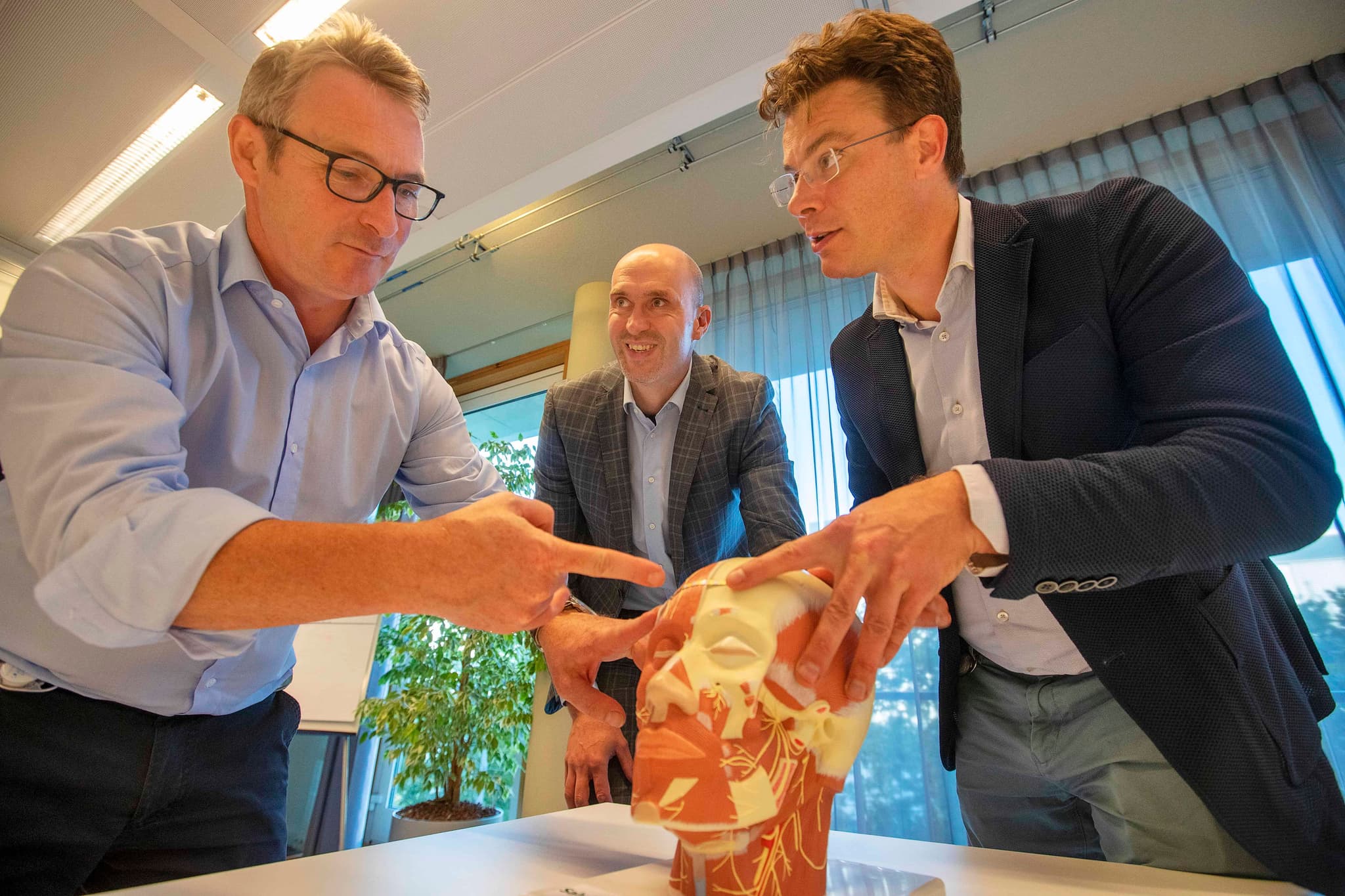
© Salvia BioElectronics
Bart, co-founder of Media52 and Professor of Journalism oversees IO+, events, and Laio. A journalist at heart, he keeps writing as many stories as possible.
A new Dealroom-based snapshot shows 47 active medtech and healthtech startups and scaleups in the Eindhoven region, together raising more than €600 million. New initiatives around research, biomaterials, clinical translation and ecosystem building may now help fuel the next generation. The study was performed by Matthijs Bulsink on behalf of the Gerard & Anton Foundation and Braventure. Studies around other sectors, like energy, semicon, photonics, and AI, are expected to follow.
Health has been part of Brainport’s DNA for decades. Long before the region became synonymous with semiconductors, photonics and deep tech, Eindhoven had already built a strong position in medical technology through Philips and the surrounding ecosystem of engineering, design, manufacturing and clinical application.
This new snapshot shows that this legacy has not disappeared. On the contrary, it has evolved into a substantial startup and scaleup ecosystem in medtech and healthtech. Based on the data from companies that reported their founding and funding rounds, Brainport Eindhoven now counts 47 active health startups and scaleups founded since 2010. Together, they have raised €611 million in capital across 114 funding rounds. That means health represents 32% of all active post-2010 Brainport startups and scaleups in the dataset, 24% of all regional funding raised, and 33% of funding rounds.
From the report
The numbers matter because they show that health is not a side theme in the Brainport economy. It is one of its strongest applied deep-tech domains.
The companies in the snapshot cover fields that fit closely with the region’s wider technology base: implantables, bio-electronics, diagnostics, surgical robotics, AI diagnostics and regenerative medicine. That makes the health cluster more than a collection of individual startups. It is a reflection of Brainport’s broader strengths: precision engineering, systems thinking, advanced manufacturing, embedded electronics, software, data and clinical collaboration.
ONWARD tops the charts
Several companies already show that this combination can lead to international traction. ONWARD Medical, founded in 2014, has raised €207 million and develops spinal cord stimulation technology for people with spinal cord injury. Its ARC-EX therapy received FDA De Novo classification in December 2024, and a pivotal trial published in Nature Medicine showed that 90% of participants improved arm and hand function. Salvia BioElectronics, founded in 2017, has raised €81 million for its ultra-thin implant for chronic migraine. Ambagon Therapeutics has raised €88 million for oncology work around molecular glue stabilizers. MicroSure, Onera Health and Sirius Medical add further examples in robotics, diagnostics and surgery.
The 5 most successful medtech scale-ups in the Brainport region. (image from the report)
The second layer of companies shows how broad the field has become. ShanX Medtech works on ultra-fast antimicrobial susceptibility testing, cutting turnaround times from two days to hours. Xyall develops automated tissue microdissection for molecular pathology. PlasmaCure has a CE-marked cold-plasma pad for chronic wounds, reimbursed in the Netherlands. SmartQare offers continuous monitoring of vital signs on hospital wards.
Most urgent problems
All of these companies address some of healthcare’s most urgent structural problems: staff shortages, long waiting lists, antibiotic resistance, chronic disease, earlier diagnosis and the need to move care from hospital settings to the home.
The report also includes Ambyon as a case study. The company develops an autonomous logistics robot for hospitals. The problem it addresses is simple but costly: healthcare professionals can lose up to two hours per day on logistics, such as fetching medication, delivering lab samples or moving materials. Ambyon One is designed not as a care robot or replacement for staff, but as a “supporting colleague” that takes over side tasks so healthcare workers can spend more time on patients. According to the snapshot, the robot can save more than one hour per staff member per day, is live in four hospitals, with a fifth in preparation.
That example underlines a broader point: Brainport’s health ecosystem is not only about high-end medical breakthroughs. It is also about practical technology that can help keep healthcare functioning.
New generation
At the same time, a new generation is already forming. Among them are VivArt-X, a TU/e spin-off working on personalized regenerative solutions for breast reconstruction after breast cancer; AIKON Health, a TNO spin-off developing home monitoring for heart failure patients; and ARTIC Technologies, another TU/e spin-off, developing magnetic artificial cilia for microscale fluid movement, with applications in 3D cell culture platforms for preclinical research.
That pipeline is important, but the next question is whether the region can turn individual success stories into a durable healthtech engine. Here, the timing is significant. Over the past period, several initiatives have emerged that may strengthen the ecosystem structurally: the new TU/e HEALTH Institute, CUREON at High Tech Campus Eindhoven and the Smart BioMaterials Center, also located at High Tech Campus.
Together, these initiatives add something the first generation of startups could not build on its own: long-term infrastructure for collaboration, translational research, pilot production, talent development and ecosystem coordination. For medtech and healthtech companies, that infrastructure is crucial. Unlike many digital startups, health companies face long development cycles, regulatory complexity, clinical validation, reimbursement questions and the need to work closely with hospitals, researchers, insurers and patients.
The foundation is there
The first generation has shown that Eindhoven can build world-class health technology companies. The next phase will depend on whether the region can make the path from lab to clinic, from prototype to certified product and from first funding to international scale less fragmented.
The Dealroom-based snapshot suggests that the foundation is already there: 47 active companies, more than €600 million in capital raised, a growing cohort of young ventures and a clear connection to Brainport’s deep-tech strengths. The new ecosystem initiatives may now provide the missing layer around them.