
Wind and solar overtake fossil fuels in EU electricity generation
Wind and solar produced more electricity than fossil sources in 2025, according to new data by energy think-tank Ember.
Published on January 22, 2026
© Unsplash

Team IO+ selects and features the most important news stories on innovation and technology, carefully curated by our editors.
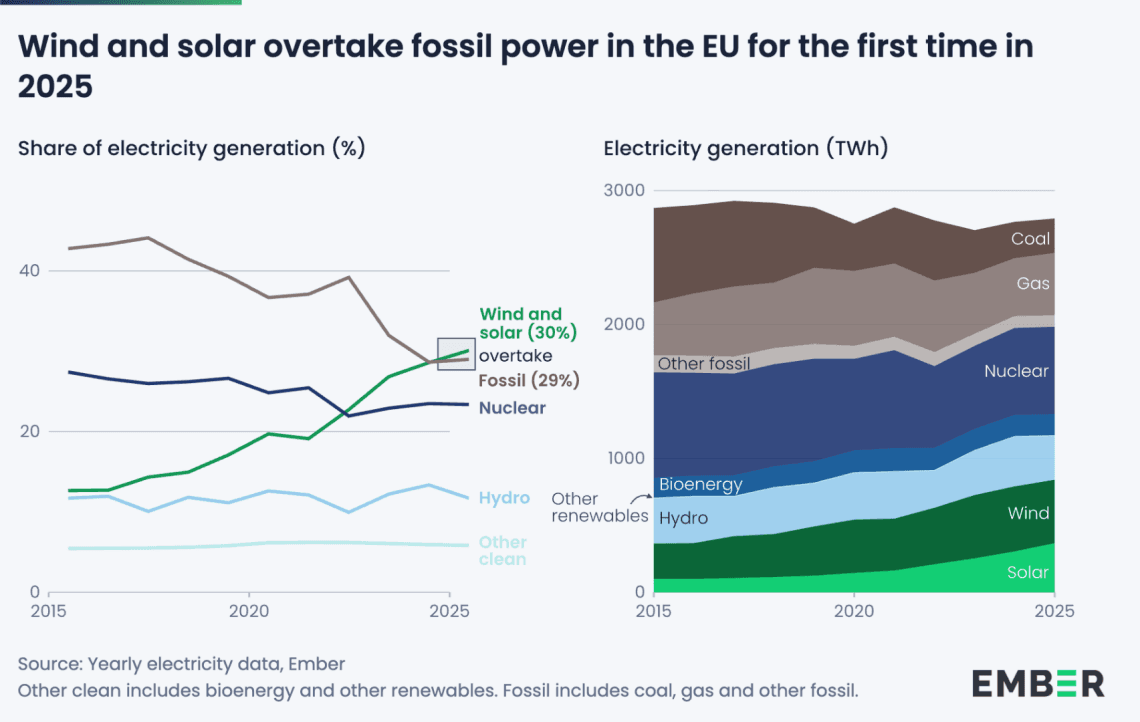
Wind and solar generated more electricity than fossil fuels in the EU in 2025, according to energy think-tank Ember's new report, European Electricity Review. This is the first time wind and solar have outpaced fossil fuels in electricity generation, accounting for 30% of power.
“This milestone moment shows just how rapidly the EU is moving towards a power system backed by wind and solar,” said report author Dr. Beatrice Petrovich. “As fossil fuel dependencies feed instability on the global stage, the stakes of transitioning to clean energy are clearer than ever.”
Ember's European Electricity Review is one of the most authoritative yearly reports on the EU power system. The analysis provides a comprehensive overview of both generation and demand data for the past year in the bloc.
Solar drives renewables rise
The analysis shows that the wind and sun's leap can largely be attributed to a significant increase in solar power generation, which in 2025 grew by over a fifth (+20.1%). Overall, solar-produced power accounted for 13% of total generation, surpassing both coal and hydropower.
A growth in solar panel installations fueled a surge in solar power generation across all EU member states. In the Netherlands, Cyprus, Spain, Greece, and Hungary, solar provided over a fifth of the total electricity.
Overall, renewables (including hydropower and other clean sources) accounted for 48% of EU power. Ember analysts explain how unusual weather conditions caused hydro and wind power generation to plunge by 12 and 2%, respectively. Yet, these conditions favored solar generation. Wind confirmed itself as the second-largest source of EU electricity (17%), producing more power than gas.
The report underlines how wind and solar generated more electricity than fossil sources in 14 of the 27 EU member states in 2025. Wind and solar have experienced significant growth (from 20% in 2020 to 30% in 2025). Over the same period, fossil fuel generation dropped to 29% from 37%. Hydro and nuclear generation remained stable or slightly declined.
© Ember
Gas generation increases, driving bills and electricity prices up
The drop in hydropower generation was compensated for by gas, whose generation grew by 8%. Nevertheless, Ember underscores that gas remains on a downward trend and is 18% below its recent 2019 peak.
As a result, the gas import bill grew to €32 billion in 2025, 16% higher than the year before. It is the first time since the 2022 energy crisis that gas import costs have increased, with Italy and Germany paying the largest shares of this sum. Additionally, the hours with the most gas use drove electricity price spikes. On average, electricity prices rose by 11% in European countries during those hours.
Coal use keeps declining
Whereas in 2015 coal accounted for a quarter of EU electricity generation, by 2025 it had fallen to a new low of 9.2%. In 19 EU member states, coal power is at zero or less than 5%. Germany and Poland, historically the two countries most reliant on coal, also recorded their all-time low in coal electricity generation.
“The next priority for the EU should be to put a serious dent in reliance on expensive, imported gas,” continued Petrovich. “Gas not only makes the EU more vulnerable to energy blackmail, but it’s also driving up prices. In 2025, we saw some early signs of using more battery storage to shift homegrown renewable power to gas-heavy hours. As this trend accelerates, it could limit how much gas is needed in evening hours, therefore stabilising prices.”