
Whispp builds trust and protection: why IP is crucial
For AI startup Whispp, patents are more than legal protection. "The mere perception that you take things seriously makes a difference"
Published on June 11, 2026

Bart, co-founder of Media52 and Professor of Journalism oversees IO+, events, and Laio. A journalist at heart, he keeps writing as many stories as possible.
When Whispp started a few years ago, the focus was primarily on the technology itself: AI that converts whispered or voiceless speech into natural-sounding speech. But as the Leiden-based company grew, founder and CEO Joris Castermans also changed the way he viewed intellectual property. What began as a technical innovation evolved into a strategic game around protection, credibility and scalability of IP.
"Initially, we were actually planning to start via a B2C route," says Castermans. "An app for people with voice disorders. But we quickly noticed that such a route is incredibly difficult to scale and expensive. It requires enormous marketing power."
That search led Whispp toward a different business model: licensing. Not conquering the market themselves, but licensing the technology to larger market players. And it was precisely there that IP suddenly became essential.
Series on startups and patents
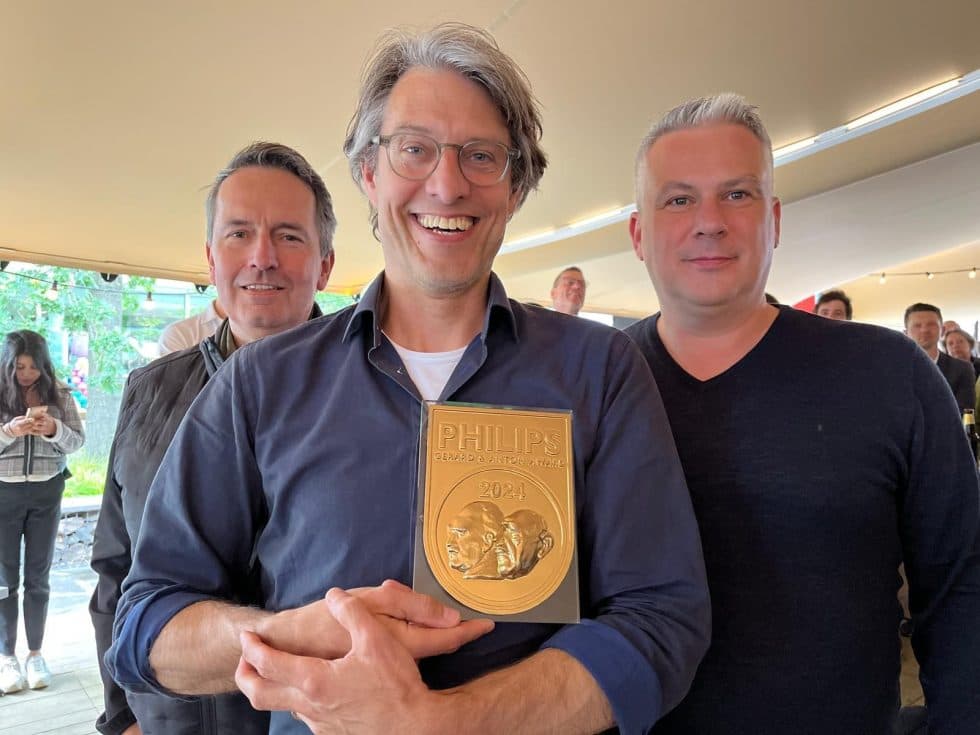
This article is part of a series in which we ask former winners of a Gerard & Anton award about the importance of patents and intellectual property (IP). Read the full series here.
From technology to negotiating a position
Whispp is currently involved in paid pilots with various parties. The actual licensing agreements are yet to follow. But it was precisely in that phase that a solid patent portfolio proved of great value. "To be able to conclude such license agreements, it is of course much stronger when you have properly documented your technology," says Castermans. "We have worked very hard on that over the past months."
Whispp filed its first patent application just over a year ago. Since then, four additional applications have followed. Not only to protect the technology, but also to radiate confidence. "We notice that even the perception that you take things seriously helps enormously. That you come to meetings with parties well-prepared. That's where it starts."
According to Castermans, this also increases the company's value, especially for investors. Because five filed patents, due to regional distribution, amount to several dozen. "You have to imagine: at some point, those patents are applied for internationally. Then it almost becomes a kind of power play: look at how much protection we have."
Protecting in an AI world
For AI startups, intellectual property is often more complex than for traditional hardware companies. Many entrepreneurs also believe that software and AI simply cannot be patented. But according to Castermans, that picture is only partially correct. "Because as soon as you truly create a new technical solution, or an inventive process or method, there are certainly possibilities."
This is an important insight for young deep-tech companies, especially now that AI solutions are increasingly integrated into physical products or specialised applications.
At Whispp, this is particularly relevant because part of the AI runs locally on devices, so-called on-device AI. This makes protection more complex. Companies with which Whispp conduct pilot projects therefore receive hardware in specially secured enclosures. "We make those devices as tamperproof as possible," says Castermans. "Connectivity is removed, data outputs are sealed off. But ultimately, of course, these are technical companies that know exactly how to get into something."
This is another reason why IP is becoming increasingly important, according to him.
Continuously scanning for risks
In addition to protecting its own technology, Whispp must also continually check whether it is not inadvertently infringing existing patents. For this purpose, the company carries out so-called white space analyses on a regular basis: scans of existing patents and technological developments. "That is truly an ongoing process," says Castermans. "Fortunately, we now have AI tools that help with that."
Whispp's AI engineers also regularly follow scientific publications and new papers in their domain. "That is at least as important as those patent scans." Notably, Whispp has not yet found any patents the company wants to license or acquire. "That is actually quite reassuring," he says with a smile.
The role of the Netherlands Patent Centre
In the early phase, the Netherlands Patent Centre (Octrooicentrum Nederland), part of the Netherlands Enterprise Agency (RVO), played an important role. Through conversations and so-called pre-scans, Whispp gained early insight into the possibilities and risks around IP. "That was incredibly valuable," says Castermans. "Especially in the phase when you are still searching."
Whispp now also works with specialised international patent advisors and legal counsel, partly thanks to its network of investors and experienced technology professionals. But he continues to see great value in the support from the Netherlands Patent Centre.
Subsequently, the challenge is to find the right patent attorney. According to Castermans, one lesson is crucial here: find specialists who truly understand your field. "If it's about audio AI, you need someone who understands that domain. That really makes a difference."
Patents as a growth accelerator
Whispp's growth spurt, made possible in part by new rounds of financing, has put the company's IP strategy into high gear. Where patents were initially mostly a future prospect, they have now become an integral part of the business strategy.
Not because Whispp itself wants to earn money by selling patents, Castermans emphasises. "That is not our strategy. For us, those patents are primarily supportive of the technology and the licenses."
But in an AI market where technological advantages can disappear at lightning speed, they do form an important foundation for the company's further growth. Or as Castermans summarises it: "You raise the bar for others to simply copy what you do. And at the same time, you show that you are a serious company."