
Wennink report shows urgency, discomfort: “The future won't wait”
Peter Wennink: “Without a leap in productivity, targeted tech investments, and a different management culture, Dutch prosperity will erode.”
Published on December 12, 2025
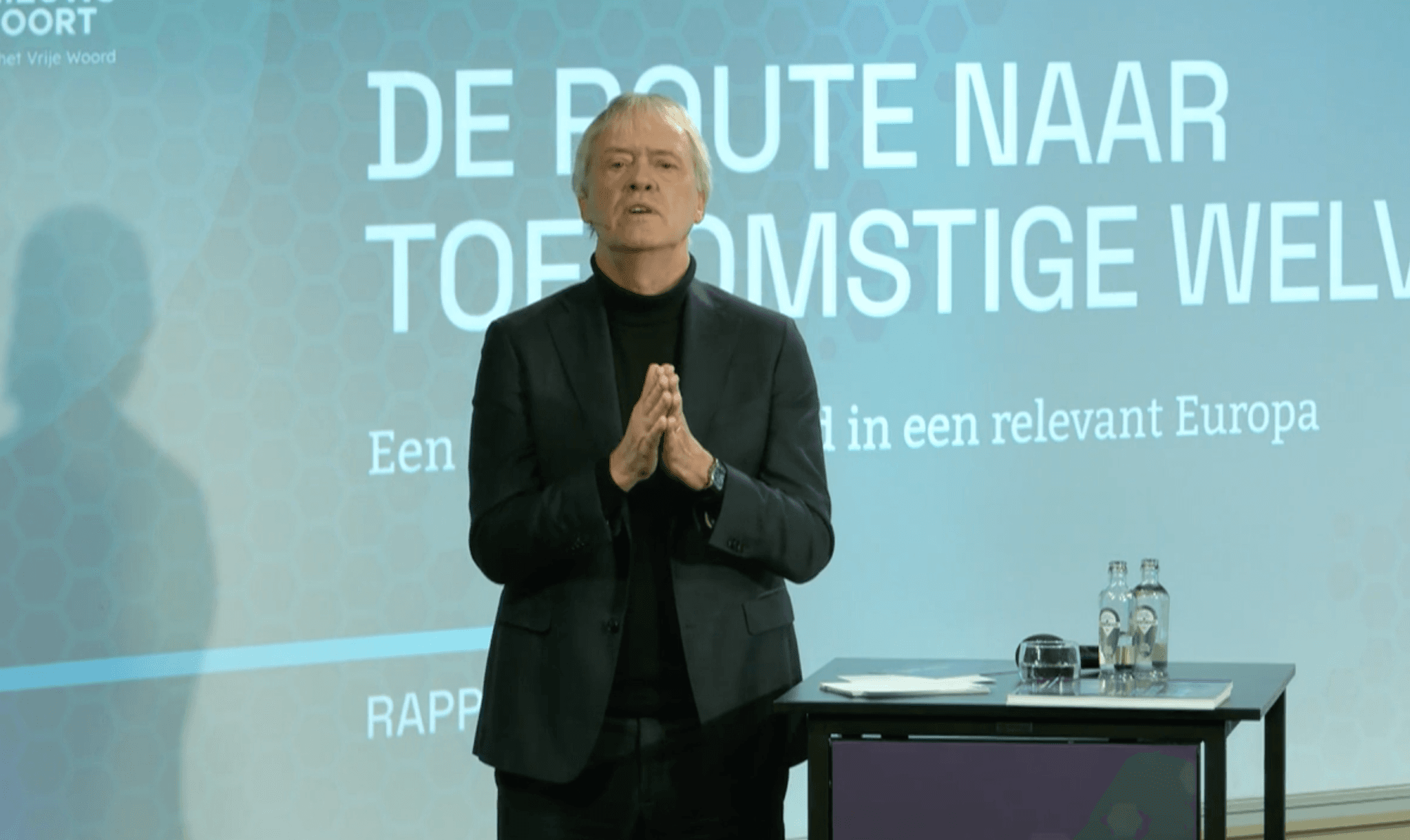
Peter Wennink presenting his report on December 12, 2025
Bart, co-founder of Media52 and Professor of Journalism oversees IO+, events, and Laio. A journalist at heart, he keeps writing as many stories as possible.
The Netherlands is one of the richest and happiest countries in the world. But the Wennink Report, entitled “The Road to Future Prosperity” and written as a Dutch translation of the Draghi report on Europe, is marked by a sense of urgency and unease. “Dark clouds are gathering over society,” writes Peter Wennink. The war in Ukraine, an aging population, the energy transition, housing shortages, and pressure on healthcare and education: together, they “make it clear that the foundation of our prosperity is beginning to erode.”
His central message is brutally clear: if the Netherlands does not invest very specifically in productivity and technology, we will lose both our broad prosperity and our strategic relevance. And that will happen faster than we would like.
Growth below the lower limit
According to Wennink, the core of all major challenges - healthcare, pensions, defense, energy transition - is economic in nature. To sustain them financially, “annual economic growth of at least 1.5% to 2.0% per year is necessary.” The forecasts from DNB and CPB are well below that: 0.5–0.9% annual growth. “Too little to maintain our services, let alone improve them.”
This is not a technical nuance, but a significant blow to prosperity. Without additional growth, government spending in 2035 will exceed revenues by more than €100 billion per year, or there will have to be substantial cuts in healthcare, social security, and other basic services. The report puts it bluntly: in practice, low growth means “a structural decline in our prosperity.”
Higher taxes alone? That directly affects citizens. At the current growth rate, an average household will lose around €1,700 in purchasing power per year by 2035; with even lower growth, that figure will rise to more than €7,000. Growth is not a fetish here, but a line of defense for the welfare state.
The Achilles heel: productivity
The scope for working even more is virtually exhausted. 85% of Dutch people aged 15 to 64 are available for work, which is exceptionally high by international standards. “Due to the limited potential for an increase in labor input, economic growth will mainly have to come from rising labor productivity.”
And that is precisely where things go wrong. Dutch productivity growth averaged only 0.6% per year over the past two decades, compared to 1.8% between 1974 and 2003. Meanwhile, the US managed to achieve 1.7% per year over the past decade, partly thanks to an explosive tech sector.
According to TNO Vector and RaboResearch, reversing this trend will require an investment boost of €151 to €187 billion over the next ten years, almost entirely in “highly productive parts of our economy.” That is around €19 billion per year.
Wennink argues that investments are currently being misdirected: we are putting relatively large amounts of money into bricks and mortar (homes, commercial buildings) and too little into machinery, R&D, and digital infrastructure. Wennink quotes Nobel Prize winner Paul Romer: “Growth comes from better recipes, not just from cooking more.” In other words, without technological innovation and capital goods that truly increase labor productivity, growth will slow.
Strategic relevance in four areas
The productivity challenge coincides with a geopolitical tech race that Europe is losing. The gap in investment by large companies between Europe and the US grew from 36 to 76 percent in seven years – a difference of around €700 billion per year. American companies now invest more than four times as much in capex and R&D as European companies, and Chinese companies are rapidly catching up.
Wennink is unusually political here: “Those who don't count technologically are not at the table – and those who are not at the table are on the menu.”
In order not to become merely a “consumer” of foreign technology, the Netherlands must choose niches in four key areas:
- Digitization & AI
- Security & resilience
- Energy & climate technology
- Life sciences & biotechnology
These domains “form the backbone of the major transitions of this century” and “increasingly determine the geopolitical balance of power.” It is precisely in these areas that our dependencies are now greatest: on American cloud providers and AI platforms, on Chinese batteries, materials, and pharmaceutical ingredients.
At the same time, the Netherlands has a strong starting position, with ecosystems such as Brainport Eindhoven, Rotterdam, Schiphol, Leiden Bioscience Park, and Wageningen Foodvalley. But without sharp choices and upscaling, these hubs are also at risk of losing ground.
Four preconditions that are currently blocking progress
The good news is that the willingness to invest is there. For the report, 51 concrete propositions were collected, developed by more than a thousand experts in thirty consortia, representing an investment potential of €126 billion – largely to be financed privately.
The bad news: “These investments will only materialize if the preconditions are in place.” And this is precisely where Wennink talks about “overdue maintenance.” He distinguishes four issues:
- Permits & regulations - The current system lacks “speed and decisiveness”; social goals are subordinated to “slow and complex procedures.” The nitrogen impasse, endless appeal procedures, and risk-averse regulators are blocking strategic projects. Solution: speed up the licensing process for crucial energy and industrial projects, implement national control over strategic issues, and introduce regulatory sandboxes for groundbreaking innovations.
- Talent & education - “Year after year, the quality of our education is declining, and technically skilled talent is becoming increasingly scarce.” At the same time, the Netherlands discourages international students and knowledge workers and lacks a serious system for retraining and further education. Wennink advocates a National Talent Agenda and a reassessment of social security and labor market policy to ensure that skills and mobility align with our technological ambitions.
- Affordable, reliable energy - Grid congestion is keeping thousands of companies from connecting to the electricity grid, while electricity is more expensive here than in neighboring countries. This threatens to drive away strategic industries. Short term: more flexible use and prioritization of grid capacity and temporary tax incentives. Long term: a “robust energy mix with sufficient security of supply” for industry and strategic clusters.
- Economic infrastructure & ecosystems - Ecosystems such as Rotterdam, Schiphol, Brainport, and the knowledge campuses need a national reinforcement plan: space, housing, energy infrastructure, digital networks, and knowledge infrastructure. Public-private partnerships are key here to provide confidence and long-term investment security.
A new investment machine, remote from politics
Preconditions alone are not enough for the Netherlands. Wennink also outlines a new financial and administrative architecture.
Financially, he proposes two institutions:
- A National Investment Bank with €10-20 billion in working capital, which bundles existing instruments and mobilizes up to €100 billion in investments through public-private co-financing.
- A National Agency for Groundbreaking Innovation with an annual budget of €2 billion, focused on ecosystems and strategic innovation projects.
Both institutions must “operate at arm's length from politics, with professional management and a clear mandate” to ensure long-term stability. In parallel, the government must reduce consumer spending, eliminate tax leaks, and be prepared to “responsibly increase the national debt” for investments with demonstrable economic returns.
Administratively, Wennink advocates for a firm anchoring of future earning capacity in the political leadership. It must become a matter for the prime minister, with direct responsibility. The Minister of Economic Affairs will regain control over energy and trade, and an independent Commissioner for Future Prosperity will be given a legal mandate, its own fund, and an implementation unit to break through impasses, for example, around grid congestion.
This will require a cultural shift within the civil service. The “excessive pressure to be accountable” has led to “process fetishism”: processes have become more important than goals, and “the government is no longer sufficiently serving society.” Administrators and supervisors must once again “dare to take risks and pursue social goals quickly and decisively.”
The Netherlands is willing, but it must also be allowed to do so
What makes the report striking is its combination of urgency and optimism. Wennink sees entrepreneurs, researchers, healthcare professionals, and civil servants throughout the country “who want to build the future.” “They are highly willing to invest, innovate, and take responsibility. What they ask for is direction and space. The Netherlands is willing, but it must also be allowed to do so.”
Creating that space - in rules, energy, talent, governance, and financial instruments - is precisely what the Wennink Report calls for. Not as an abstract growth plan, but as a condition for keeping healthcare, education, security, and climate affordable and for continuing to play a leading role as a technology country rather than being left behind.
Wennink's last sentence is both a warning and an invitation: “Not acting is also a choice.” And then, almost casually: “The future will not wait.”