
VTEC’s ‘Quspads’ aim to break quantum free from the freezer
A new photon detector promises room-temperature quantum performance, at a fraction of today’s cost and energy use.
Published on December 13, 2025
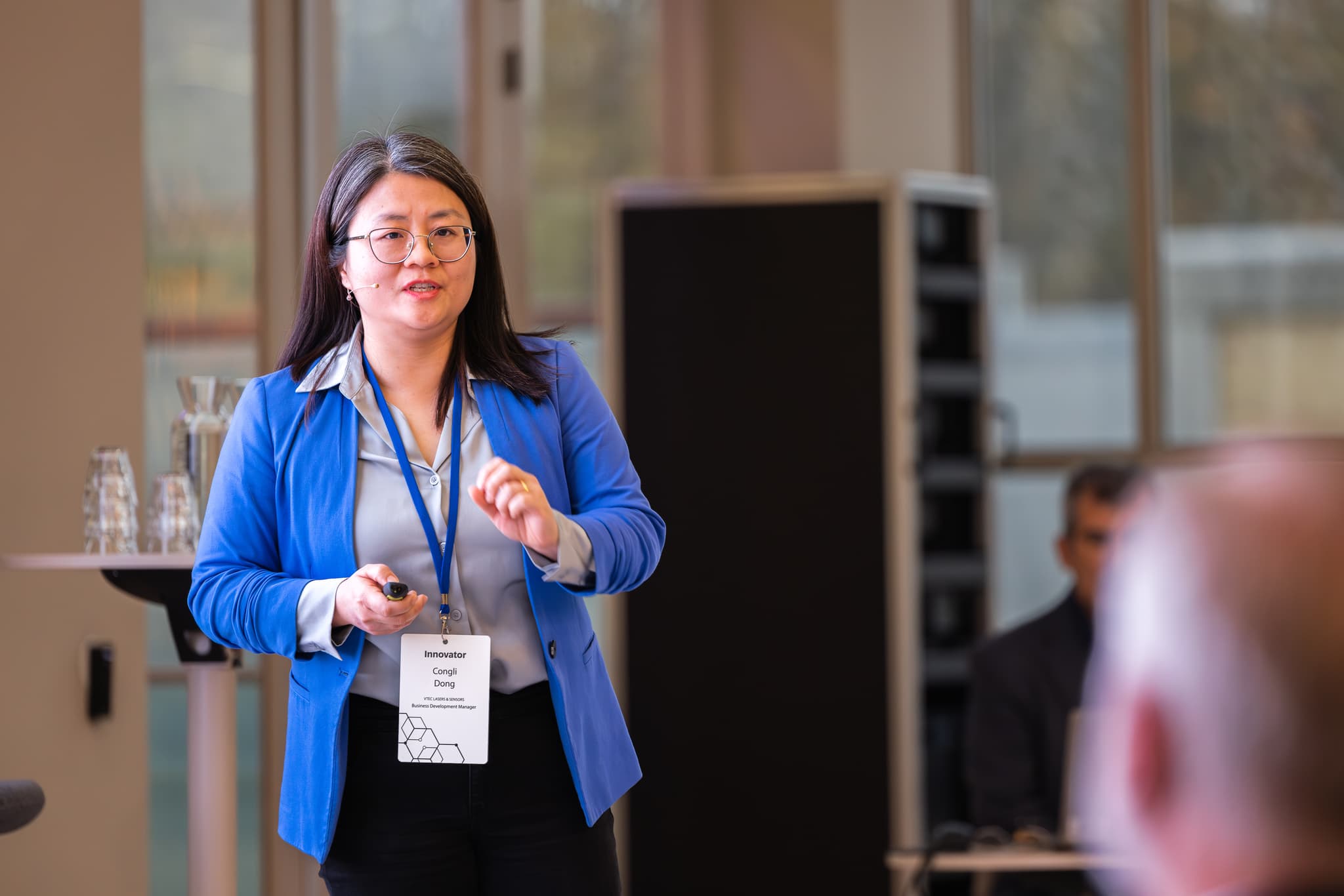
Qongli Dong, VTEC © Nadia ten Wolde

Bart, co-founder of Media52 and Professor of Journalism oversees IO+, events, and Laio. A journalist at heart, he keeps writing as many stories as possible.
At the Blue Magic Netherlands event, among defence giants, drone-spotters and satellite innovators, one of the most radical ideas on stage came from a compact photonics lab in Eindhoven. VTEC Lasers & Sensors, known regionally for its deep semiconductor know-how, presented something deceptively small: a detector that can “see” individual photons, the smallest packets of light.
But as CBO Congli Dong made clear, this wasn’t just another incremental step in photonics. It is an attempt to rewrite the economics and the practicality of quantum technologies. “VTEC is an Eindhoven-based company specializing in designing and manufacturing photonic chips and devices. Today I'm not presenting the company,” Congli began. “I'm presenting the Quspads project.”
Quspads are high-efficiency single-photon avalanche detectors (SPADs). These devices sit at the heart of quantum computing, quantum communication, advanced LiDAR, and biomedical imaging. Their job is simple to describe but notoriously difficult to do: they must detect one single photon and convert it into an electrical signal without creating noise, errors, or heat.
For years, the gold standard has been the superconducting nanowire single-photon detector (SNSPD) - a device so sensitive that it must operate at temperatures close to absolute zero. That means cryogenic refrigerators, oversized infrastructure, and power bills that only large research labs or national quantum programs can justify.
Congli quoted customers frankly: “It is not sustainable anymore to keep using these detectors. They are costly, bulky and complex.”

Blue Magic Netherlands
Read our stories about this event, focused on innovation in the defense industry.
Quantum without the fridge
VTEC’s answer is the Quspad: a detector built on indium phosphide chip technology that operates at room temperature, with no cryogenic cooling required. “Our device can operate in much higher temperatures, even room temperature,” Congli said. “That makes it more energy-efficient, more compact, and at much lower cost.”
In numbers, the claimed improvements are striking: 10× lower cost, 30× smaller size, and 10× lower power consumption.
This is not just a performance argument; it is an adoption argument, Congli said. Quantum computing startups, national labs, and photonics companies repeatedly face the same bottleneck: the superconducting detectors they rely on are some of the most expensive and limiting components in the entire optical chain.
If VTEC’s detector delivers comparable photon detection efficiency and low dark-count rates (two parameters that rarely coexist in one device), the company may be positioned to unlock vastly larger markets. “Existing single-photon avalanche detectors can’t do both,” Dong explained. “Either the efficiency is high but the noise is terrible, or vice versa. Our design aims to combine the best of both.”

Qongli Dong, VTEC © Nadia ten Wolde
Three billion-euro markets
Given that the device converts light into digital information, the applications span three high-growth sectors:
1. Quantum Computing: The immediate target. Every qubit transmitted optically requires a detector to read it out. “This is our first application,” Congli said. “Quantum computing needs photon detectors everywhere in the signal chain.”
2. LiDAR: Here, the Quspad’s sensitivity could shine, literally. Current automotive LiDAR works at shorter wavelengths and struggles with range, fog, and weak reflections. “We can detect long-distance, very weak light,” Congli noted. That could mean safer autonomous vehicles or long-range sensing for defence.
3. Quantum Key Distribution (QKD): Secure communication using quantum states of light is becoming a national-security priority. “You need the detector to capture the photon carrying the encrypted key,” Congli said. If tampered with, the signal collapses, revealing eavesdroppers.
Together, these markets are expected to reach €6 billion in 2028 and €10 billion in 2030.
A full photonics stack-in-house
One of VTEC’s major advantages is vertical integration. From chip design to lithography and packaging, all steps are performed in-house. “This allows us to shorten the development cycle,” Congli said. “We fully control the process.”
The team behind the work includes former senior engineers from leading photonics companies of the Dutch photonics ecosystem. Support comes from EU funding, the Quantum Delta NL ecosystem, TU/e cleanroom facilities, and multiple industry partners.
VTEC already has prototype wafers fabricated and tested. The commercial roadmap is equally concrete:
- 2026: advanced optimization with pilot customers
- 2028: first commercial detector for quantum computing
- 2029: full launch, then expansion into LiDAR and QKD
To move from prototypes to pilot production, VTEC is seeking investment to bridge the gap from prototypes to pilot production and to enable the eventual scale-up of manufacturing . If successful, VTEC projects €140 million in revenue by year five, primarily from quantum markets.
A tiny detector with system-level impact
The Quspad is not flashy hardware. It is a component, a building block. But as with semiconductors in the 1980s or CMOS sensors in the 2000s, disruptive components create entire industries. A world where quantum computers run without cryogenic overhead, where long-range LiDAR works through fog, where secure global quantum communication becomes practical, all of that begins with detecting one photon, reliably, at scale, without a freezer. “This is a very niche product, yes,” Congli acknowledged during the Q&A. “But it is necessary for almost all quantum devices. And we already have the chip available.”
At Blue Magic Netherlands, where defence, dual-use innovation, and deep tech converged, VTEC’s pitch felt like a quiet revolution: not a futuristic machine, but the tiny sensor that might finally set quantum free.