
Video: I went on an adventure in Nijmegen with ChatGPT
The series ‘AI as a travel agency: a good or bad idea?’ explores how an AI tool can be used to plan your next holiday.
Published on March 20, 2026
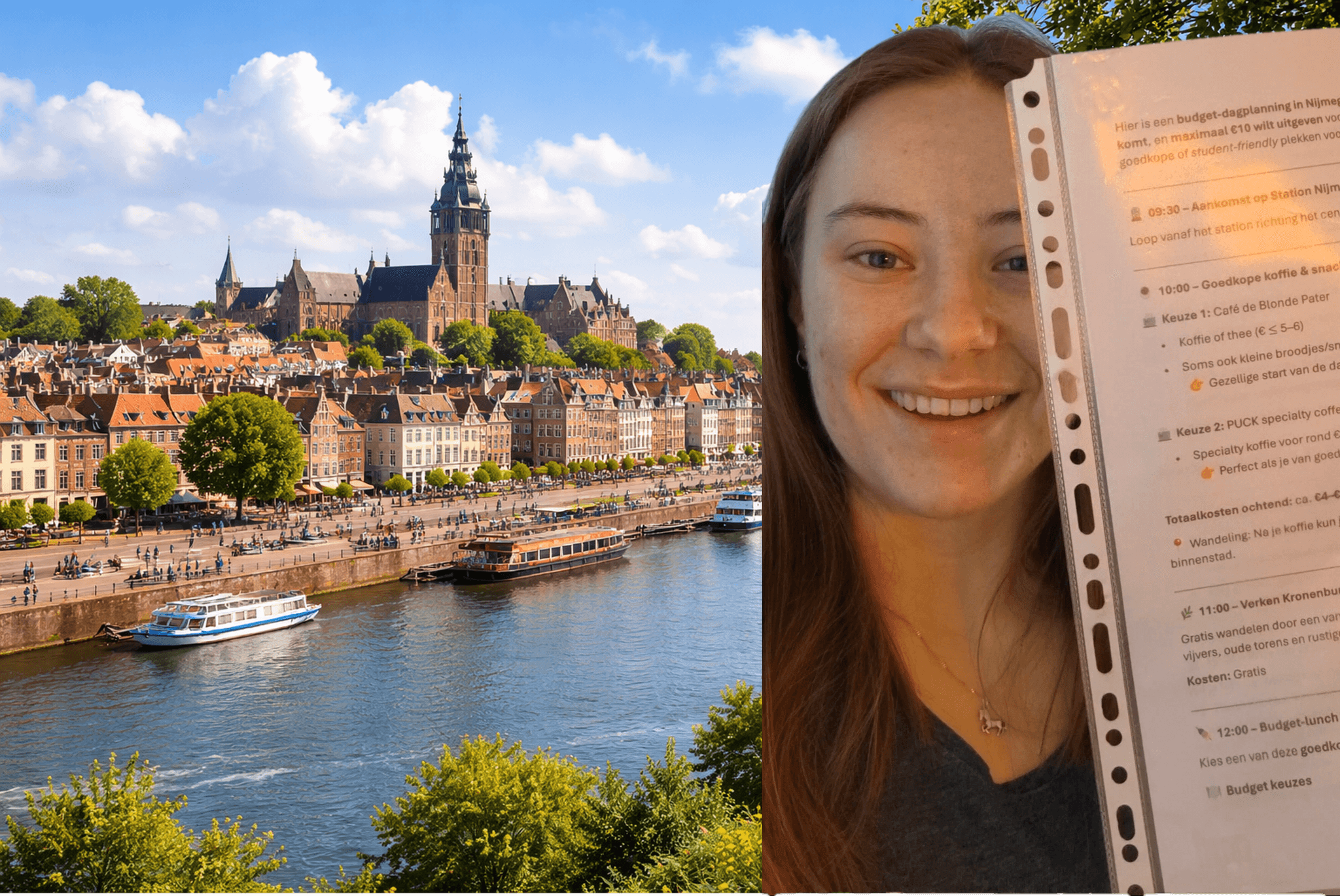
ChatGPT's Nijmegen en ik © Amber van Kempen
Masterstudente journalistiek aan de RUG, stagiair bij IO+, schrijft graag over de integratie van AI in het dagelijks leven
I, Amber from IO+, visited Nijmegen and asked ChatGPT to put together an itinerary for the day. The task: ‘Plan a day in Nijmegen. I’m on my own, I’m travelling by train, and I don’t want to spend more than €10.’ The result was a day where I spent most of my time outdoors and walked a lot: 25,000 steps, to be precise. But did I enjoy myself? In the video, I’ll show you how the day went.
External Content
This content is from youtube. To protect your privacy, it'ts not loaded until you accept.
Plan it yourself or use AI?
The daily itinerary resembled what people would normally do on their own in an unfamiliar city: wandering around the city, visiting parks and perhaps taking a look at nearby villages. Paid planners or travel agencies also often suggest a similar experience if the traveller’s budget isn’t very large, such as plenty of cycling or walking.
AI offers a quick plan but isn’t necessarily more original than one made by humans.
Lost because of the AI route
AI has its limitations. For instance, I found that the routes aren’t always clear, which meant I regularly had to resort to Google Maps. When I first asked ChatGPT for the route from Café de Blonde Pater to Kronenburg Park, it said we should walk westwards, but after a follow-up question, it suddenly turned out to be southwards.
Another option was to follow street signs. But with so many streets, following such signs proved rather slow. That’s why finding the next location was easiest when I asked for landmarks and buildings I could follow.
As for public transport: what stood out was that when ChatGPT was asked for the platform number for the train, it got it right. However, the answer did state that I should keep an eye on the signs myself for any last-minute platform changes.
AI makes inaccurate estimates
I must admit, with a budget of €10, excluding train fares, I did impose some restrictions on ChatGPT.
Nevertheless, there are plenty of things to do and buy in Nijmegen for less than €10. ChatGPT still offered expensive suggestions, such as certain coffee shops, lunch spots or museum visits that quickly exceeded the small budget. At both coffee spots, for example, ChatGPT suggested getting coffee with something to eat. Unfortunately, these combinations quickly eat up a large chunk of the budget. That’s why I carefully calculated what would fit within the budget myself and spent exactly €10. This consisted of a lungo coffee at Café de Blonde Pater (€3.20), a chicken and cheese sandwich at BackWerk (€3.25) and a cappuccino at Café Camelot (€3.55).
Interestingly, ChatGPT itself calculated that the suggested day would end up being more expensive than the budget—a sign that the estimates do not align well with the task.
Look up the facts yourself
ChatGPT does not take current circumstances into account: for example, it suggested visiting the Valkhof Museum near Valkhof Park. But it was temporarily closed. Chat did not mention this. Furthermore, an admission ticket costs as much as the entire budget.
Inspiration with a critical eye
ChatGPT is a handy source of inspiration for a day out and can provide a good starting point for your planning. But make sure you look up practical details such as current prices, routes and opening hours yourself. You’ll also know for yourself when you’ve had enough of a particular place or seen all there is to see. For me at least, 1.5 hours per park felt quite long. As a result, by the end of the day I wasn’t sticking to the schedule quite so strictly and was home earlier than ChatGPT had planned.