
Using gamification to support children through an MRI
Özgür Taşar, who works at Philips MRI, has been working on a solution to make MRI scans more pleasant for children.
Published on December 12, 2025

Our DATA+ expert and Editor-in-Chief, Elcke Vels, explores AI, cyber security, and Dutch innovation. Her "What if..." column imagines bold scenarios beyond the norm.
Hospitals aren’t usually the places we think of as ‘fun’ to visit. Sterile corridors, machines that buzz and beep. The experience can be overwhelming, especially for children. Fortunately, there is such a thing as gamification and storytelling. Özgür Taşar, who works at Philips MRI, and his team have come up with a solution to make MRI scans more pleasant for children: Philips Pediatric Coaching. “We guide the child every step of the way with cartoon characters—from home to the very last moment.”
Technology in hospitals is advancing—CT scanners, X-ray systems, and MRIs are becoming faster and more accurate. But the patient's experience is just as important. “There is plenty of evidence that if you support a patient well, the whole procedure runs more smoothly,” explains Taşar. That this can be achieved very effectively through gamification and storytelling is precisely the message he wanted to convey during his presentation at Dutch Game Week. Last week, Breda was all about gaming. For a week, the city was transformed into a vibrant meeting place. The workshops and presentations showed that gaming is not only fun; Taşar and other experts demonstrated that it can also have societal value.
Helping children through the MRI
Taşar is involved in a promising application for children who need to undergo an MRI scan. An MRI scan can be overwhelming for adults — a narrow tunnel, loud mechanical noises, and lying still for a long time. “But for children, such an experience is even more challenging. That is why children are often still sedated today. But that costs time, money, and is not without risks.”
To improve the patient experience and to reduce the need for sedation, Taşar and his team at Philips developed Philips Pediatric Coaching, of which ScanBuddy is one component. This is an app with virtual friends such as Ollie the elephant. The app is designed to reduce anxiety, but also to familiarize children and their parents with MRI scans. The app explains playfully how such a scan works, what an MRI does, and how you have to lie still.
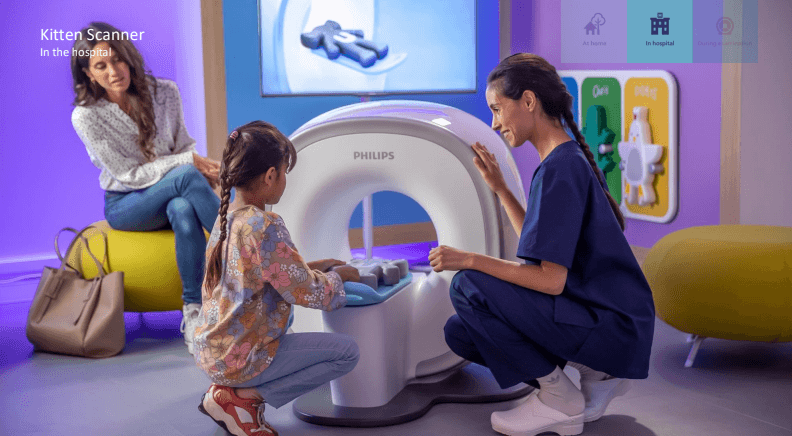
The mobile app is already accessible to the child at home. Taşar explains: “If you prepare children and their parents at home, they arrive at the hospital feeling calmer.” In the waiting room, the child can then try out the Kitten Scanner, a mini version of the real scanner.
During the scan itself, the child meets their virtual friend again. “Ollie the elephant and others guide the child with child-friendly language and visuals. They explain, for example, when to hold their breath.” The child can choose the cartoon they want to watch in the MRI room. Then the cartoon plays in a projection on the wall as the child enters the room, and a TV screen behind the MRI scanner, where the child can enjoy via a mirror above their head while being scanned. There is even dynamic lighting in the room, matching the cartoon playing. “That's what I like about our solution: it brings so many things together.”
Innovative techniques in the hospital
Gamification and storytelling can not only help children reduce their fear of medical procedures. According to Taşar, hospitals are increasingly using apps and other innovative technologies to make the hospital experience more pleasant for patients, young and old.
“There are already hospitals using VR in the ICU. Patients are taken away to a more pleasant and calming environment, away from their ICU bed. Applications like this can really make a big difference. We at Philips are also constantly exploring how we can use this type of technology to improve the hospital experience,” he says.
When asked if there is anything new on the horizon, he smiles: “I can't say too much about that yet. Who knows what the future will bring!”
Starting with the need
But, as Taşar emphasizes in conclusion, “technology should never be the starting point. We always start with the need. Not with, ‘We have VR, let's come up with something. What will benefit the patient?’ If the answer is VR, we use it. But the need comes first.”