
Twenty years in, Holst Centre is still sparking new industries
At Innovation Day, Holst Centre looked back on two decades of turning research into companies, supply chains and industrial opportunities.
Published on June 25, 2026
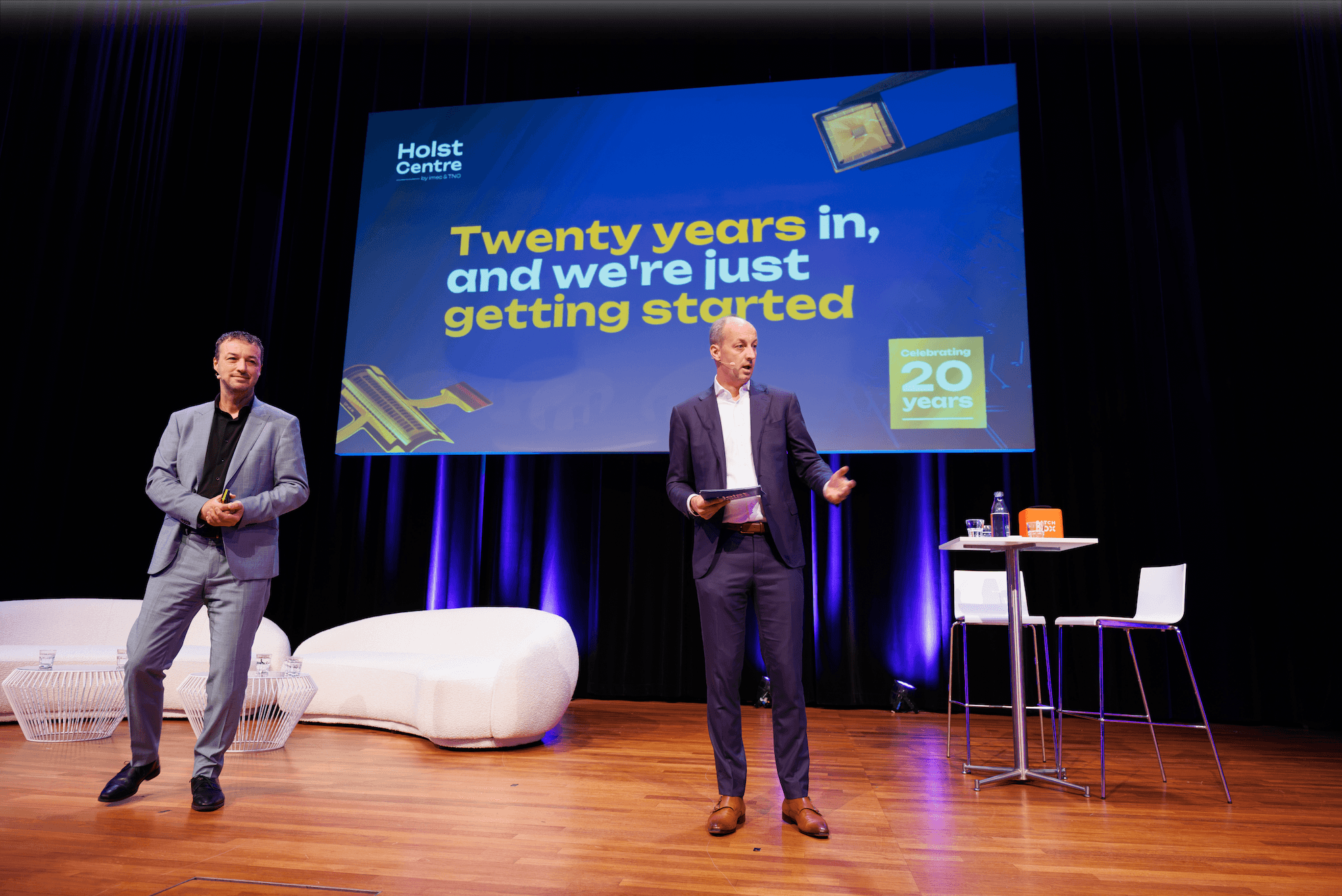
Ton van Mol and Jesse Robbers, Holst Centre © Bram Saeys

Bart, co-founder of Media52 and Professor of Journalism oversees IO+, events, and Laio. A journalist at heart, he keeps writing as many stories as possible.
Twenty years ago, Eindhoven’s innovation landscape looked very different. Philips had begun opening up its research campus to outside partners, creating the foundation for what would become the High Tech Campus Eindhoven. But an open campus also needed an organisation capable of connecting companies, research institutes and public partners around shared technological challenges.
That became Holst Centre.
At the opening of this year’s Innovation Day, appropriately titled Sparking New Industries, managing directors Ton van Mol of TNO and Jesse Robbers of imec placed the anniversary in that wider story. Holst Centre, they argued, was never meant to be a research institute working in isolation. Its role has always been to bring technologies, companies and people together early enough to create something that can eventually travel beyond the lab.
“The facts speak for themselves,” Robbers told the audience. “But the most important one, in my opinion, is industry participation.”
That message ran through the entire introduction. Holst Centre’s 2025 figures are substantial: €60.5 million in turnover, 280 FTE, more than 28 nationalities, 54 industrial partners, 73 funded projects, 33 patent filings and 49 scientific publications. Yet for Robbers, those numbers are valuable mainly because they show the strength of the network behind them. “We do not innovate for ourselves, or for research alone,” he said. “We do it in cooperation with the ecosystem, with you.”
20 Years Holst Centre, many more to come
At Innovation Day 2026, Holst Centre looked back on two decades of turning deep-tech research into companies, supply chains and new industrial opportunities. Its next chapter will be shaped by photonics, healthcare, batteries and the ambition to keep critical technology in Europe.
The annual Holst Centre Innovation Day program contained dozens of high-level lectures, panel discussions, pitches, and demonstrations. In the coming days, IO+ will publish more highlights about the event.
From research programme to industrial platform
That ecosystem has changed shape many times during Holst Centre’s first two decades. What began as a collaboration between Philips, TNO, imec and public partners has grown into a bridge between fundamental technology, industrial development and new business creation.
The centre now works across fields that rarely stay neatly separated: health technology, low-power connectivity, edge AI, integrated photonics, new manufacturing technologies and energy storage. Behind those themes lies a common objective: develop technologies deeply enough to make them useful, manufacturable and investable.
The first major lessons came from flexible electronics and displays. Looking back on his early years at Holst Centre, Van Mol recalled working with teams involving imec, TNO and industrial partners such as Philips, Panasonic, DuPont and Agfa on OLED technology. “It was one team, moving through the technology-readiness levels together,” he said. The result, he noted, was technology that is now embedded in the displays people use every day.
That model remains central today. Holst Centre does not simply develop a component or demonstrate a scientific effect. It tries to identify the gaps that prevent a promising technology from becoming a functioning market: manufacturing methods, supply-chain partners, validation infrastructure, applications and, sometimes, entirely new companies.
Healthcare as a proving ground
Healthcare has been one of the clearest examples of that approach. An ageing population, rising care costs and growing shortages of professionals make preventive monitoring and home-based care increasingly important. Technology will not solve these pressures on its own, but it can make care more efficient and more personal.
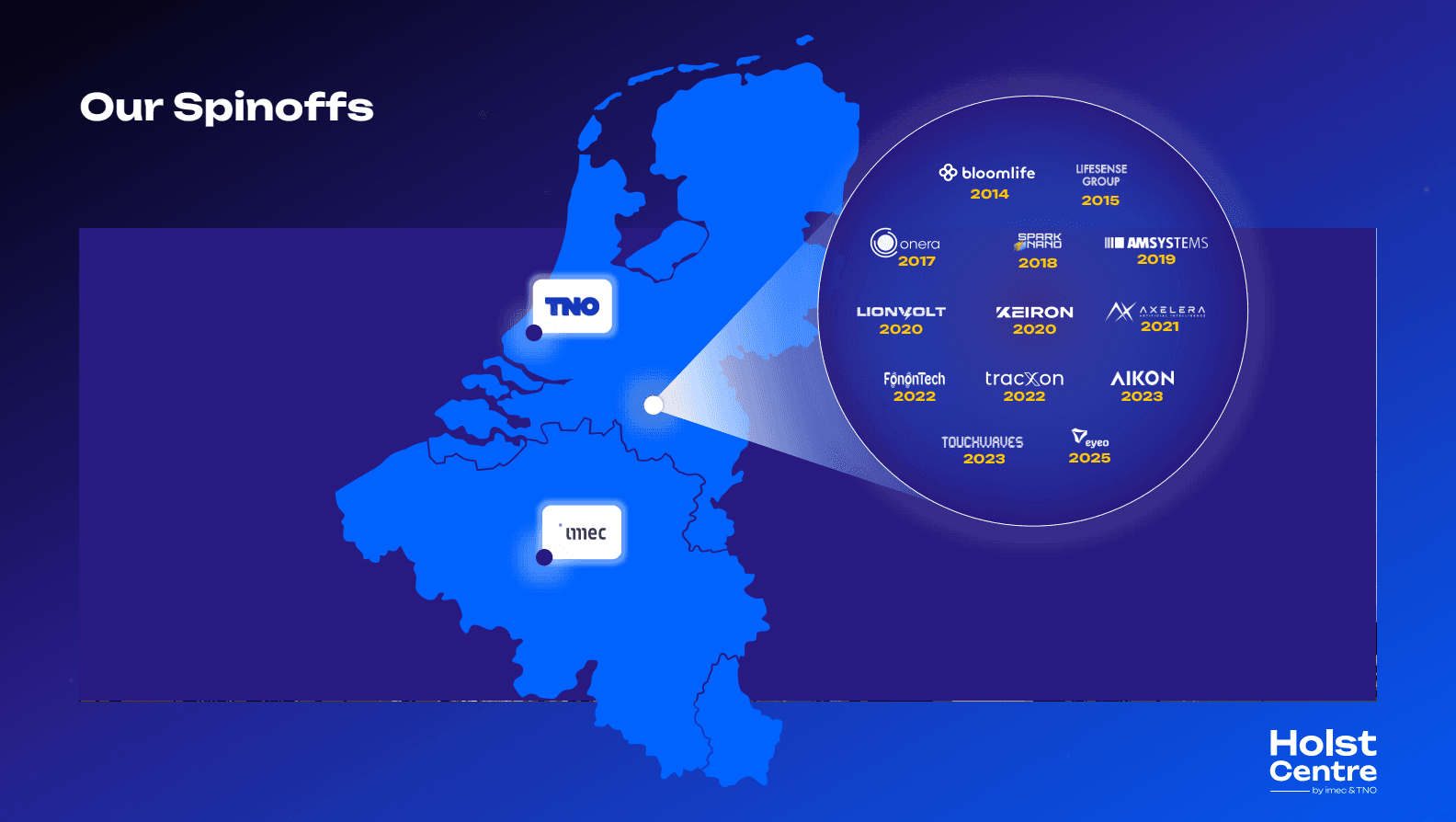
Holst Centre’s work on health patches helped show what a multidisciplinary ecosystem can achieve. By combining flexible electronics, materials expertise and medical applications, the centre developed technology for monitoring vital signs in hospitals and at home. That effort has fed into commercialisation programmes and helped create new ventures, including companies such as Onera, Bloomlife and IconHealth.
The agenda is now wider still. Holst Centre is working on smart wound care, wearable ultrasound, biosensors, organ-on-chip systems, bioprocessing, speckle sensing and high-precision neuromodulation. The underlying ambition is clear: bring better measurements closer to the patient, while creating solutions that are practical enough for hospitals, clinicians and health systems to adopt. “It is crucial for quality of life,” Van Mol said, “but also for efficiency.”
From low-power chips to the AI-era infrastructure
The anniversary celebration also looked firmly ahead. Low-power wireless technology, edge AI and integrated photonics are increasingly becoming part of the same industrial puzzle.
Holst Centre’s ultra-wideband work, for example, is aimed at high-accuracy ranging, sensing and localisation with radically lower power consumption. That matters not only for smartphones, but also for robotics, drones, automotive applications, aerospace and security.
In edge AI, the centre is developing architectures that combine conventional neural networks with neuromorphic computing on a single chip. The goal is to bring intelligence closer to sensors and devices, where decisions need to be made under tight constraints on energy, privacy and processing power.
But integrated photonics may be the field where the industrial urgency is most visible. AI data centres are expanding rapidly, and increasingly need optical interconnects to move data between chips at scale. That creates demand for photonic chips and, crucially, for the manufacturing infrastructure able to produce them in volume.
Van Mol pointed to the collaboration with ASML announced the day before Innovation Day as a significant next step. Together with partners including TNO, imec, Smart Photonics, PhotonDelta, universities and companies throughout the ecosystem, the ambition is to scale integrated photonics from promising technology into a serious manufacturing capability in the Netherlands. “If we bundle our forces,” Van Mol said, “we can meet, or even beat, the rest of the world.”
Keeping deep tech close to home
That challenge extends well beyond photonics. Holst Centre sees the same industrial logic in batteries, advanced coatings, 3D printed electronics, pharmaceutical printing and chiplet placement. In batteries, its technology has already contributed to ventures such as SparkNano, LeydenJar and LionVolt. A battery pilot line planned for Helmond is intended to help validate and scale next-generation production technologies in the years ahead.
The European Chips Act is another important pillar. TNO’s PIXEurope programme in Eindhoven will focus on scaling indium-phosphide photonics manufacturing, while imec’s NanoIC pilot line in Leuven will work on next-generation systems-on-chip. Together, they illustrate why Holst Centre’s position between Eindhoven and Leuven matters: it is part of a connected deep-tech corridor rather than a standalone institute.
For Robbers, who joined Holst Centre just over a year ago, the strongest impression has been the people behind that network. “The expertise, the skills, the way of working: it is amazing,” he said. “The way people interact internally, but also with the ecosystem, is the foundation for the coming twenty years.”
Crossovers
Those coming decades will bring new priorities. Van Mol mentioned defence, productivity and robotics as areas where Holst Centre’s technology portfolio could become increasingly relevant. Robbers emphasised the importance of crossovers: quantum with photonics, connectivity with new applications, sensing with healthcare, food and industrial systems.
The message of Innovation Day was therefore not nostalgic. Twenty years after its creation, Holst Centre is not simply celebrating what it has built. It is positioning itself as a cornerstone in the future deep-tech supply chain: from core technology and chip design to applications, pilot lines, manufacturing and new ventures.
Or, as both men concluded: "Twenty years in, and Holst Centre is just getting started.