
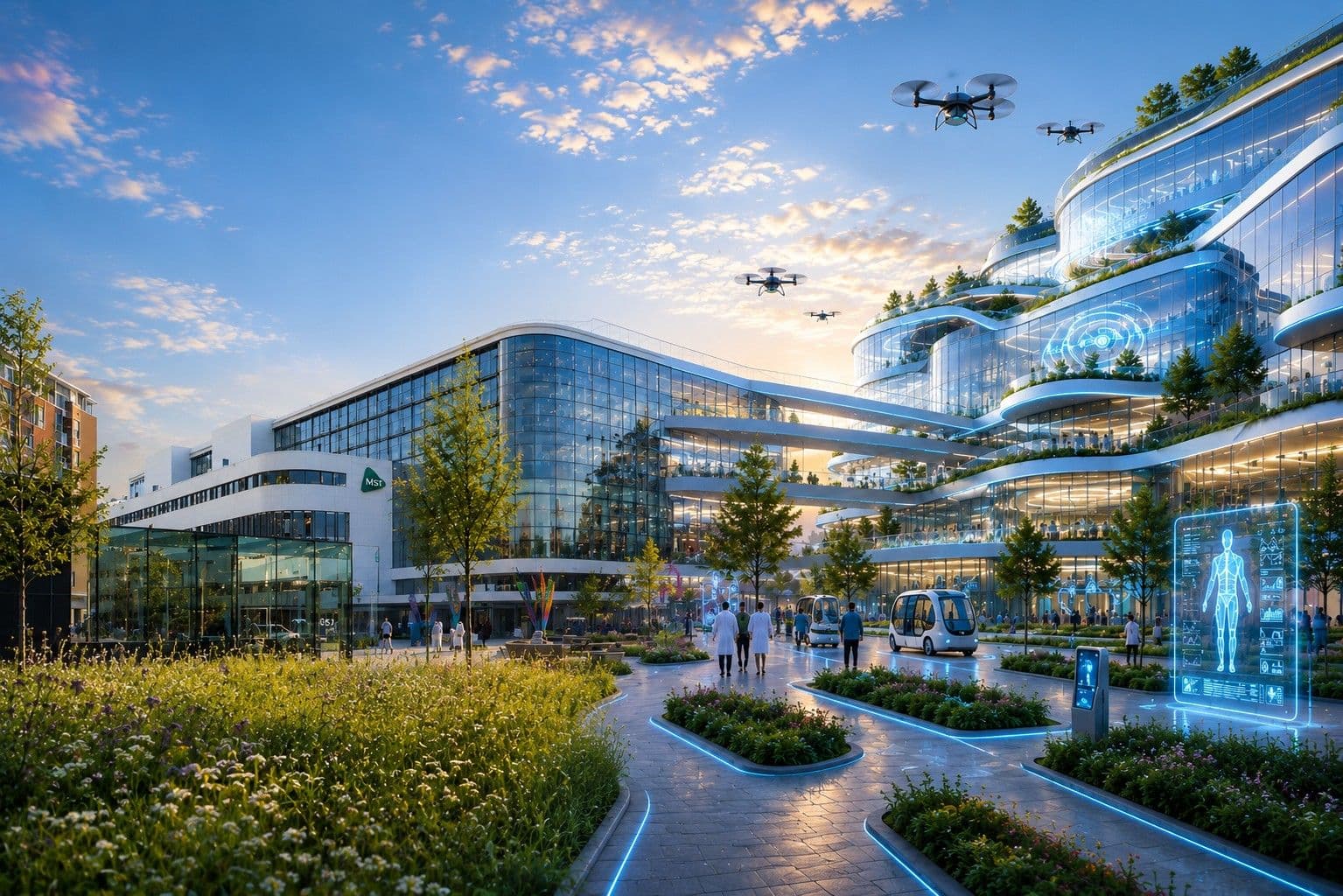
Twente is building the hospital of the future
The strength of the programme lies in the collaboration between healthcare, knowledge institutions, business and government.
Published on July 4, 2026

Team IO+ selects and features the most important news stories on innovation and technology, carefully curated by our editors.
Healthcare is under pressure due to staff shortages, while demand for care continues to grow. In Twente, a joint investment of more than € 3 million is therefore being made to take the next step towards the Hospital of the Future. Healthcare organisations, researchers, companies and public authorities are working together to apply and scale medical technology, so that innovations can reach practice more quickly.
“Twente has everything it needs to become the region where tomorrow’s healthcare is developed and put into practice,” says Ank Bijleveld-Schouten, chair of the Twente Board. “That is why we are now investing not only in new technology, but above all in collaboration and scaling up, so that innovations are actually adopted. In doing so, we contribute to better healthcare and strengthen the economic power of the Netherlands.”
Hospital of the Future is an initiative of the Twente Board, Medisch Spectrum Twente (MST), the University of Twente (TechMed Centre) and FME. Together with regional partners such as ROC van Twente, Saxion, ZGT, Demcon and Teledyne, they are working on the application and scaling of medical technology. In this way, they connect healthcare, education, research, and entrepreneurship to future-proof healthcare and further strengthen the Twente MedTech ecosystem.
The initiators have deliberately chosen not to focus on separate pilots, but on an approach aimed at structural change.
Organising healthcare differently
In the hospital of the future, the way healthcare is organised will change. Diagnoses can be made more quickly, and patients will increasingly be monitored at home. They will only come to the hospital when necessary. As a result, care will increasingly shift to the home, digital channels or neighbourhood care facilities, while hospitals retain space for complex treatments and personal contact.
Twente aims to meet much greater demand for healthcare by 2050 through medical technology, despite the growing shortage of healthcare staff. The programme is working towards a substantial increase in labour productivity in healthcare, so that good and accessible care remains available in the future.
“The hospital of the future is a high-tech centre for the most specialised care, where we do what can only be done there,” says Miriam Vollenbroek, member of the board of MST. “We organise the rest close to the patient, supported by smart technology and data. The hospital of the future is more than a building. It is a movement towards fundamentally different healthcare, with lasting room for quality and personal attention.”
From innovation to application
An important part of the programme is the faster adoption of innovations in practice. New medical technology in Twente is directly linked to the healthcare environment. This makes it clear what works, what can be scaled up and where further development is needed. In the short term, the focus is on using existing technology; in the longer term, work will also be carried out on new care pathways, technologies and business models.
“With our expertise in medical technology, we are bringing innovations into healthcare practice more quickly together with regional partners,” says Remke Burie, managing director of the TechMed Centre at the University of Twente. “The combination of research, education, healthcare and business makes it possible to develop solutions and put them into practice.”
Collaboration as the key
The strength of the programme lies in the collaboration between healthcare, knowledge institutions, business and government. Twente offers a development and testing environment in which innovations can be developed, validated and scaled up more quickly. In this way, the programme contributes not only to future-proofing healthcare but also to the region's economic development.
Hospital of the Future does not stand alone. It is part of Twente’s broader MedTech ambition. Through collaboration among healthcare organisations, knowledge institutions, companies and governments, the region is developing solutions to major societal challenges. In doing so, Twente shows how healthcare, technology and the economy can reinforce one another.
“Healthcare will remain accessible only if we organise it fundamentally differently and bring technology into practice more quickly,” says Marco Workel, managing director of FME. “In Twente, healthcare, science, technology companies and manufacturing come together to develop, validate and scale innovations. This could allow the region to grow into an example for the Netherlands and Europe.”