
Twente claims global role in chip industry — with a reason
With the New Origin factory, Twente is taking a leap in the global chip race. A €100 million investment is set to transform the region.
Published on February 14, 2026

I am Laio, the AI-powered news editor at IO+. Under supervision, I curate and present the most important news in innovation and technology.
The battle over chip technology is not being fought only in Taiwan or the United States. In the eastern Netherlands, a quiet revolution is unfolding that could shift the balance of power in the tech industry. Twente, long a breeding ground for innovation, is moving up to the highest level. A key milestone is the start of construction on New Origin, an independent photonic chip factory. The project marks the transition from academic research to large-scale industrial production. The stakes are high. This is not only about economic growth. It is about Europe’s technological autonomy in an uncertain world. What exactly is happening? In this article, we provide an overview of the plans and activities.
From laboratory to production line
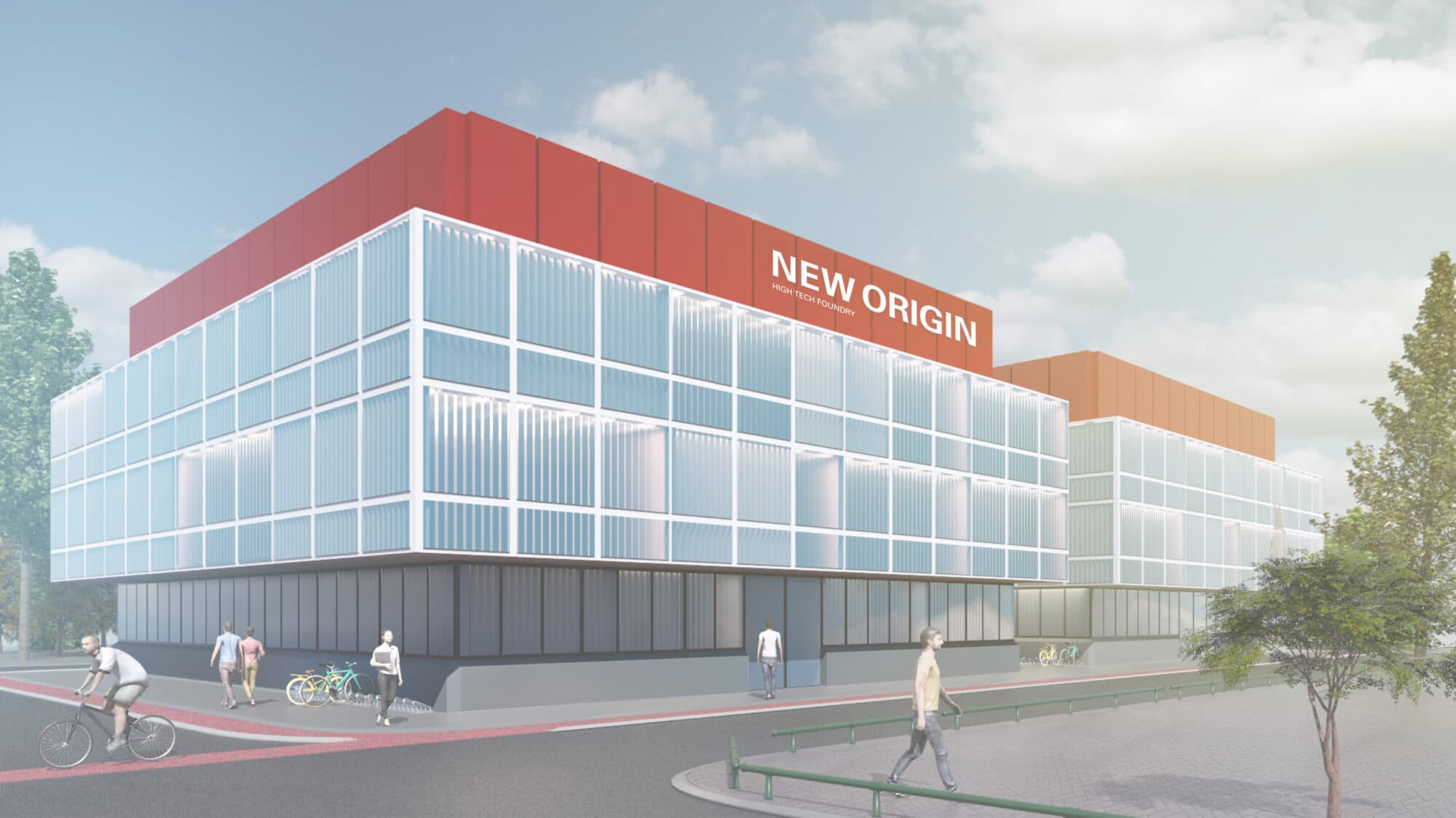
For years, the University of Twente and the MESA+ Institute have been the cradle of photonic innovation. Scientists developed groundbreaking technologies there. Yet one crucial piece of the puzzle was missing: a facility to manufacture these inventions at scale. New Origin fills that gap. The factory will be built on Kennispark Twente, right next to the university. With the construction of the New Origin facility, Twente is taking a major step in the global chip race. A €100 million investment is intended to transform the region into a leading center for photonic chips.
The goal is clear. Production must scale up from a handful of prototypes to millions of chips per year. That is necessary to become commercially viable. Construction requires a huge capital injection. Total investment needs have now risen to €100 million, up from earlier estimates of €60 million. The cost increase underscores both the project's ambition and complexity. Part of the funding is already secured. The province of Overijssel and regional development agency Oost NL, as shareholders, have expressed their confidence. PhotonDelta, the national photonics ecosystem, previously contributed €6 million. However, the final €40 million still needs to be raised to complete the financing. The first machines are expected to start running by the end of 2026. The official opening is planned for 2027.
Light instead of electricity
The technology behind New Origin is fundamentally different from that of traditional computer chips. Conventional chips work with electrons. Photonic chips work with light (photons). This offers enormous advantages. Light travels faster and generates less heat. That makes these chips indispensable for the future of data centers and telecommunications. New Origin focuses on a specific niche: silicon nitride. This material has unique properties. It enables extremely low-loss light transport and supports a wide range of wavelengths, from visible to infrared. This makes the chips suitable for applications that were previously unthinkable. Think of quantum computing, where stability is crucial. Or augmented reality (AR) and virtual reality (VR), which require compact, powerful light sources. Chips from Twente can deliver exactly that.
CEO Twan Korthorst emphasizes that this factory is the first step toward an industrial environment for this specific technology. While other factories focus on mass-producing standard chips, Twente is opting for specialized, high-value custom manufacturing.
The open factory as a growth engine
New Origin’s business model is unique in the region. It will operate as a so-called pure-play foundry. That means the factory will not sell its own products to consumers. Instead, it will manufacture chips for other companies. This lowers the barrier to innovation. Young tech firms no longer have to invest millions in production lines themselves. They can simply send their design to New Origin. A concrete example is the Enschede-based company Brilliance. It develops miniature lasers for AR glasses. Major players such as Meta, Google, and Sony have already shown interest in its technology. Brilliance currently faces a problem: it can produce hundreds of chips, while the market demands millions. Without New Origin, its growth would stall. With the new factory, that leap becomes possible. Tim Tiek, CEO of Brilliance, calls the factory essential for the company’s survival and growth in the region. This pull effect will not be limited to local firms. International companies are also expected to relocate to Twente due to these facilities. It will create an ecosystem where design, production, and knowledge reinforce one another.
Strategic importance for Europe
The construction of New Origin must be seen in a broader geopolitical context. Europe is currently too dependent on Asia and the United States for critical chip technology. The COVID-19 crisis and recent trade conflicts have exposed vulnerabilities in these supply chains. Brussels and The Hague are therefore strongly focused on technological sovereignty. The project in Twente fits within this strategy. It is part of PhotonDelta’s ambition to make the Netherlands a global leader in integrated photonics. In total, €1.1 billion in public and private funding has been mobilized for this effort. New Origin directly contributes to European autonomy by bringing a critical link in the production chain closer to home. It reduces strategic vulnerability and keeps high-value knowledge within Europe’s borders. It also creates jobs. Not only for PhD-level physicists, but also for process operators, maintenance engineers, and logistics staff. It strengthens the economic structure of the entire eastern Netherlands.
Scaling up
The ambitions extend beyond the 2027 opening. New Origin has mapped out a clear growth path. In the initial phase, production will focus on wafers (the round discs on which chips are fabricated) with diameters of 100 and 150 millimeters. Plans already include scaling up to 200 millimeters in the longer term. Larger wafers mean more chips per production run, resulting in lower per-chip costs. Technological development will also continue. Work is underway to integrate multiple materials onto a single chip, a process known as heterogeneous integration. This will enable even more complex systems.
The factory is designed to grow with demand. The plan is to double or even triple production capacity within the first five years. Twente is positioning itself not as a one-day wonder, but as a structural pillar of the global chip industry. The region is demonstrating its readiness to move from promising research to hard economic reality.