
TUSK IC raises €15M to cut the cost of satellite internet
Antwerp-based TUSK IC raises €15M to make satellite internet cheaper and more power-efficient.
Published on September 17, 2026
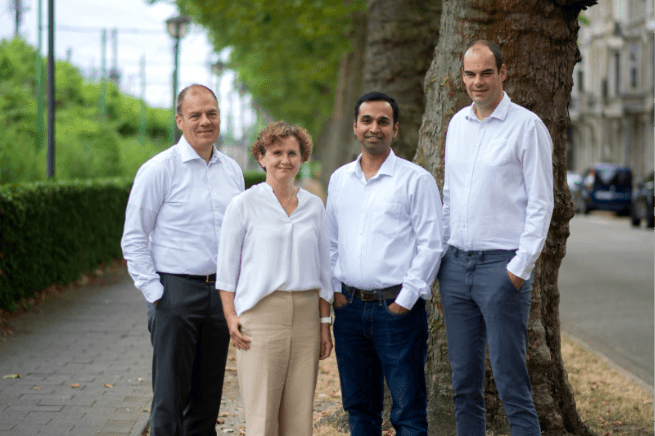
© TUSK IC

Team IO+ selects and features the most important news stories on innovation and technology, carefully curated by our editors.
TUSK IC, a semiconductor spin-out of KU Leuven, has closed a €15 million Series A funding round to speed up commercialization of what it calls the world's first standard-CMOS beamformer chips for Ka-band satellite communications — a technology the company says could make high-speed satellite internet significantly cheaper and more power-efficient to deliver.
The round was led by Matterwave Ventures, FORWARD.one, and the Flanders Future Tech Fund (managed by PMV), with participation from the Schaubroeck family and TUSK IC's existing investors.
TUSK IC's core product is a beamformer chip, a small component that sits inside flat-panel antennas and steers a satellite signal electronically rather than through a mechanically moving dish. These flat panels are increasingly replacing the bulky satellite dishes long associated with the industry, and they are central to how low- and medium-Earth-orbit (LEO/MEO) satellite constellations — the kind operated by companies such as Amazon, Telesat, Eutelsat OneWeb, and SES — plan to deliver broadband to homes, vehicles, ships, and government users.
A cheaper chip manufacturing process
What sets TUSK IC apart, according to the company, is its use of mainstream CMOS chip manufacturing rather than the specialty silicon-germanium (SiGe) processes typically used for this kind of high-frequency hardware. Standard CMOS is cheaper to produce at scale and, TUSK IC says, allows its chips to run on roughly 30% less power than comparable alternatives — a meaningful advantage for antenna manufacturers trying to bring costs down as satellite networks scale up.
The fresh capital builds on momentum the company gained earlier this year, when it secured a contract from the European Space Agency, backed by Belgium's federal science policy office BELSPO, under ESA's Advanced Research in Telecommunications Systems (ARTES) programme. That contract is funding the final push toward market readiness for TUSK IC's ConnectKa chip and ConnecTile antenna module lines: qualification testing, a first production batch, and the manufacturing tooling needed for volume output. The company has said it expects small-batch production in 2027 and full-scale manufacturing in 2028, with early samples reaching select customers this year. TUSK IC is also working with a satellite communications manufacturer to integrate its chips into a new electronically steered array antenna.
Independent space supply chain
Investors framed the deal as a bet on Europe's ability to build an independent supply chain for space technology. "TUSK IC combines leading-edge mmWave innovation with the economics and scalability of standard CMOS, addressing a critical bottleneck in satellite communications," said Silviu Apostu, Partner at Matterwave Ventures. Arjan Göbel, General Partner at FORWARD.one, called the company's approach a way of "democratizing high-performance connectivity from space." Vincent Hebbelynck of PMV, which manages the Flanders Future Tech Fund, pointed to the deal as validation of Flanders' growing semiconductor-and-space ecosystem.
TUSK IC CEO Kathleen Philips said the funding would help the company move "from prototype chips to high-volume production." Founded in 2018 out of KU Leuven's MICAS research group, TUSK IC designs chips for the automotive, industrial, and satellite communications markets, with customers spanning commercial, government, and defense applications.