
TU/e students unveil ‘GENTOO’: robot set to conquer Antarctica
After successful tests in Sweden last December, more trips to Svalbard in Norway are planned.
Published on May 14, 2026
© TU/e

Team IO+ selects and features the most important news stories on innovation and technology, carefully curated by our editors.
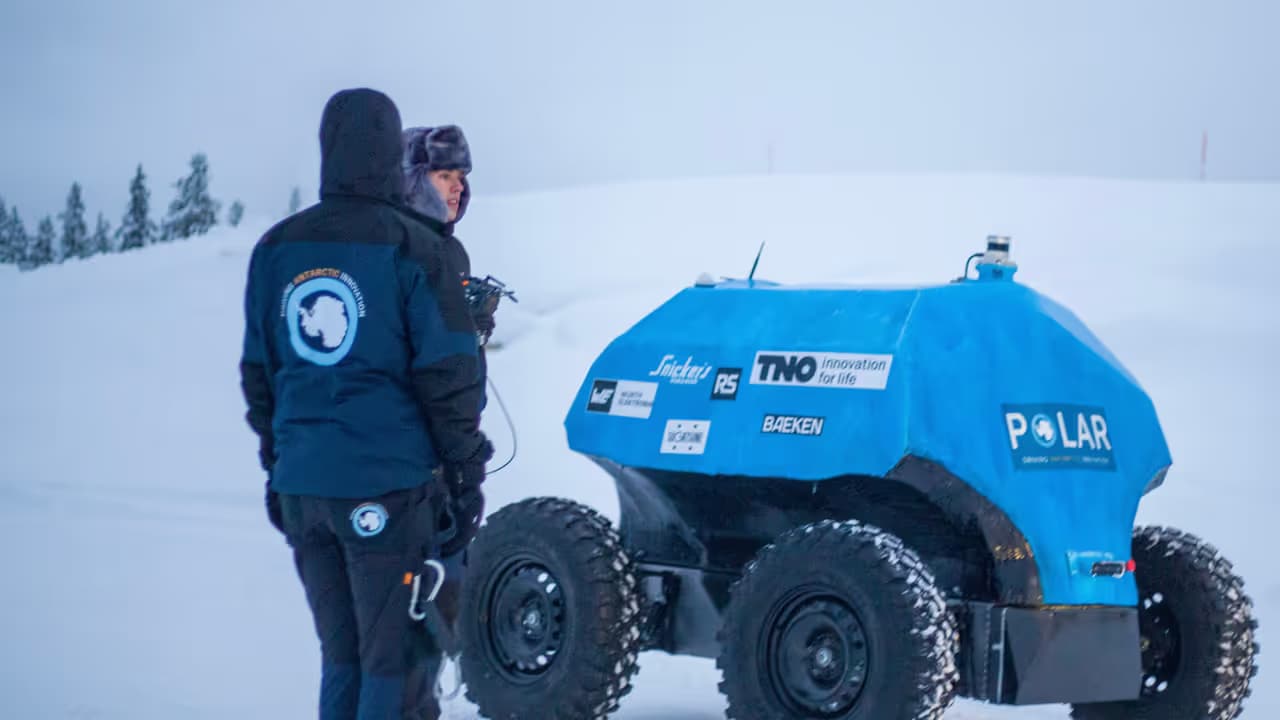
After more than three years of tinkering, testing, and innovating, the moment has arrived. The student team Polar from the TU/e unveiled their latest showpiece on Wednesday afternoon. The GENTOO, a hypermodern robot, is designed to make climate research possible at the icy South Pole.
The GENTOO robot is the successor to the ‘Ice Cube’ from 2023. While the Ice Cube survived its trial by fire in the Swedish snow, the GENTOO has been built for the real heavy work: the extreme conditions of Antarctica.
Reinvented
The name GENTOO is a nod to the penguin species of the same name and to ‘Generation Two’. And this second generation has undergone a major overhaul. The students spent two years completely redesigning the robot so it would be better prepared for the rough and freezing Antarctic landscape.
The robot now has larger wheels, an advanced suspension system for rugged terrain and a battery capable of withstanding temperatures as low as minus 40 degrees Celsius.
Sustainable research
The Eindhoven students have ambitious goals. Conducting research in Antarctica is often expensive, polluting and logistically a nightmare. Next year, GENTOO is expected to prove that things can be done differently by collecting valuable data on climate change fully autonomously, meaning without a human driver.
The mobile robot is intended to travel to places scientists can currently barely reach, such as some of the world’s oldest glaciers. The collected data could be important in better understanding the factors behind global warming.
Antarctica mission
Although the robot is still in Eindhoven for now, it already has plenty of kilometers in cold conditions behind it. After successful tests in Sweden last December, more trips to Svalbard in Norway are planned. The mission to Antarctica is scheduled for the end of 2027.