
TNO spinout polySCOUT accelerates polymer development with AI
This new Dutch company designs custom, lab-validated polymers within weeks, while traditional methods take years.
Published on October 16, 2026

Team IO+ selects and features the most important news stories on innovation and technology, carefully curated by our editors.
Europe’s plastics industry is under pressure. Regulations are banning more and more substances, such as bisphenol A and PFAS, while traditional replacement-polymer development takes years to decades and succeeds in only 5–10% of cases. Dutch AI startup polySCOUT offers a solution: within just a few weeks, the company delivers lab-validated polymers that meet customers’ specific requirements. Originally developed by TNO, the technology combines AI models with a verified database and a high-throughput lab to efficiently explore a search space of more than 10^60 possible structures.
A revolutionary approach to forced substitution
polySCOUT focuses on solving the problem of “forced substitution”: replacing polymers that can no longer be used under new regulations. Since July 20, 2026, the EU has banned bisphenol A in food-contact materials, and further restrictions on microplastics (with a phase-out extending to 2035) and PFAS are in the pipeline. Traditional polymer development often starts with making molecules and then measuring their properties. polySCOUT reverses this process: customers first specify the desired properties, such as a glass transition temperature above 105°C, transparency, or dishwasher resistance. AI models then select suitable candidates from industrial, REACH-certified building blocks. The lab synthesises and tests these candidates at a high throughput, with a capacity of 25 materials per week.
Polymer-native AI for complex structures
The company deliberately specialises in polymers rather than offering a broad AI platform for all materials. Polymers are not simple molecules but complex distributions characterised by features such as chain length, sequence, and crystallinity. To address this complexity, polySCOUT has developed a polymer-native AI representation based on a verified database of thousands of polymer-property data points. The team built this database over four years of research at TNO under the “sustainable polymer design by machine learning” program. The AI models are trained to predict polymer behaviour in terms of technical performance, safety, sustainability, and cost-effectiveness. Using readily available, REACH-certified building blocks enables immediate scale-up without exotic laboratory chemistry.
From TNO research to an independent company
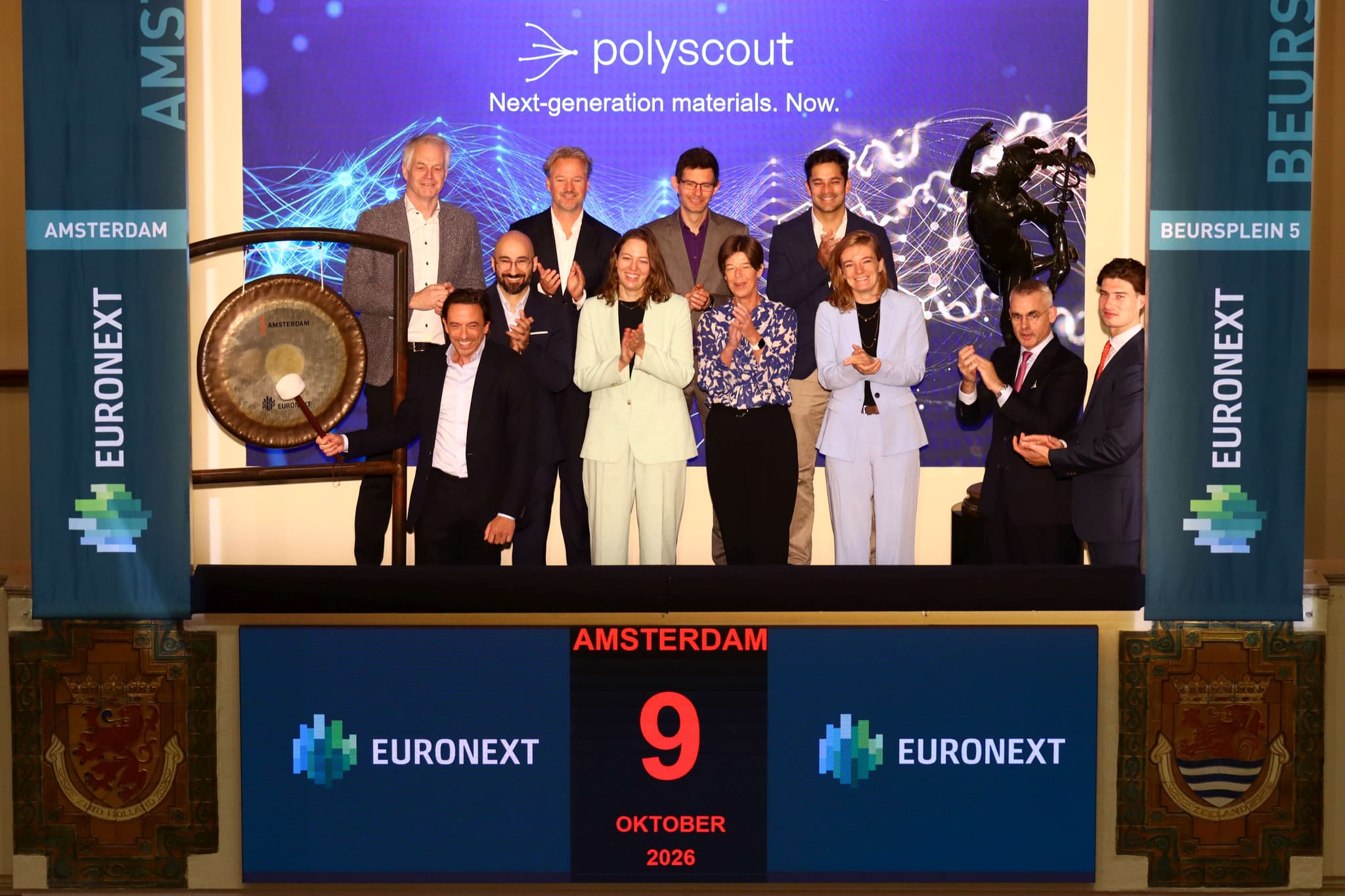
polySCOUT launched as an independent company in August 2026, with TNO as a shareholder. polySCOUT has exclusive rights to the technology, and TNO has been developing it since 2022. The company celebrated its official launch by sounding the gong at Euronext Amsterdam on October 9.
The company is led by three co-founders: Michaël van der Jagt (CEO), who has more than 20 years of experience in polymer materials; Ellen de Ruiter (CCO), a chemical engineer and former McKinsey consultant; and Milad Golkaram (CSO), a polymer scientist with a PhD from the University of Groningen. polySCOUT is currently in discussions with manufacturing companies and materials producers about its first design programs.
Industrial scalability and future plans
polySCOUT focuses on industrial scalability. By using REACH-certified building blocks, it can scale up the polymers it designs directly for production. This is crucial for sectors such as electronics, automotive, and textiles, where sustainability, compliance, and rapid innovation are essential. Global plastics production totals 431 million tonnes per year, and pressure to find more sustainable alternatives is growing because of environmental and health concerns, including greenhouse gas emissions, microplastic pollution, and waste management. polySCOUT plans to hold its first external funding round in autumn 2026 to expand its platform and team.
Impact on European autonomy and the economy
polySCOUT’s technology could make an important contribution to European autonomy and the economy. Rapid, efficient development of custom polymers can help European companies respond more effectively to regulatory requirements and remain competitive. This is particularly relevant to the food-packaging industry, where the ban on bisphenol A has already taken effect, and to sectors facing future restrictions on microplastics and PFAS. polySCOUT’s approach enables delivery of lab-validated materials within weeks, compared with the 20–30 years typically required for traditional polymer development. As a result, the company offers a concrete solution to the challenges of forced substitution in European industry.