
Tiny pyramid sensor maps hidden magnetism in quantum materials
A sensor on the tip of a tiny pyramid can detect magnetic fields at the nanoscale, and it can be made by the hundred.
Published on September 24, 2026
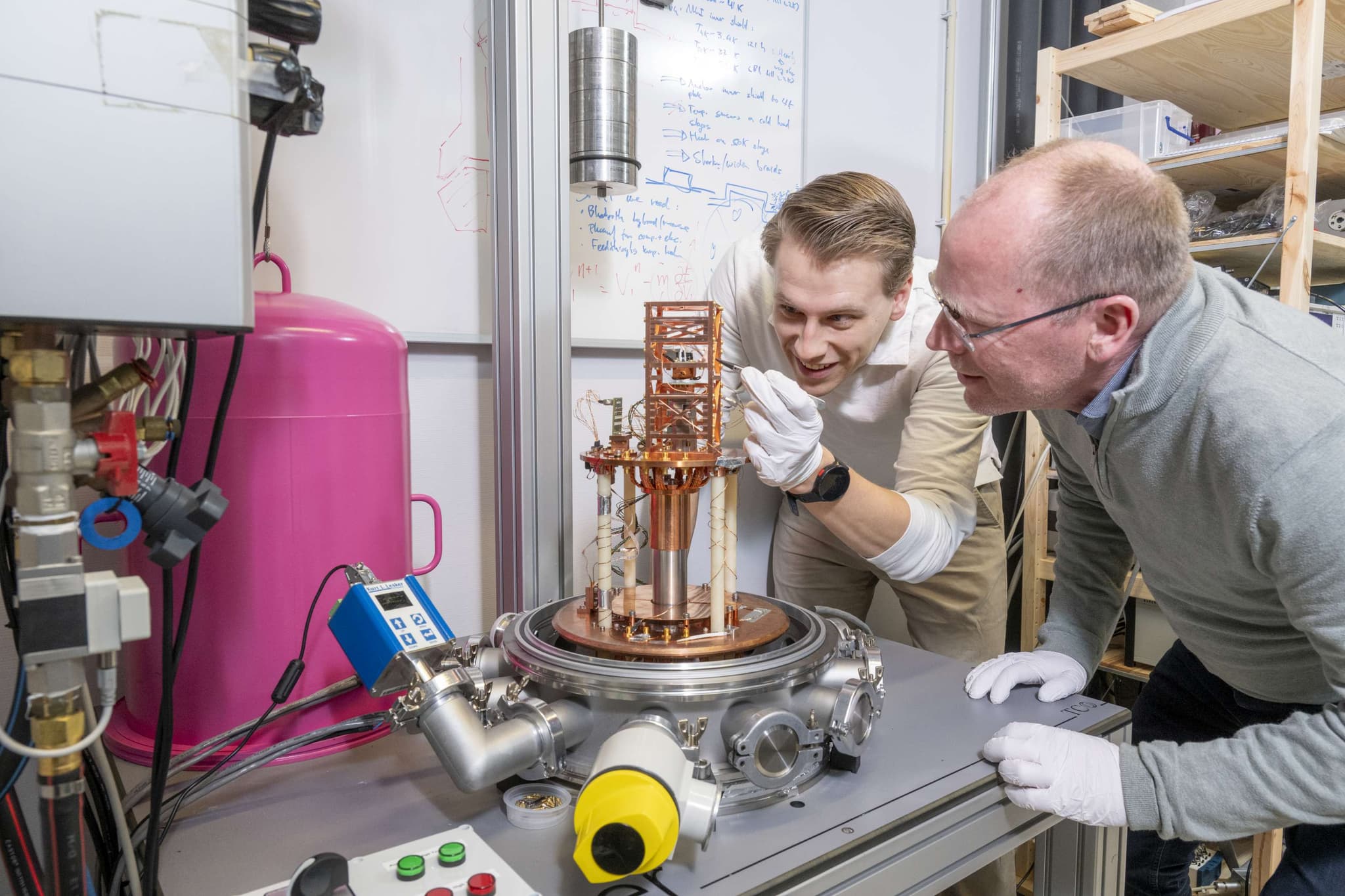
© University of Twente

Team IO+ selects and features the most important news stories on innovation and technology, carefully curated by our editors.
Every phone, laptop, and power grid depends on materials that carry electricity. Scientists are now working with a new generation of so-called quantum materials, which behave in ways ordinary metals cannot. Some carry electric current with no energy lost at all. Others conduct electricity only along their outer edges while the inside stays insulating. Materials like these could one day power quantum computers, more efficient electronics, and extremely precise sensors.
To develop them, however, researchers need to see what is actually happening inside: where the electric currents flow and where the magnetic fields they create are strongest. These patterns play out at the nanometre scale, thousands of times thinner than a human hair.
Researchers at the University of Twente have now built a tool designed to do exactly that. They published their results this week in the scientific journal Physical Review Applied.
Getting close enough to see
The most sensitive way to detect magnetism is a device called a SQUID, a tiny ring made from a superconductor, a material that conducts electricity perfectly when cooled to very low temperatures. A SQUID can pick up magnetic changes far too faint for any ordinary instrument.
The difficulty is distance. Magnetic signals fade very quickly as you move away from their source. Normally, a SQUID is built lying flat on a chip, and the chip itself keeps the ring a few micrometers away from whatever is being measured. At that distance, the finest details blur.
The Twente team's solution was to lift the sensor up. They placed the superconducting ring on the tip of a microscopic pyramid, just a few micrometers high, attached to a thin flexible arm. The arm sweeps across a surface much like the needle of a record player, letting the sensor pass almost directly over the material and map its magnetism point by point.
“On top of that pyramid, the sensor can be brought right up to the material we want to look at, with nothing else in the way. That lets us image magnetism at the scale where quantum materials do their work,” explains Professor Hans Hilgenkamp.
Built like a computer chip
The pyramid is made using a technique invented at the same university. Researchers etch pyramid-shaped pits into silicon, the material used for computer chips, and then leave behind only an ultra-fine wire frame along the pyramid's edges. These wires are coated in niobium, a metal that becomes superconducting when cold, and the ring at the top is finished with a precise beam of charged particles.
Similar sensors exist elsewhere, but they are made by hand, one at a time, with inconsistent results. The Twente method uses the same kind of processes as industrial chipmaking, producing hundreds of sensors on a single silicon disc. About 80 to 90% work.
The sensor also has another practical advantage. Strong magnetic fields usually destroy superconductivity, yet scientists often need exactly those fields to study quantum materials. The new sensor keeps working in fields around 20,000 times stronger than Earth's.
Why it matters
A better measuring tool often makes discoveries possible. Just as improved microscopes opened up the study of cells, instruments like this one could help researchers understand and design the materials behind future technologies.
Local microscope manufacturer Bruker took part in the project, raising the prospect that other laboratories could eventually buy the sensor rather than build their own. The work is part of QuMat, a ten-year Dutch national research program on materials for the quantum age.