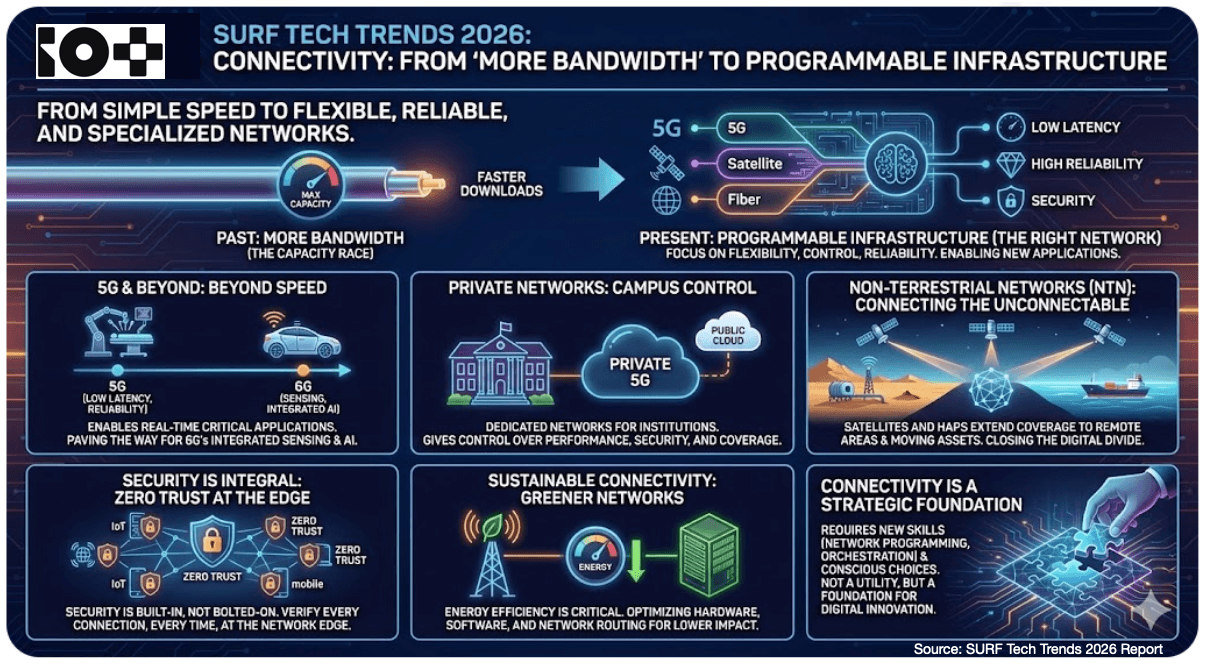
These are the trends in connectivity for 2026
Experts predict that by 2026, fixed internet without cables will become increasingly common and there will be a battle for the 6 GHz band.
Published on December 31, 2025
.png&w=2048&q=75)
Our DATA+ expert and Editor-in-Chief, Elcke Vels, explores AI, cyber security, and Dutch innovation. Her "What if..." column imagines bold scenarios beyond the norm.
The online world is becoming increasingly important. Every day, we are connected to each other and to servers worldwide. According to the SURF Tech Trends 2026 report, we can expect a lot in terms of connectivity next year. Key trends include: fixed internet without cables and the battle for the 6 GHz band.
Tech Trends 2026
The Tech Trends Report 2026 is a biannual publication based on international trend studies and market reports, enriched with insights from experts from and around the SURF cooperative. In ten episodes, IO+ and SURF look ahead to the most important technological developments of the coming year.
Fixed internet, but without cables
FWA, or Fixed Wireless Access, is a form of fixed internet without physical cables. Instead, it uses the mobile 5G network. This enables fast and reliable internet at virtually any location. For FWA, you only need two components: a 5G-compatible modem and a SIM card with 5G data.
FWA will increasingly become the norm. It is particularly suitable for places where fixed internet is lacking.
Think of rural areas, research locations, or remote offices. And another plus: even satellites can participate in the network. Satellite connections can thus become an alternative to traditional providers.
The battle for the 6 GHz band
Another important topic in 2026: the battle for the 6 GHz band. How will countries use this band? The lower part of the 6 GHz band has already been allocated to Wi-Fi. This has made Wi-Fi 6E and Wi-Fi 7 possible.
Now the discussion is about the upper part of the band. Some countries want to use it for indoor Wi-Fi. Other countries, such as France and Germany, are opting for 5G and 6G. The European Commission is working on a decision on this.
AI and digital twins for network management
In the report, the experts also predict that AI and digital twins will be used more and more in network management. AI helps to automatically monitor and improve networks.
A digital twin is a digital copy of a real network. Administrators can test changes in it first, before implementing them in the real network. This prevents errors and malfunctions. AI and digital twins are already being tested in initiatives such as the WATCH PLAN ACT project.
Sustainable networks
Another important prediction: sustainability is becoming increasingly important. Rising energy prices and an overloaded power grid are forcing data centers and network administrators to reduce their energy and cooling consumption. Additionally, demand for bandwidth is increasing by approximately 25% annually. More performance means more power consumption and extra heat.
To compensate for this, smart energy-saving solutions are increasingly being considered. These include dynamically adjusting routers, switching off unused systems, and using energy-efficient standards. Institutions in the Netherlands are increasingly looking at equipment with built-in energy-saving features.
Over their five- to ten-year lifespan, these systems are often more cost-effective and better aligned with sustainability goals.