
The woman behind Ziemi knew as a child she'd become an inventor
In the three-part series *The Early Years of an Inventor*, we explore what inventors' childhoods were like and what experiences shaped them.
Published on September 17, 2026
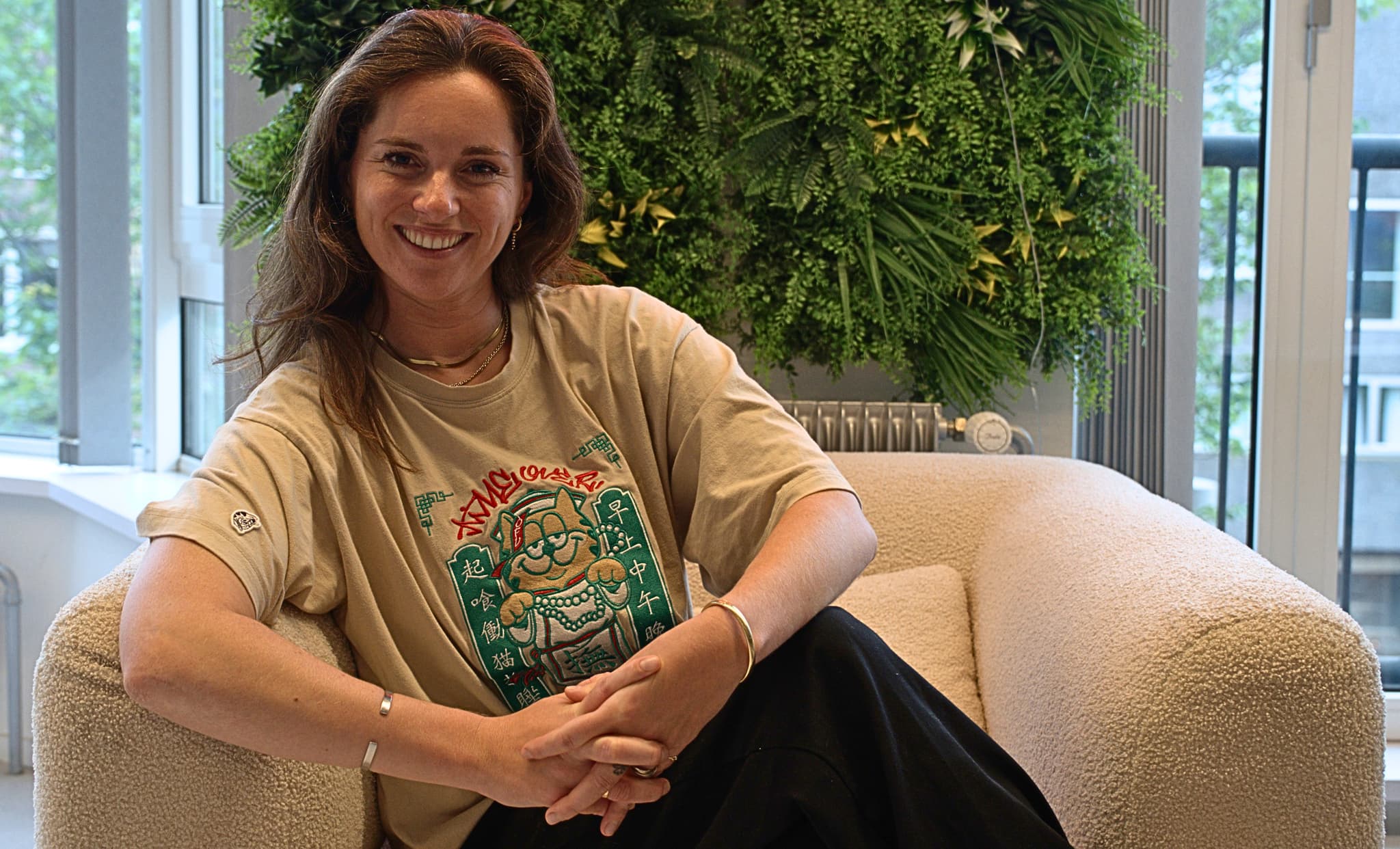
Luci Santema
Our DATA+ expert and Editor-in-Chief, Elcke Vels, explores AI, cyber security, and Dutch innovation. Her "What if..." column imagines bold scenarios beyond the norm.
It’s a simple yet ingenious idea: Ziemi’s biomotion lighting makes cyclists’ moving legs visible. This makes them more noticeable and helps prevent accidents. The mastermind behind the company is Luci Santema, who now has her own R&D space in her office where she experiments to her heart’s content—a place she’d dreamed of since she was a child. “As far back as I can remember, I knew I would follow this path.”
When Santema heard that 71% of bicycle accidents occur when cyclists veer off course, she saw a problem that could be solved. Her concrete solution: founding Ziemi.
That’s typical of Santema. She sees a problem and almost immediately thinks: how can this be done differently? “Actually, I’ve always been busy coming up with ideas and building things. Even as a child, I felt that urge to create very strongly.”
Outgoing and sociable
Anyone who pictures an inventor as a reclusive nerd hunched over a workbench might need to adjust that image when it comes to Santema. As a child, she was actually outgoing and sociable. “I had lots of friends, both boys and girls,” she says.
Gyro gearloose and a hot wire
Still, she could lose herself for hours in coming up with and making things. Inspiration sometimes came from unexpected places.
“It all started for me with Donald Duck,” Santema says with a laugh. Or rather: with Gyro Gearloose, the inventor from Duckburg who constantly tries to solve problems with his endless stream of inventions. Her family had a subscription to the magazine. “I always flipped straight to the Gyro Gearloose pages.”
She also picked up a lot at home. Her father is a professor of industrial design and took her to his workplace at Delft University of Technology when she was around eight. There, she walked among students who were making all kinds of things. In the basement, there was a makerspace where she was allowed to get to work herself.
“I remember using a hot wire to cut through Styrofoam. You could make little figures and all sorts of other things with it. I thought it was fantastic.” That visit left a lasting impression. “I think that’s where my dream of coming up with and building things myself really took off.”
The WCiraf
In elementary school, it was especially the unknown that caught her attention. For a class presentation, Santema chose Wubbo Ockels as her topic—not so much because of his space missions, but because of his sailboat. Ockels had developed a boat that wasn’t propelled by a regular mast and sail, but by a large kite. A clever display of inventiveness.
Santema found that interesting. “I thought it was really cool to learn that you can solve problems in new ways. That you don’t necessarily have to follow the beaten path.”
When she was ten, she got to test out an idea of her own on the TV show *Het Beste Idee van Nederland* (The Best Idea in the Netherlands). Together with others, she came up with the WCiraf: a toilet paper holder where an empty roll would automatically fall down and a new roll would pop up. It might not sound like much today, but back in 2006, no such system existed.
It didn’t stop at just one idea. In her grandparents’ apartment complex, she slipped notes into the mailboxes. “They said: ‘Do you have a problem? Tell me, and I’ll come by.’ That’s how she created a click-on system for a walking stick so you could click it onto a table to keep it from tipping over.”
She didn’t ask for money for it. “I just really enjoyed coming up with solutions.”
From the classroom to the drawing board
In high school, Santema chose the Science and Technology track. Afterward, she ended up—almost naturally—in the Industrial Design program at TU Delft. Improving the world continued to fascinate her, with sustainability as one of her main areas of focus.
During her internship at Unilever Research & Development in Wageningen, she felt she was getting close to the heart of the plastic waste problem. If she wanted to make a difference regarding the enormous mountain of plastic waste, she reasoned, she needed to be where a large portion of that packaging is conceived and produced.
The reality was disappointing.
“I’d expected to find myself in a sort of Gyro Gearloose-style environment, with all kinds of tests and experiments and people with the same inventive minds as mine. But that just wasn’t the case.” Santema noticed there was less room for innovation than she’d anticipated.
Perhaps she’d just have to create that environment herself.
Ziemi: a new chapter
And that’s exactly what she did. However, Santema chose a different direction. Her focus shifted from sustainability to safety. According to Santema, Ziemi is heading in the right direction. Earlier this year, the company raised nearly 2 million euros through a crowdfunding campaign. “The team is growing, we have a new office, and I finally have the space I’ve been dreaming of since I was a child: my own R&D lab.” They’re already working on new ideas there. “We’re developing running lights, dog lights, and basically anything else that might come along to make things a little safer.”
A dream for the future
With that, the circle is almost complete. Yet there’s still one dream Santema is saving for later: an inventors’ academy for children. “I think it would be really cool to inspire the future generation of inventors and show them that you can also look at the world this way.”
For now, that dream will have to wait. First, Santema wants to gain plenty of experience at Ziemi itself in coming up with and bringing new products to market.
“I’ve put it on hold for the time being.” To be continued.