
The solutions to the housing shortage are closer than we think
There is no silver-bullet solution to the housing shortage; it takes many small initiatives that everyone can contribute to.
Published on January 15, 2026

As Head of Partnerships, Linda liaises with new partners. She coordinates all ongoing collaborations and connects our journalistic editorial and commercial articles. She is not only the connector behind our articles, but also all of our events.
The housing shortage is one of the most important topics of discussion now, both in politics and during our dinner conversations. How are we going to make up the housing shortage of more than 400,000 homes? How can we ensure that young people can leave their parents' homes and start on their own in the housing market? And how can we make sure we do so in a sustainable way? These are questions to which we do not yet have the answers.
Over the past year, we have spoken with many professors from 4TU.Built Environment, companies, startups, and other stakeholders who are working to solve the housing crisis. The overarching message: we need to act. No more talking and complaining about difficult regulations, but acting. 4TU.Built Environment, the partnership between the construction-related faculties of the four technical universities in the Netherlands, sees a clear role for itself. “We must use scientific knowledge not only for research, but also in practice,” said scientific director Frank van der Hoeven to IO+ earlier this academic year.
The government has a clear role to play. It must make plans, tighten or relax rules, and ensure they are implemented. The winning party in the last parliamentary elections, D66, proposed a plan to build 10 new cities in the Netherlands. But is that practically feasible? Considering the limited space in our country, the ongoing battle against rising water levels, nitrogen measures, and bottlenecks in the energy and road networks.
Dry feet
The short answer: not necessarily, says Jos Arts, professor of Environmental and Infrastructure Planning at the University of Groningen (RUG). He is a member of 4TU.Built Environment and the Disciplinary Council for Built Environment Design. He sees climate change, especially in the Randstad, as a major obstacle. "The areas around cities such as Amsterdam, The Hague, and Rotterdam—where the expansion districts would have to be built—are very vulnerable to flooding from the sea or rivers. We don't know whether we can keep our feet dry there in the long term. Some scientists say that it will be possible to keep the water out, but at what cost? We could also choose to move to higher sandy soils that are intrinsically more future-proof," he says.
Arts also sees another challenge in building on peat meadow land in the Randstad. “To build new neighborhoods around existing cities, the groundwater level is often lowered. This means that the groundwater level also drops in inner cities. Many buildings and quays are built on wooden piles. These piles rot when the water level drops and oxygen is added. This causes foundation problems, as we see in cities such as Gouda and Amsterdam.”
According to Arts, limited space in the Randstad and accessibility are also problems; the roads and railways are overcrowded. "If you build in the Randstad, you also have to take into account the necessary expansion of infrastructure, otherwise you are implicitly handing out extra subsidies for housing projects that bear a much more expensive social cost. Moreover, there is very little space for that extra infrastructure. Overall, it does not seem to me to be the most convenient place to continue building in the Randstad. I would rather look at higher areas with more space, such as the Achterhoek, Twente, Brabant, and the Northern part of the country."
Housing market in flux
Furthermore, Arts argues that, contrary to current plans, fewer single-family homes should be built. “Much more needs to be done in the housing market to help groups such as young first-time buyers find a home. The first step could be to look for suitable housing for older people, who are becoming increasingly vulnerable and in need of care,” says Arts. We now have a relatively large number of elderly people in the Netherlands, the baby boomers. “They generally live with one or two people in a relatively large house. If they had a high-quality alternative, with good, smaller living spaces and the prospect of care in the future, then the single-family homes would become available for families,” he says. “These are generally the more expensive homes. That means that these homes are not immediately suitable for first-time buyers. But families in starter homes can move on to larger single-family homes, which also creates more space for first-time buyers.”
Housing and care
He believes this shift in the housing market may already address a significant portion of the problem. “If we start building lots of single-family homes now, while many of those homes will become vacant in the coming decades because the older generation needs care or dies, there is a good chance that we will have far too many of those types of homes within a few decades,” says Arts.
He believes that a focus on housing for the elderly is a good way to immediately address some of the problems in healthcare, which is an enormous financial burden on the working generations. “People now must live at home for as long as possible, so home care workers drive around all day to care for everyone at home in too little time. That is an inefficient and expensive process; some people become lonely, and for those working in healthcare, it is unsatisfying work,” he says. That is why he sees opportunities in attractive residential complexes for the elderly where they can live together and where essential care, such as nursing, consultations with a general practitioner, and physical therapy, is readily available.
Ten years ago, former Chief Government Architect Floris Alkemade developed a plan to convert existing buildings, such as barracks and offices, into suitable residential and care facilities for older adults. “I think the government should facilitate this because project developers often opt for the familiar path with predictable financial results,” says Arts.
Small-scale but inventive
At the same time, the professor observes that more people are launching initiatives independently, without government intervention. Peter Prak, for example, founded Knarrenhof, a community where older adults can live together and receive immediate care. More Knarrenhofjes will be built in the coming years, RTL Nieuws recently reported. Arts also sees another trend: the three-generation home. “In Japan, where they have had a relatively old population for much longer, you see more parents or parents-in-law living with a family so that they can be better cared for. This is something that could also work in the Netherlands.”
Splitting homes
Wim Bens, founder and owner of management consultancy Bens en Partners, is taking matters into his own hands. He has been active in the innovation ecosystem around Eindhoven for many years and, in his role as a consultant, maintains relationships with innovative companies and Eindhoven University of Technology (TU/e).
Bens has lived in a courtyard of semi-detached houses for decades. “Many of my neighbors moved here with small children. Now, all the children have long since left home, and only couples and singles live in the large houses in our courtyard,” explains Bens. They don't want to move: “We've lived here for so long and have a good relationship with the neighborhood.”
That is why the residents came up with the idea of splitting their houses. “That way, a student or a young couple can live on the upper floor, while the older people continue to live on the ground floor. Young people can also monitor the situation if anything happens. Ideal, if you ask me.” He is now investigating financing options, renovations, and other practical matters.
Room for radical change
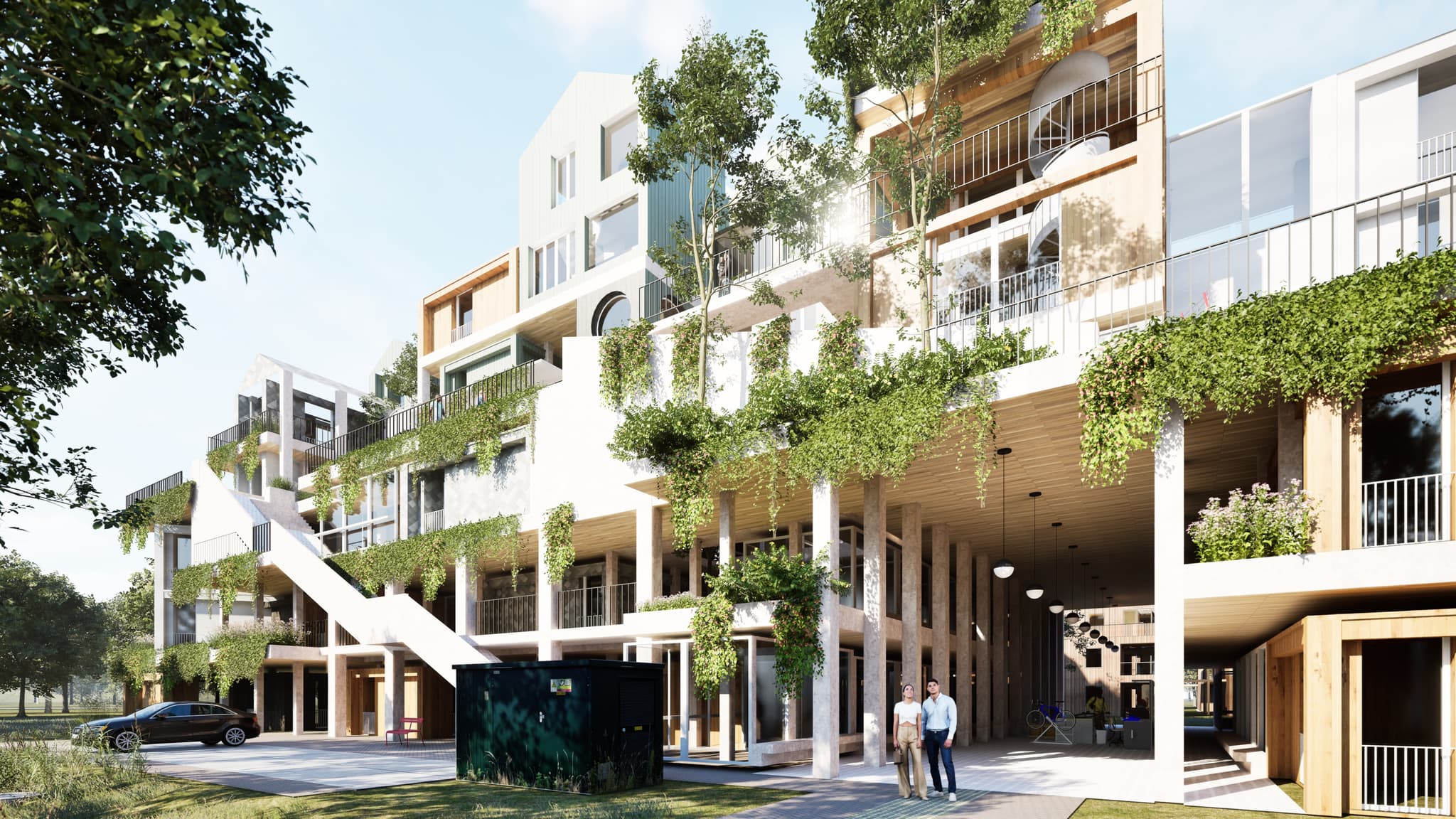
As the initiator of Living LAB 040, Monique Donker offers government agencies, companies, and people like Bens a space to explore new housing and living concepts. Living LAB 040 is an 8500 m2 physical space in Eindhoven for experimental homes, products, and services. Donker graduated as a product developer from TU Eindhoven and specialized in the diffusion of innovation, earning a PDEng through 4TU.Federation.
She has a different mindset than most of her colleagues. "It is important to work in shorter cycles with sprints and to share ideas more quickly with other stakeholders. This makes you more flexible, better able to anticipate societal demands, more innovative, and less likely to get stuck. This is already happening in other sectors. It's very different from the rigid construction sector, where an innovation cycle can easily take years. Innovation then happens in very small steps, while the challenges we now face require a complete reset."
Living LAB 040 provides space for radical innovations. "You are allowed to make mistakes, start over, and change your mind. What would it be like to start from scratch? Without taking the beaten path into account. We try things out without putting the ‘yes, but’ on the table,” she says. The development of the innovative neighborhood starts bottom-up, without a predetermined urban development master plan. “That's exactly the opposite of traditional construction and area development. There, they often start with a master plan for the area and then make it smaller and smaller to realize it."
How does Living Lab 040 work?
New way of working and thinking
Donker believes the Living LAB 040 method promotes innovation, but it is not always easy to implement. “We are going to build a total of 119 homes in the coming years. What will those homes look like? We don't know yet. We want to let that develop bottom-up, see what startups, companies, and residents come up with in response to trends and developments. For example, connecting the first homes to the energy grid and grid operator Enexis was just as difficult,” explains Donker. A network operator wants to know exactly where the front door is, how many solar panels there are, and other practical details that have not yet been fully defined in an organically growing neighborhood like the LAB. “Ultimately, we went looking for the right people within the organization to work with us to see how it could be done. This led to surprising results. An energy strategy that not only enables organic growth but also offers a solution to the national problems of grid congestion.”
Plans to address the housing shortage are emerging from various sectors. Some can be implemented quickly, while others require more time. Donker believes that the most important link in all projects is the residents. "We can use technology to come up with all kinds of ideas for energy-efficient construction, splitting houses, using biobased materials, or finding other solutions to today's housing problems. Ultimately, it's about whether people embrace these ideas and are willing to look at what they've been doing for years differently. To do that, we have to work beyond the boundaries of our own sector, and it takes courage, but if we work together openly, we'll come up with the best solutions."
Sponsored
This story is the result of a collaboration between 4TU.Built Environment and our editorial team. IO+ is an independent journalism platform that carefully chooses its partners and only cooperates with companies and institutions that share our mission: spreading the story of innovation. This way we can offer our readers valuable stories that are created according to journalistic guidelines.
Want to know more about how IO+ works with other companies? Click here